Always positive?
A preprint claims that two shapes of complementary dimension, meeting at a single point of a smooth space, always meet with a positive count, in every characteristic
Covers result 193 in OpenAI’s catalog: its one paper. See its connections to other results and the work it cites.
5:50. English captions available. The video loads from YouTube when you press play.
Chapters
The claim, in plain words
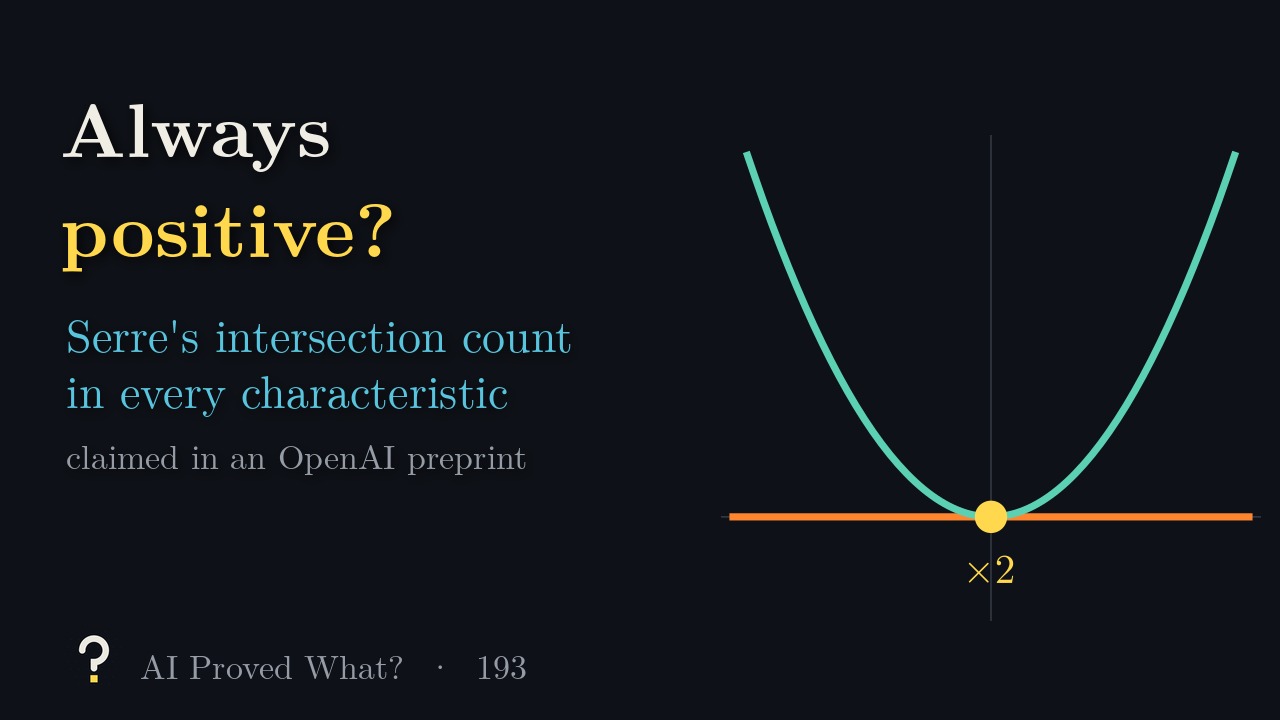
Two curves meeting at a point are counted with multiplicity: a parabola touching a line counts twice, which is the size of the ring obtained by imposing both equations near the point. In higher dimensions the naive count can be wrong: two planes in 4-dimensional space meeting only at a point, cut by a third plane through it, give a naive count of 3, though each plane meets the third once. Serre’s intersection multiplicity corrects this with the higher Tor groups, with alternating signs: χ(M,N) = Σi (−1)i length Tori(M,N), here 3 − 1 = 2.
Three statements are usually attached to Serre’s name, for shapes meeting only at the point of a regular local ring: χ is never negative; it is zero when the dimensions add up to less than the dimension of the ring; and it is positive when they add up exactly. As the paper tells it, Serre proved positivity when the ring contains a field, in the unramified setting, and for power series over any complete discrete valuation ring. Roberts, and independently Gillet and Soulé, proved vanishing; Gabber proved nonnegativity. Positivity stayed open in general for ramified rings of mixed characteristic, with partial results by Skalit and by KC and Soto Levins.
Result 193 is one OpenAI preprint, Positivity of Serre’s Intersection Multiplicity (31 pages, dated September 23, 2026). Its Theorem 1.1: if R is a regular local ring and M, N are nonzero finitely generated R-modules with length(M ⊗ N) finite and dim M + dim N = dim R, then χR(M,N) > 0, with no restriction on characteristic or ramification and no lifting hypothesis. The paper also notes a consequence for symbolic powers (after Kurano and Roberts) and a lower bound by the product of multiplicities when the tangent cones meet in finitely many lines, with equality exactly when they meet only at the point (Corollary 1.2).
What it doesn’t claim
Anything new about vanishing or nonnegativity, which were already known. Any explicit lower bound beyond positivity, apart from Corollary 1.2. Anything for rings that are not regular. There is no computation in the paper; our examples are over the rational numbers, in Serre’s known case, and only illustrate the definitions.
Where it stands
- Posted as a preprint
- OpenAI, 31 pages, dated September 23, 2026
- Peer reviewed
- Not yet
- Checked in Lean
- No: there is no formal statement or proof of this result in the release
Last checked October 19, 2026. The preprint has not been revised since it was added to the repository in its initial commit on October 6, 2026. Unlike most results in this release, it has no Lean formalization: there is no scope note, no comparator statement and no entry in the collection’s formalization.yaml, so the result rests on the 31-page paper alone. In our view, its new steps in algebraic K-theory, the descent theorem (Theorem 3.1) and the asymptotic comparison (Theorem 4.7), are where expert review is most needed. The paper is not among those OSVerify reviewed, and we have seen no expert review.
How the proof goes
- Shrink the problem. Break each module into irreducible pieces; by the vanishing theorem, pieces of too small a dimension contribute nothing. Rings containing a field are Serre’s case, so the residue field has prime characteristic p (Lemma 5.1).
- Make it symmetric. Each shape sits over a smooth base with finitely many sheets; pass to a larger shape whose sheets are permuted by a finite group. Enlarging scales the count by the degrees of the enlargements: χ(D′,E′) = aDaEχ(D,E) (Lemma 5.2).
- A refined copy and a rescaled ruler. Adjoin all p-power roots (a perfectoid version in mixed characteristic) and measure with normalized length, which divides by the growing degree. On that ruler the refined copy’s correction terms weigh nothing, though they need not be zero (Theorem 2.5).
- Equal on average. The refined count need not match the true count symmetry by symmetry, but summed over all symmetries the two agree, by a new descent theorem in algebraic K-theory (Theorem 3.1; (5.3)).
- Every term is positive. Approximate the refined copy by finite modules, cut their resolutions where the terms become negligible, and compare on the other shape in a setting where negligible ranks count as zero (Theorem 4.7). Only the degree-zero term survives, and it is positive (Lemma 5.6; (5.18)). So χ > 0.
The numbers in the video
- Plane curves at the origin (ours, over ℚ): a parabola touching a line 2, a line along an inflection 3, a cusp against its tangent 3.
- Serre’s classical two planes in 4-space against a third plane (computed by us): naive count 3, Tor1 of length 1, χ = 2; each plane alone gives 1.
- The example ring ℤp[[x,y,z,w]]/(p − xy + zw) is ours, as a typical ring of the hard kind; the paper does not use it.
Read the source
- Positivity of Serre’s Intersection Multiplicity (PDF), 31 pages.
- The collection’s catalog, where this is result 193.
The paper
OpenAI groups related papers into one result; this one has a single paper.
Transcript
Read the full script
0:00The question
Two curves in a plane meet at a point. How many times? A line crossing a parabola meets it once there; slide the parabola down until it just touches the line, and two crossings merge into one point that counts twice. In algebra, that count is the size of the ring you get by imposing both equations near the point: in our check, 2 for the touching parabola, 3 for a line along an inflection, 3 for a cusp against its tangent. In higher dimensions this naive count can be wrong. Take two planes in 4-dimensional space that meet only at a point, and cut them with a third plane through that point: the naive count is 3, but each plane meets the third just once. Serre’s fix subtracts and adds correction terms, the sizes of the higher Tor groups, with alternating signs: here one correction of size 1, giving 2, the right answer. That alternating sum is Serre’s intersection multiplicity, written chi. Serre worked in regular local rings, the algebra of a smooth point. For two shapes meeting only at the point, three statements are usually attached to his name: chi is never negative; it is zero when their dimensions add up to less than the dimension of the space; and it is strictly positive when they add up exactly. As the paper tells it, Serre proved positivity when the ring contains a field, and in the unramified setting, and his argument even covers power series over any complete discrete valuation ring. Roberts, and independently Gillet and Soulé, proved vanishing in general; Gabber proved nonnegativity. Positivity stayed open in general for ramified rings of mixed characteristic, where a prime number p is tangled up with the geometric coordinates, with partial results by Skalit, and by KC and Soto Levins.
1:48The claim
Result 193 is one OpenAI preprint, 31 pages, dated September 23, 2026. It claims: over any regular local ring, if two nonzero finitely generated modules have a tensor product of finite length, and dimensions adding up to the dimension of the ring, then Serre’s intersection multiplicity is strictly positive. There is no restriction on characteristic or ramification, and neither module needs to lift to an unramified ring. Since chi is a whole number, it is at least 1. The paper also notes two consequences: a statement about symbolic powers due to Kurano and Roberts, now in the ramified case; and a lower bound by the product of the two multiplicities when the tangent cones meet in at most finitely many lines, with equality exactly when they meet only at the point. Not claimed: anything new about vanishing or nonnegativity, which were already known; any explicit lower bound beyond positivity, apart from that corollary; or anything for rings that are not regular. There is no computation in the paper. Our examples are over the rational numbers, in Serre’s known case, and only illustrate the definitions. And unlike most results in this release, there is no Lean formalization.
3:08How the proof goes
The proof first shrinks the problem. Break each module into irreducible pieces; by the vanishing theorem, pieces of too small a dimension contribute nothing, so it is enough to take two irreducible shapes of complementary dimension, meeting only at the point. Rings containing a field are Serre’s case, so the residue field has prime characteristic p. Then each shape is made symmetric. It sits over a smooth base with finitely many sheets; pass to a larger shape whose sheets are permuted by a finite group of symmetries. The count then scales by the degree of each enlargement. Next comes an infinitely refined copy of each shape: adjoin all p-th roots, p²-th roots, and so on, or in mixed characteristic its perfectoid version. Measure it with a rescaled ruler, normalized length, that divides by the growing degree at each stage. On that ruler, the correction terms of the refined copy weigh nothing, although they need not be zero. The refined count need not match the true count symmetry by symmetry, but summed over all the symmetries, the two agree. The engine is a new descent theorem in algebraic K-theory: what is symmetric upstairs comes from downstairs. So it is enough to show that each refined term is positive. The paper approximates the refined copy by ordinary finite modules, cuts their resolutions off where the terms become negligible, and compares again on the other shape, summing over its symmetries, in a setting where negligible ranks count as zero. There, against the other shape’s refined copy, only the degree-zero term survives, and it is at least the number of generators times a positive size. So every term is positive, and so is chi. The descent theorem, the asymptotic comparison and the final assembly are new; the normalized-length tools build on earlier work the paper cites, including Cai, Lee, Ma, Schwede and Tucker.
5:09Where it stands
The preprint is unrefereed and has not been revised. It has no Lean formalization, no formal statement and no formal proof, so it rests on the 31-page paper alone. Its new K-theory steps, the descent theorem and the asymptotic comparison, are in our view where expert review is most needed. The paper is not among those OSVerify reviewed, and we have seen no expert review. If it holds, two shapes of complementary dimension, meeting at a single point of a smooth space, always meet with a positive count, in every characteristic, as the positivity conjecture predicted.
Spot a mistake?
This episode simplifies on purpose, but it shouldn’t be wrong. If something is, open an issue on GitHub or leave a comment on YouTube. Corrections are noted here with a date.