Count like monomials?
Two preprints claim proofs of the Eisenbud–Green–Harris and lex-plus-powers conjectures in characteristic zero, by rewriting the variables with coefficients in a division algebra
Covers result 200 in OpenAI’s catalog: all 2 papers. See its connections to other results and the work it cites.
5:52. English captions available. The video loads from YouTube when you press play.
Chapters
The claim, in plain words
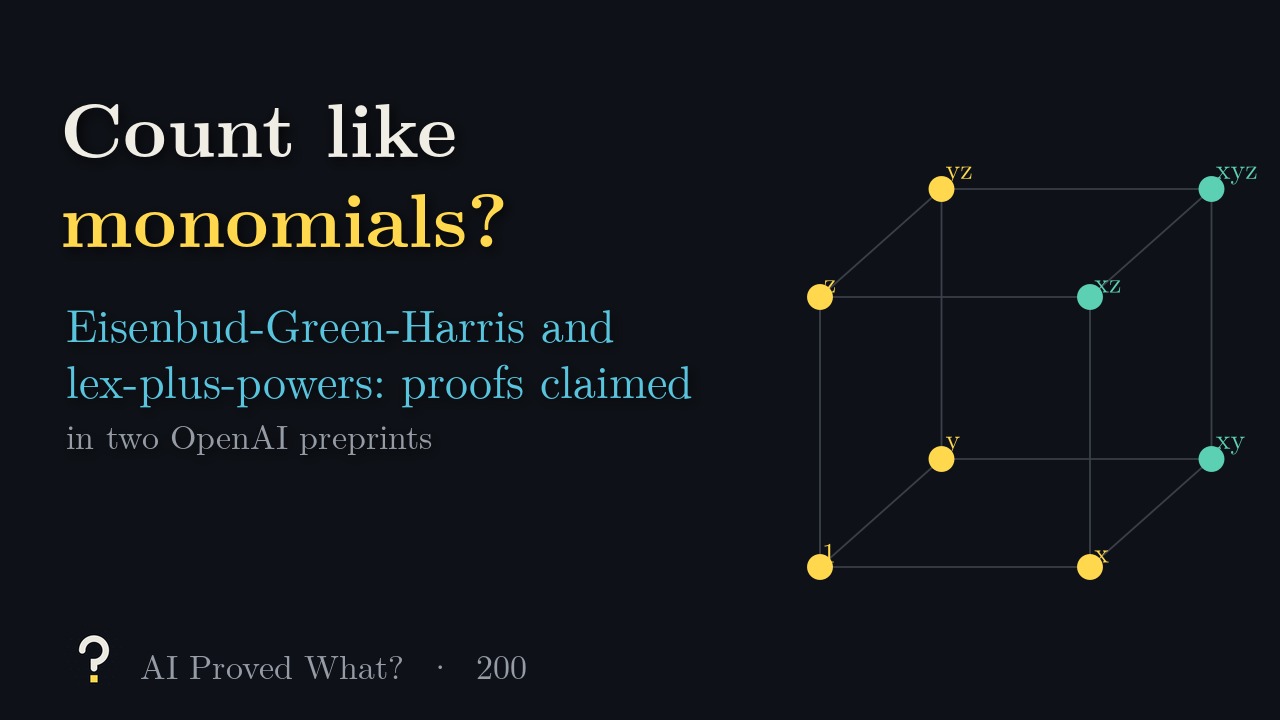
Declare x², y² and z² to be zero, and the monomials that survive are the eight corners of a cube: one in degree 0, three in degree 1, three in degree 2, one in degree 3. That count, degree by degree, is the Hilbert function, 1, 3, 3, 1. Any three quadratic equations whose only common solution is zero, such as x² + yz, y² + xz and z² + xy, give the same count. Eisenbud, Green and Harris conjectured in 1993 that whatever equations you add, the count is one you could also get from monomials, keeping the pure powers; equivalently, by a classical theorem of Clements and Lindström, from one explicit ideal, the lex-plus-powers ideal, which in each degree adds the dictionary-first monomials of the box.
Graded Betti numbers count more: the generators, the relations among them, the relations among those, degree by degree. The lex-plus-powers conjecture, generally attributed to Charalambous and Evans, says the same explicit ideal has the most of these in every slot. As the papers tell it, when the equations are themselves pure powers, the counting part was proved by Clements and Lindström in 1969 and the Betti part by Mermin and Murai in 2011; for other equations only special cases were known, mostly for the counting part.
Result 200 bundles two OpenAI preprints, both dated September 23, 2026. The first (43 pages) builds a new tool and proves the Eisenbud–Green–Harris conjecture in characteristic zero. The second (22 pages) uses that tool to prove the lex-plus-powers conjecture. Together they claim: over any field of characteristic zero, for any homogeneous ideal containing a regular sequence of any length with degrees 2 ≤ a1 ≤ … ≤ ac, the lex-plus-powers ideal has exactly the same Hilbert function, and Betti numbers at least as large, in every slot.
Our example: add x² and xy to the three quadrics above. The Hilbert function becomes 1, 3, 1, and the lex-plus-powers ideal is (x², y², z², xy, xz). Its quotient’s Betti numbers total 1, 5, 6, 2; the original quotient’s total 1, 5, 5, 1, smaller or equal in every slot and strictly smaller in two.
What it doesn’t claim
Anything in positive characteristic: “no conclusion in positive characteristic is asserted for an arbitrary regular sequence” (second paper, p.20). Degree-one equations are excluded by hypothesis. And the second paper calls its final monomial step not new: it reproves Mermin and Murai’s theorem.
Where it stands
- Posted as preprints
- OpenAI, 43 and 22 pages, both dated September 23, 2026
- Peer reviewed
- Not yet
- Checked in Lean
- Not formalized: no formal statement or proof in the release
Last checked October 19, 2026. Neither preprint has been revised since the repository’s initial commit on October 6, 2026. Neither is formalized in Lean: the release has no formal statement or proof for this result. Neither paper is among those OSVerify reviewed, and we found no expert reaction. Our checks, on all 1,514 monomial ideals in eight small boxes and on our example, agree with the theorems, but they lie in cases that were already known. The geometric core, about 30 pages, is where an error would hide, and we did not check it.
How the proof goes
- Why it is hard. Replacing an ideal by its leading terms keeps the Hilbert function but can lose the pure powers: in our example the dictionary-order leading terms miss y².
- Change coordinates. Find new commuting linear forms t1, …, tn such that each tiai equals a nonzero multiple of the i-th equation, plus multiples of earlier equations and of later t’s. In those coordinates the leading terms keep every pure power, and the classical monomial theory applies.
- Matrix-like coefficients. With ordinary numbers as coefficients this cannot work in general: u² + v² is not the square of a linear form. With matrices it is easy (the classical clock and shift matrices give ub + vb as a b-th power), but matrices have zero divisors, which would break the step that reads off a monomial ideal.
- A division algebra. So the coefficients come from a division algebra, like the quaternions, in which every nonzero element can be divided by; then each space of leading coefficients is zero or everything. Building one with the needed power identities takes most of the 43 pages: curves, Picard varieties, descent, the Riemann–Roch theorem and topological K-theory.
- Betti numbers. The second paper lets the new variables act on all polynomials with division-algebra coefficients. A resolution of the original quotient becomes one over the new variables with every Betti number multiplied by the dimension of the division algebra; leading terms can only increase Betti numbers; cancelling the common factor leaves a monomial ideal with the same Hilbert function and at least as many syzygies, and the known monomial theory finishes the job.
The numbers in the video
- Our example (exact, mod two large primes): Hilbert functions 1, 3, 3, 1 and 1, 3, 1; Betti totals 1, 5, 5, 1 (S/I), 1, 5, 6, 2 (lex-plus-powers), 1, 6, 8, 3 (plain lex); strict at β2,4 and β3,4.
- All 1,514 monomial ideals containing the pure powers in eight small boxes (ours): Clements–Lindström and Mermin–Murai hold; with the degrees in the wrong order the lex-plus-powers choice can fail to be an ideal.
- The clock and shift identity (uC + vX)b = (ub + vb)I, checked by us for b up to 7.
Read the source
- Commuting Division-Coefficient Forms and the Artinian Eisenbud–Green–Harris Conjecture (PDF), 43 pages.
- The Artinian Lex-Plus-Powers Betti Theorem (PDF), 22 pages.
- The collection’s catalog, where this is result 200.
The 2 papers in this result
OpenAI groups related papers, such as alternative proofs, supporting results and consequences, into one result; we label the first paper it lists the main paper and the others companions.
Transcript
Read the full script
0:00The question
Take polynomials in three variables, x, y and z, and declare x², y² and z² to be zero. The monomials that survive are the eight corners of a cube: one in degree zero, three in degree one, three in degree two, and one in degree three. That count, degree by degree, is the Hilbert function: 1, 3, 3, 1. Replace the squares by any three quadratic equations whose only common solution is zero, such as x² + yz, y² + xz, and z² + xy, and the count is the same. Now add more equations. Eisenbud, Green and Harris conjectured in 1993 that whatever you add, the count is one you could also get from monomials, keeping the pure powers. Equivalently, by a classical theorem, from one explicit ideal: the lex-plus-powers ideal, which in each degree adds the dictionary-first monomials of the box. Hilbert functions count what survives. Graded Betti numbers count more: the generators, the relations among them, the relations among those, degree by degree. The lex-plus-powers conjecture, generally attributed to Charalambous and Evans, says that the same explicit ideal has the most of these, in every slot. As the papers tell it, when the equations are themselves pure powers, the counting part was proved by Clements and Lindström in 1969, and the Betti part by Mermin and Murai in 2011. For other equations, only special cases were known, mostly for the counting part: fast-growing degrees, a few quadrics, or forms that split into linear factors.
1:41The claim
Result 200 bundles two OpenAI preprints, both dated September 23, 2026. The first, 43 pages, builds a new tool and proves the Eisenbud–Green–Harris conjecture in characteristic zero. The second, 22 pages, uses that tool to prove the lex-plus-powers conjecture. Together they claim: over any field of characteristic zero, for any homogeneous ideal containing a regular sequence of any length, with degrees at least two, the lex-plus-powers ideal has exactly the same Hilbert function, and Betti numbers at least as large, in every slot. Our example: take the three quadrics above and add x² and xy. The Hilbert function becomes 1, 3, 1. The lex-plus-powers ideal is generated by x², y², z², xy and xz. Its quotient’s Betti numbers total 1, 5, 6, 2; the original quotient’s, 1, 5, 5, 1, smaller or equal in every slot, and strictly smaller in two. Not claimed: anything in positive characteristic, which the second paper says it leaves open. And that paper calls its final monomial step not new: it reproves Mermin and Murai’s theorem.
2:59How the proof goes
Why is this hard? The usual move, replacing an ideal by its leading terms, keeps the Hilbert function but can lose the pure powers: in our example, the dictionary-order leading terms miss y². The papers’ idea is to change coordinates. Find new commuting linear forms, t₁ through tₙ, such that each tᵢ^aᵢ equals a nonzero multiple of the i-th equation, plus multiples of earlier equations and of later t’s. In those coordinates the leading terms keep every pure power, and the classical monomial theory applies. But with ordinary numbers as coefficients this cannot work in general. For instance, u² + v² is not the square of any linear form. With matrices as coefficients it is easy: the classical clock and shift matrices give u^b + v^b as a b-th power, for every b. Matrices, though, have zero divisors, and that would break the step that reads off a monomial ideal. So the coefficients come from a division algebra: a number system, like the quaternions, in which every nonzero element can be divided by, but multiplication need not commute. Then each space of leading coefficients is either zero or everything. Building a division algebra with the needed power identities takes most of the 43 pages: curves, Picard varieties, descent, the Riemann-Roch theorem, and topological K-theory. For Betti numbers, the second paper lets the new variables act on all polynomials with division-algebra coefficients. A resolution of the original quotient then becomes a resolution over the new variables, with every Betti number multiplied by the same number, the dimension of the division algebra. Passing to leading terms can only increase Betti numbers. Then the common factor cancels, leaving a monomial ideal with the same Hilbert function and at least as many syzygies, and the known monomial theory finishes the job.
5:02Where it stands
Both preprints are unrefereed and unrevised. Neither is formalized in Lean: the release has no formal statement or proof for this result. Neither is among those OSVerify reviewed, and we found no expert reaction. Our checks, on all 1,514 monomial ideals in eight small boxes, and on our example, agree with the theorems, but they lie in cases that were already known. The geometric core, about 30 pages, is where an error would hide, and we did not check it. If it holds, in characteristic zero, every ideal containing a regular sequence of degree two or more has exactly the count of one explicit monomial ideal, and no more relations than it.
Spot a mistake?
This episode simplifies on purpose, but it shouldn’t be wrong. If something is, open an issue on GitHub or leave a comment on YouTube. Corrections are noted here with a date.