Every element tame, yet infinite?
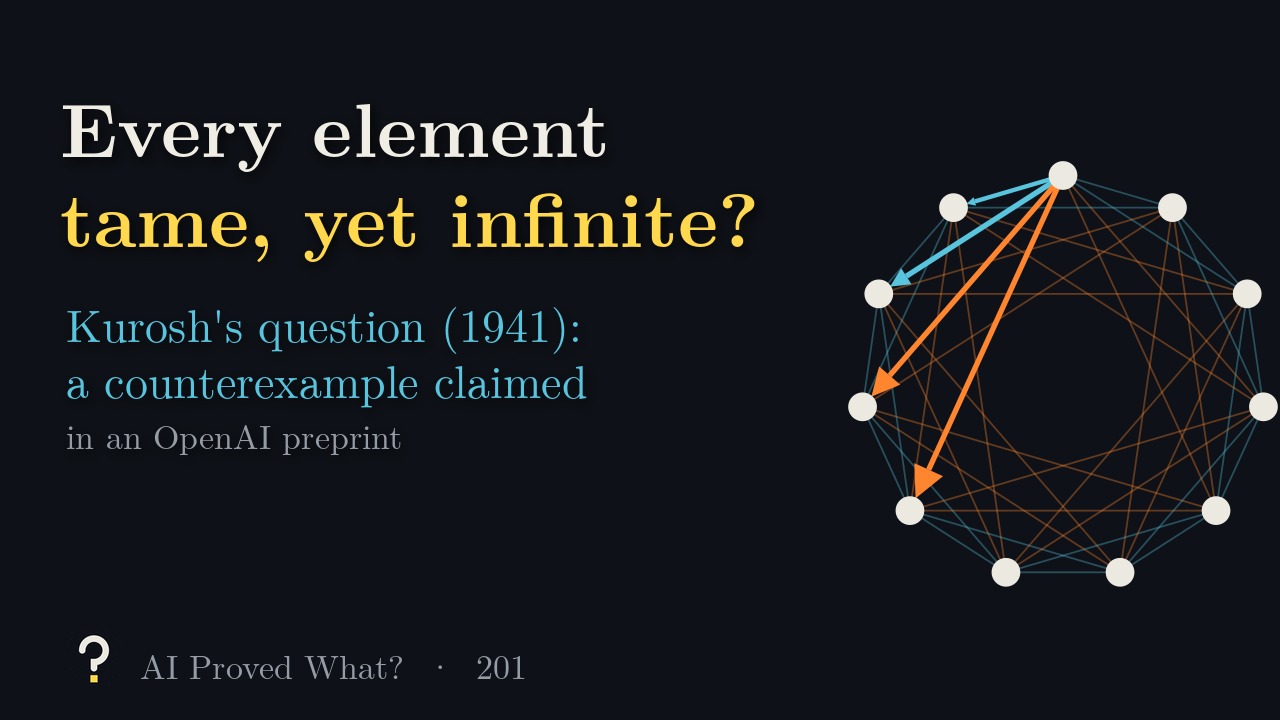
A preprint claims a division ring in which every element satisfies a polynomial over the center, yet two elements generate an infinite-dimensional ring, answering Kurosh’s 1941 question negatively
Covers result 201 in OpenAI’s catalog: its one paper. See its connections to other results and the work it cites.
5:13. English captions available. The video loads from YouTube when you press play.
Chapters
The claim, in plain words
The quaternions are a number system in which multiplication does not commute, yet every nonzero element can be divided by: a division ring. Take them with rational coefficients: then every quaternion satisfies a quadratic equation with rational coefficients; for example q = 1 + 2i + 3j + 4k satisfies q² − 2q + 30 = 0. In any division ring of finite dimension over its center, every element satisfies a polynomial over the center, with a ceiling on the degrees; and the words in two elements span a space that grows and then stops at the dimension.
Alexander Kurosh asked about the converse in 1941, in connection with Burnside’s problem on groups: if every element of a division ring satisfies some polynomial over the center, must finitely many elements always generate something finite-dimensional? For algebras that are not division rings the answer is no (Golod, 1964), but those finitely generated, infinite-dimensional examples rely on nilpotent elements, which a division ring cannot have. When the degrees are bounded, the answer is yes, by theorems of Jacobson and Kaplansky.
Result 201 is one OpenAI preprint, A Counterexample to Kurosh’s Division-Ring Problem (45 pages, dated September 23, 2026). Its Theorem 1.1: there is a countable division ring D of characteristic zero, with center F, and x, y in D such that D = F[x, y] = F(x, y), D is infinite-dimensional over F, and every element of D is algebraic over F. Every element has its own polynomial, but their degrees can have no ceiling.
What it doesn’t claim
Anything in positive characteristic. An explicit example: the ring is built with an ultrafilter and with choices at every stage, and no formula for x and y is given. A named center: “The construction does not prescribe the center” (p.2); by our reading it contains every algebraic number, and much more.
Where it stands
- Posted as a preprint
- OpenAI, 45 pages, dated September 23, 2026
- Peer reviewed
- Not yet
- Checked in Lean
- Only the final step, uncatalogued; the 36-page lifting theorem is assumed, not proved
Last checked October 19, 2026. The preprint has not been revised since it was added to the repository in its initial commit on October 6, 2026. The release’s catalog lists no Lean formalization for this result, but the Lean folder contains one that is not catalogued (source): 20 files and about 1,700 lines proving that the lifting theorem implies the counterexample, with no sorry, admit, axiom or native_decide by our search. Its main statement matches Theorem 1.1, but the lifting theorem is a hypothesis there, never proved, so the 36-page core is not formalized. We did not run the check. The paper is not among those OSVerify reviewed, and we found no expert reaction.
How the proof goes
- A schedule. Build an infinite sequence of finite-dimensional division algebras, each generated by a pair. List every noncommutative polynomial in x and y and, at each stage, force the next one on the list to satisfy a polynomial while keeping all the earlier ones.
- Glue the stages. The algebras need not sit inside one another, so the paper glues them with an ultraproduct, a kind of limit by vote in which whatever holds at almost every stage holds in the limit. In each stage the span of the words stops growing at that stage’s dimension, but the dimensions grow without bound, so in the limit the span never stops growing. A short descent argument moves this from a central subfield to the actual center. This takes about two and a half pages.
- The lifting theorem. About 36 pages. The free letters are replaced by series of matrices so that old identities survive; the paper studies how eigenvalues respond to small changes, shows the leading errors satisfy cyclic relations among rotations of words, and cancels them on a ring of eleven blocks, one letter on arrows that jump one or two places and the other on arrows that jump three or four. The data are realized in a division algebra of at least eleven times the degree, and a final shift fuses the eleven blocks into one, ready for the next step. By our reading nine or ten blocks would meet the conditions the proofs use too; eleven is the paper’s choice.
The numbers in the video
- Toys (ours): q = 1 + 2i + 3j + 4k satisfies q² − 2q + 30 = 0; word spans 1, 3, 4, 4 for the quaternions and 1, 3, 6, …, 25 for an algebra of dimension 25 on two generators.
- Checks of the paper’s finite pieces (ours): the cycle trace test for all words up to length 9; obstruction classes 4, 6, 8, 14, 20, 36 for word lengths 3 to 8 (binary necklaces); the last step in its smallest case, dimension 11 to 121 and rank 11² + 1; degree at least 11n after n steps.
- The Lean counts are ours.
Read the source
- A Counterexample to Kurosh’s Division-Ring Problem (PDF), 45 pages.
- The uncatalogued Lean folder (conditional on the lifting theorem).
- The collection’s catalog, where this is result 201.
The paper
OpenAI groups related papers into one result; this one has a single paper.
Transcript
Read the full script
0:00The question
The quaternions are a number system in which multiplication does not commute, yet every nonzero element can be divided by: a division ring. Take them with rational coefficients: then every quaternion satisfies a quadratic equation with rational coefficients. For example, 1 + 2i + 3j + 4k, call it q, satisfies q² − 2q + 30 = 0. That is no accident. The quaternions are four-dimensional over their center, the rational numbers, and in any division ring of finite dimension over its center, every element satisfies a polynomial over the center, with a ceiling on the degrees. Another way to see the finiteness: take two elements and multiply them in all possible ways. The span of the words grows, 1, 3, 4, and then stops at 4. For a bigger algebra of dimension 25, built the same way from two generators, it climbs to 25, and stops. Alexander Kurosh asked about the converse in 1941, in connection with Burnside’s problem on groups. Suppose every element of a division ring satisfies some polynomial over the center. Must finitely many elements always generate something finite-dimensional? For algebras that are not division rings, the answer is no: Golod’s construction of 1964 gives finitely generated, infinite-dimensional examples, but they rely on nilpotent elements, which a division ring cannot have. When the degrees of the polynomials are bounded, the answer is yes, by theorems of Jacobson and Kaplansky. For division rings in general, the question remained open.
1:43The claim
Result 201 is one OpenAI preprint, 45 pages, dated September 23, 2026. It claims a countable division ring of characteristic zero in which every element satisfies a polynomial over the center, yet two elements, x and y, generate the whole ring over that center, and the ring is infinite-dimensional over it. So for division rings, the answer to Kurosh’s question is no. Every element has its own polynomial, but by the theorems just mentioned, their degrees can have no ceiling. Not claimed: anything in positive characteristic. Nor an explicit example: the ring is built with an ultrafilter and with choices at every stage, and no formula for x and y is given. Nor a named center: the paper does not prescribe it, and by our reading it contains every algebraic number, and much more.
2:40How the proof goes
The plan: build an infinite sequence of finite-dimensional division algebras, each generated by a pair. List every noncommutative polynomial in x and y, a list that never ends but reaches every item, and at each stage force the next one on the list to satisfy a polynomial, while keeping all the earlier ones. The algebras need not sit inside one another, so the paper glues them with an ultraproduct, a kind of limit by vote, in which whatever holds at almost every stage holds in the limit. In each stage, the span of the words in x and y stops growing at that stage’s dimension. But the dimensions grow without bound, so in the limit the span never stops growing. A short descent argument then moves this from a central subfield to the actual center. That part takes about 2½ pages. The real work is the lifting theorem, about 36 pages. In one step, the free letters are replaced by series of matrices, so that old identities survive. The paper studies how the eigenvalues of the chosen expression respond to small changes, shows that the leading errors satisfy cyclic relations among rotations of words, and cancels them on a ring of eleven blocks, with one letter on arrows that jump one or two places, and the other on arrows that jump three or four. The matrix data are then realized inside a division algebra of at least eleven times the degree, and a final shift fuses the eleven blocks into one, restoring the conditions for the next step. Our checks on the finite pieces agree: the cycle test, the eleven-block count, and the rank count of the last step. By our reading, nine or ten blocks would meet the stated conditions too; eleven is the paper’s choice.
4:27Where it stands
The preprint is unrefereed and has not been revised. The release’s catalog lists no Lean formalization for this result, but the Lean folder contains one that is not catalogued: about 1,700 lines proving that the lifting theorem implies the counterexample. There, the lifting theorem itself is an assumption, never proved, so the 36-page core is not formalized. We did not run the check. The paper is not among those OSVerify reviewed, and we found no expert reaction. If it holds, every element of a division ring can satisfy a polynomial over the center, and still two elements can generate something infinite-dimensional.
Spot a mistake?
This episode simplifies on purpose, but it shouldn’t be wrong. If something is, open an issue on GitHub or leave a comment on YouTube. Corrections are noted here with a date.