Global = local?
A preprint claims the numerical blockwise Alperin weight conjecture for every finite group and every prime, without using the classification of finite simple groups
Covers result 202 in OpenAI’s catalog: its one paper. See its connections to other results and the work it cites.
5:06. English captions available. The video loads from YouTube when you press play.
Chapters
The claim, in plain words
A group can act on a vector space by matrices: a representation. Over the complex numbers every representation splits into irreducible pieces; over a field of characteristic p, a prime dividing the size of the group, representations need not split. The atoms are then the simple modules, counted by irreducible Brauer characters, and the group algebra breaks into blocks, each holding some of them. Some information is local: it lives in the subgroups whose order is a power of p, and in their normalizers.
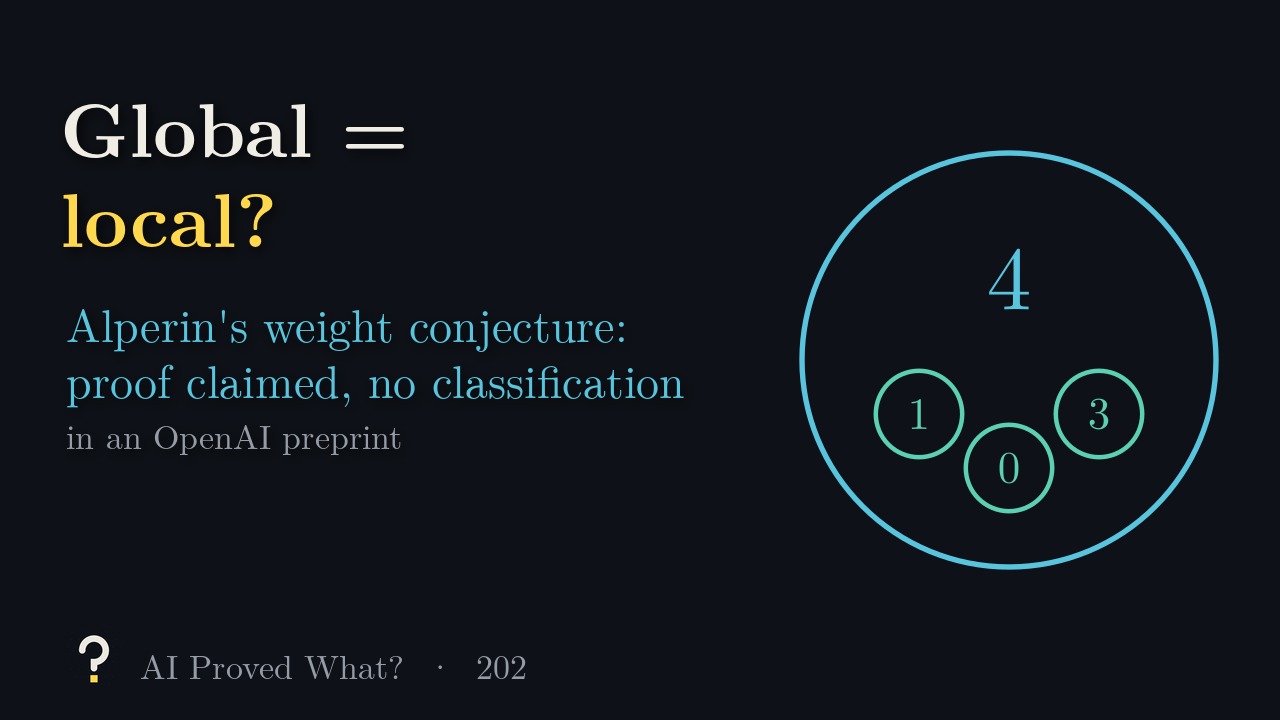
In 1986 Jonathan Alperin conjectured an exact count: in every block, the number of simple modules equals the number of its weights, up to conjugacy, where a weight is a pair of a p-subgroup Q and an irreducible character of its normalizer modulo Q whose degree carries the full power of p. For the alternating group on five letters at the prime two there are four simple modules, and the weights are one from the trivial subgroup, none from the subgroups of order two and three from the Klein four-group, matching block by block. As the paper tells it, early cases were settled by Alperin and Fong, and Navarro and Tiep, then Späth, reduced the conjecture to conditions on simple groups; that route runs through the classification of finite simple groups.
Result 202 is one OpenAI preprint, The Blockwise Alperin Weight Conjecture (59 pages, dated September 23, 2026). Its Theorem 1.1: for every prime p, every finite group G and every p-block B, l(B) = |Wp(B)|. The equality is numerical: no natural matching between simple modules and weights is claimed. The paper says its proof does not use the classification of finite simple groups or an inductive weight condition. If it holds, several results by other authors that assumed the conjecture become unconditional.
What it doesn’t claim
A canonical bijection; the stronger inductive and equivariant forms; related conjectures such as Dade’s, which the paper never mentions. Our check, on 30 small (group, prime) pairs up to the alternating group on six letters, matches block by block, but these cases were already known: they illustrate the statement, not the new proof.
Where it stands
- Posted as a preprint
- OpenAI, 59 pages, dated September 23, 2026
- Peer reviewed
- Not yet
- Checked in Lean
- Not formalized; only uncatalogued definitions and one supporting lemma
Last checked October 19, 2026. The preprint has not been revised since it was added to the repository in its initial commit on October 6, 2026. The theorem is not formalized in Lean: the release lists nothing for it, and its Lean library holds only uncatalogued pieces, definitions of blocks and weights with some basic facts (source) and a formal proof of one supporting lemma, a chain cancellation. The paper is not among those OSVerify reviewed, and we found no expert reaction. The geometry, where an error would most likely hide, we did not check.
How the proof goes
- Algebra (about 10 pages). Weights are peeled off by p-subgroups, chains of p-subgroups cancel in pairs, and a detector built from commutators picks out the characters of defect zero. Raising to powers ps and letting s grow, the conjecture becomes one counting statement.
- The counting statement. In a group J with no normal p-subgroup, count, up to conjugation, the tuples x, y, u1, …, un with n = ps and each u of order divisible by p (classes prescribed) that generate J and satisfy [x, y]u1⋯un = 1. As s grows, these counts become divisible by ever higher powers of p. For the symmetric group on three letters at the prime two the counts are 16, 160, 13,120, …, gaining one factor of 2 each time; with a normal p-subgroup the pattern stalls.
- Geometry (about 35 pages). Such tuples describe covers of a torus with n punctures, and a Sylow p-subgroup of a Galois group permutes them in orbits of p-power size; if every orbit is large, the count is divisible. The paper builds a genus-one curve over a large function field in characteristic p on which every divisor has degree divisible by ps, proves an exact genus bound for inseparable covers, and works over a valued field. A cover defined over a field that is too small would force a nontrivial normal p-subgroup, which J does not have.
The numbers in the video
- Blockwise counts (ours) for 30 small (group, prime) pairs from C2 to A6, all classically known; A5 at p = 2: 4 simple modules, weights 1 + 0 + 3.
- Tuple counts (ours): for S3 at p = 2, N = 2(32s − 1) = 16, 160, 13,120, 86,093,440; in all 15 groups we tried with no normal p-subgroup, the smallest power of p rose by exactly one per step; for C2 at p = 2 the count stays at 4.
- The Lean counts are ours.
Read the source
- The Blockwise Alperin Weight Conjecture (PDF), 59 pages.
- The collection’s catalog, where this is result 202.
The paper
OpenAI groups related papers into one result; this one has a single paper.
Transcript
Read the full script
0:00The question
A group can act on a vector space by matrices: a representation. Over the complex numbers, every representation splits into irreducible pieces. Over a field of characteristic p, a prime, and when p divides the size of the group, representations need not split. The atoms are then the simple modules, counted by irreducible Brauer characters, and the group algebra breaks into blocks, each holding some of them. Finding them is hard. But some information is local: it lives in the subgroups whose order is a power of p, and in their normalizers, which are usually much smaller. In 1986, Jonathan Alperin conjectured an exact count. In every block, the number of simple modules equals the number of its weights, up to conjugacy: pairs made of a p-subgroup Q, and an irreducible character of its normalizer modulo Q whose degree carries the full power of p. Our example: the alternating group on five letters, at the prime two. It has four simple modules. The weights: one from the trivial subgroup, none from the subgroups of order two, and three from the Klein four-group. Four in all, and they match block by block. As the paper tells it, early cases were settled by Alperin and Fong: symmetric groups, and general linear groups at odd primes. Navarro and Tiep reduced it to conditions on simple groups, and Späth did the same block by block. That route runs through the classification of finite simple groups.
1:34The claim
Result 202 is one OpenAI preprint, 59 pages, dated September 23, 2026. It claims the numerical blockwise conjecture for every prime, every finite group, and every block: the two counts are always equal. Numerical means only the numbers; no natural matching between simple modules and weights is claimed. And the paper says its proof does not use the classification of finite simple groups, or the inductive conditions of the reduction program. If it holds, several results by other authors that assumed the conjecture become unconditional. Not claimed: a canonical bijection; the stronger inductive and equivariant forms; or related conjectures such as Dade’s, which the paper never mentions. Our check, on 30 pairs of small groups and primes, up to the alternating group on six letters, matches block by block. But these cases were already known; they illustrate the statement, not the new proof.
2:35How the proof goes
The proof has two halves. The first is algebra, about 10 pages. Weights are peeled off by p-subgroups, chains of p-subgroups cancel in pairs, and a detector built from commutators picks out the characters of defect zero. Raising to powers p^s, and letting s grow, the conjecture becomes one counting statement. Take a group J with no normal p-subgroup. Count, up to conjugation, the tuples x, y, u₁ through uₙ, with n equal to p^s and each u of order divisible by p, that generate J, and in which the commutator of x and y, times all the u’s, equals one. The claim: as s grows, these counts become divisible by ever higher powers of p. You can test this on a computer. For the symmetric group on three letters at the prime two, the counts are 16, 160, 13,120, gaining one factor of two each time. In all 15 such groups we tried, the smallest power of p rose by exactly one per step. With a normal p-subgroup it stalls: for the group of order two, the count stays at 4. The second half is geometry, about 35 pages. Such tuples describe covers of a torus with n punctures, and a Sylow p-subgroup of a Galois group permutes these covers, in orbits whose sizes are powers of p. If every orbit is large, the count is divisible. So the paper builds a special genus-one curve over a large function field in characteristic p, on which every divisor has degree divisible by p^s; proves an exact genus bound for inseparable covers; and works over a valued field. A cover defined over a field that is too small would force a nontrivial normal p-subgroup, which J does not have.
4:24Where it stands
The preprint is unrefereed and has not been revised. The theorem is not formalized in Lean. The release lists nothing for it; its Lean library holds only uncatalogued pieces: definitions of blocks and weights with some basic facts, and a formal proof of one supporting lemma, a chain cancellation. The paper is not among those OSVerify reviewed, and we found no expert reaction. The geometry, where an error would most likely hide, we did not check. If it holds, in every block of every finite group, the simple modules are counted by local data, with no appeal to the classification of finite simple groups.
Spot a mistake?
This episode simplifies on purpose, but it shouldn’t be wrong. If something is, open an issue on GitHub or leave a comment on YouTube. Corrections are noted here with a date.