Fix the defect group: finite?
Two preprints claim Donovan’s conjecture in full: with the defect group fixed, blocks of all finite groups fall into finitely many Morita classes, over algebraically closed fields and over p-adic rings
Covers result 203 in OpenAI’s catalog: all 2 papers. See its connections to other results and the work it cites.
4:38. English captions available. The video loads from YouTube when you press play.
Chapters
The claim, in plain words
The group algebra of a finite group over a field of characteristic p breaks into blocks, and each block has a defect group: a subgroup of prime-power order that measures how far the block is from being as simple as a matrix algebra. Two blocks count as the same if their categories of modules are equivalent, called Morita equivalence; it ignores matrix sizes. One block of the alternating group on five letters at the prime two has dimension 16, yet it is Morita equivalent to the field itself.
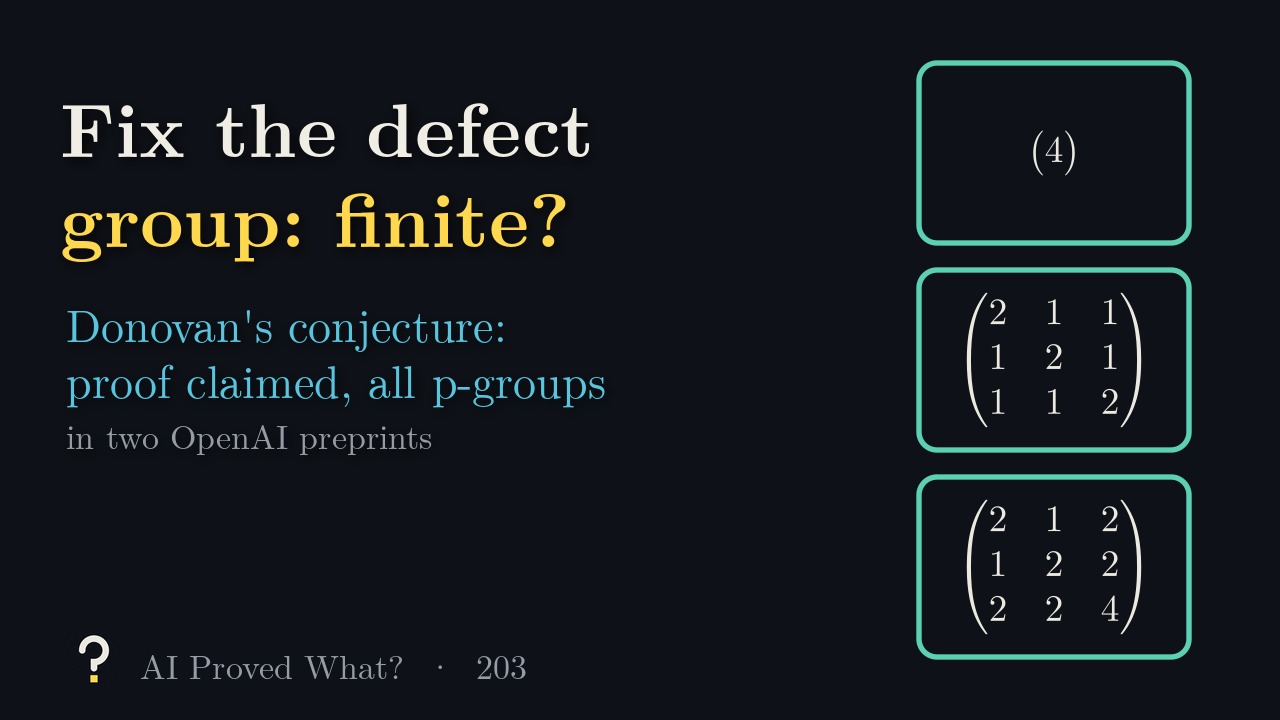
Donovan’s conjecture, recorded by Alperin around 1980: fix the defect group, and however large the group, only finitely many blocks occur up to Morita equivalence. In our table of 69 blocks, all 10 whose defect group has order two share the same invariants, and blocks with the Klein four-group as defect group come in exactly three kinds, as is known. As the papers tell it, the conjecture was known for some defect groups, such as abelian 2-groups, and in August 2026 a human team finished the tame case. Earlier, Kessar had split the problem in two: bound the size of the blocks, measured by their Cartan matrices, and bound the field they can be written over.
Result 203 bundles two OpenAI preprints. Donovan’s Conjecture over Algebraically Closed Fields (94 pages, dated September 24, 2026), Theorem 1.1: fix a prime p, an algebraically closed field K of characteristic p and a bound M; blocks of all finite groups with defect groups of order at most M fall into finitely many K-linear Morita classes, for every prime, including 2. Integral Donovan Finiteness over Witt Vectors (22 pages, dated September 25, 2026), which builds on the first, claims the stronger integral version: over the Witt vectors W(F̄p), and over every complete discrete valuation ring of characteristic zero whose residue field is algebraically closed.
What it doesn’t claim
An explicit list of Morita classes, or any bound on its length; Puig’s conjecture, the stronger source-algebra form; fields that are not algebraically closed. And unlike result 202, this proof uses the classification of finite simple groups (field paper, p. 33).
Where it stands
- Posted as preprints
- OpenAI, 94 and 22 pages, dated September 24 and 25, 2026
- Peer reviewed
- Not yet
- Checked in Lean
- Not formalized; one uncatalogued file of definitions and supporting lemmas
Last checked October 19, 2026. Neither preprint has been revised since they were added to the repository in its initial commit on October 6, 2026. Neither is formalized in Lean: the release lists nothing for them, and its Lean library holds one uncatalogued file of definitions and supporting lemmas (source, 408 lines), which describes itself as not a proof of Donovan’s conjecture. Neither paper is among those OSVerify reviewed, and we found no expert reaction. Our table only illustrates known small cases; it does not test the new uniform bounds.
How the proof goes
- Size. Using the classification, the field paper bounds the Cartan numbers of every block of every quasisimple group with small defect group (Theorem 4.1). Sporadic groups are only finitely many, and alternating groups follow from earlier work. The hard case is groups of Lie type in cross characteristic, which can grow without bound while the defect group stays small: for bounded rank, geometry on flag varieties; for unbounded rank, moving beads between the runners of an abacus; and a special endpoint the paper calls the cuspidal triangle. This part runs to almost 60 pages.
- Field. Up to Morita equivalence, any block is a crossed extension of a base block built from quasisimple pieces. The paper compares each base block with its twist by a bounded power of Frobenius, in a way that respects the action of a Sylow subgroup (Proposition 9.1); the leftover scalar error is removed because p-groups have no positive-degree cohomology with these coefficients. With both the size and the field bounded, only finitely many Morita classes remain (Theorem 8.8).
- Integral version. The second paper upgrades the comparison over the Witt vectors, where the errors are Teichmüller units, and removes a large kernel of order prime to p.
The numbers in the video
- Blocks (ours), computed directly in the group algebra over a splitting field: 33 pairs of small groups and primes, 69 blocks; in every block the largest elementary divisor of the Cartan matrix equals the order of the defect group.
- Klein four-group at p = 2 (ours): three fingerprints, the Klein four-group itself (Cartan matrix (4)), A4 and A4 × C3 (three simples, Loewy length 3), the principal block of A5 (three simples, Loewy length 5). Defect group of order two: one fingerprint across 10 blocks. A5 at p = 2: a block of dimension 16 with basic dimension 1.
- The papers’ central-transfer lemma (Lemma 2.1) checked on 4 pairs (ours). The Lean line count is ours.
Read the source
- Donovan’s Conjecture over Algebraically Closed Fields (PDF), 94 pages.
- Integral Donovan Finiteness over Witt Vectors (PDF), 22 pages.
- The collection’s catalog, where this is result 203.
The 2 papers in this result
OpenAI groups related papers, such as alternative proofs, supporting results and consequences, into one result; we label the first paper it lists the main paper and the others companions.
Transcript
Read the full script
0:00The question
Back to modular representations. The group algebra of a finite group breaks into blocks, and each block has a defect group: a subgroup of prime-power order that measures how far the block is from being as simple as a matrix algebra. Two blocks count as the same if their categories of modules are equivalent. This is called Morita equivalence, and it ignores matrix sizes: one block of the alternating group on five letters has dimension 16, yet it is Morita equivalent to the field itself. Our computer splits the group algebras of 33 pairs of small groups and primes into 69 blocks, and measures each one. Donovan’s conjecture, recorded by Alperin around 1980: fix the defect group, and however large the group, only finitely many blocks occur, up to Morita equivalence. In our table, all 10 blocks whose defect group has order two share the same invariants. Blocks with the Klein four-group as defect group come in exactly three kinds, as is known: those of the Klein four-group itself, of the alternating group on four letters, and the principal block of the one on five. As the papers tell it, the conjecture was known for some defect groups, such as abelian two-groups, and in August 2026 a human team finished the tame case. Earlier, Kessar had split the problem in two: bound the size of the blocks, measured by their Cartan matrices, and bound the field they can be written over.
1:32The claim
Result 203 bundles two OpenAI preprints. The first, 94 pages, dated September 24, 2026, claims Donovan’s conjecture over every algebraically closed field of characteristic p: fix the field and a bound on the order of the defect group, and all blocks of all finite groups fall into finitely many Morita classes, for every prime, including two. The second, 22 pages, dated a day later, claims the stronger integral version: over the Witt vectors, and over every complete discrete valuation ring of characteristic zero whose residue field is algebraically closed. It builds on the first. Not claimed: an explicit list, or any bound on its length; the stronger source-algebra form, known as Puig’s conjecture; or fields that are not algebraically closed. And unlike the previous episode’s paper, this proof uses the classification of finite simple groups.
2:32How the proof goes
Size first. Using the classification, the first paper bounds the Cartan numbers of every block of every quasisimple group with small defect. Sporadic groups are only finitely many, and alternating groups follow from earlier work. The hard case is groups of Lie type in cross characteristic, which can grow without bound while the defect group stays small. For bounded rank, the paper uses geometry on flag varieties; for unbounded rank, it moves beads between the runners of an abacus; and it treats a special endpoint it calls the cuspidal triangle. This part runs to almost 60 pages. Second, the field. Up to Morita equivalence, any block is a crossed extension of a base block built from quasisimple pieces. The paper compares each base block with its twist by a bounded power of Frobenius, in a way that respects the action of a Sylow subgroup. The leftover error is a scalar, and it can be removed, because p-groups have no positive-degree cohomology with these coefficients. With both the size and the field bounded, only finitely many multiplication tables remain. The integral paper upgrades this comparison over the Witt vectors, where the errors are Teichmüller units, and removes a large kernel of order prime to p.
3:53Where it stands
Both preprints are unrefereed and have not been revised. Neither is formalized in Lean. The release lists nothing for them; its Lean library holds one uncatalogued file of definitions and supporting lemmas, which describes itself as not a proof of Donovan’s conjecture. Neither paper is among those OSVerify reviewed, and we found no expert reaction. Our table only illustrates known small cases; it does not test the new uniform bounds. If it holds, fixing a defect group leaves only finitely many kinds of blocks, over any algebraically closed field of characteristic p and over its p-adic lifts, though no one has written those lists down.
Spot a mistake?
This episode simplifies on purpose, but it shouldn’t be wrong. If something is, open an issue on GitHub or leave a comment on YouTube. Corrections are noted here with a date.