Idempotents: only 0 and 1?
Two preprints claim Bass’s trace conjecture for every group, its ℓ¹ strengthening, and Kaplansky’s idempotent conjecture in characteristic zero
Covers result 207 in OpenAI’s catalog: all 2 papers. See its connections to other results and the work it cites.
3:59. English captions available. The video loads from YouTube when you press play.
Chapters
The claim, in plain words
Take a group of symmetries, such as the shifts and flips of the integer line. Its group ring is made of finite formal sums of symmetries. Some elements are idempotent: squaring them changes nothing, and each one splits the ring into pieces. Symmetries of finite order make them easy to find: a flip s has order two, so (1 + s)/2 is idempotent.
In the 1970s, Hyman Bass proposed a rule: record the trace of such a piece separately for each conjugacy class of the group; it should live only on symmetries of finite order, never on an infinite-order shift. (His 1976 conjecture concerns integer coefficients, where only the identity survives; the complex form allows finite-order classes.) Kaplansky asked: if the group has no finite-order symmetries except the identity, are zero and one the only idempotents, over any field? As the papers tell it, both were known for many classes of groups, Bass’s rule for amenable and linear ones, but not in general.
Result 207 bundles two OpenAI preprints of 33 pages each. The Bass trace conjecture and the characteristic-zero Kaplansky idempotent conjecture (September 24, 2026) claims Bass’s conjecture for every group over the complex numbers, and, with an older result of Linnell, over the integers. For groups without finite-order elements it gets Kaplansky’s conjecture in characteristic zero: over any commutative domain of characteristic zero, the only idempotents are 0 and 1. The ℓ¹-Bass Conjecture for Discrete Groups (October 5, 2026) claims the stronger version over the ℓ¹ algebra, which allows infinite absolutely convergent sums: the trace lives on finitely many finite-order classes.
What it doesn’t claim
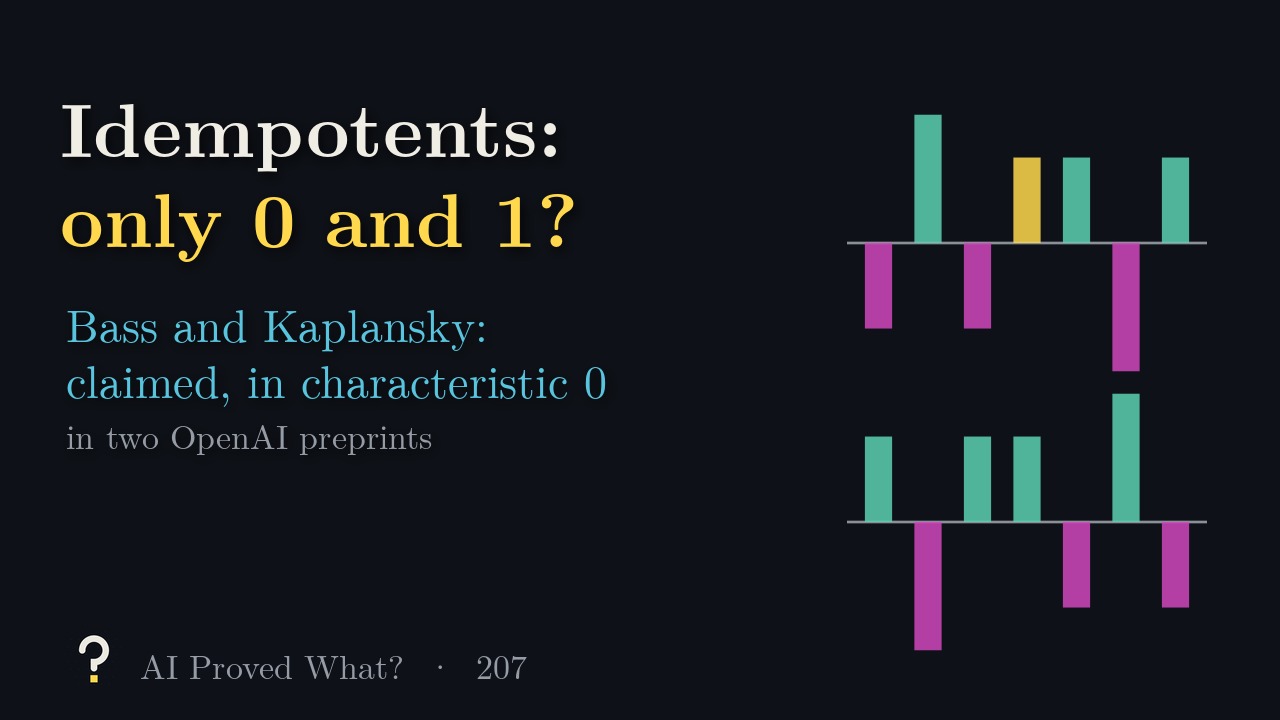
Kaplansky’s conjecture in positive characteristic, such as two; or the stronger question for C*-algebras (the Kadison–Kaplansky conjecture), which another paper in the same release claims is false. Our computer builds an idempotent in the shifts-and-flips group with 14 terms, 6 of them shifts; their coefficients cancel class by class, so the trace sits only on the identity and one class of flips.
Where it stands
- Posted as preprints
- OpenAI, 33 pages each, dated September 24 and October 5, 2026
- Peer reviewed
- Not yet
- Checked in Lean (partly)
- The complex theorem and the idempotent result (docs); not the ℓ¹ theorem or the integer version
Last checked October 19, 2026. Neither preprint has been revised since they were added to the repository in its initial commit on October 6, 2026. The first paper’s complex theorem and its idempotent result are formalized in Lean (Bass trace statement, torsion-free statement), about 24,000 lines with no unproved steps; we did not rebuild them. The ℓ¹ theorem in the catalog headline is not formalized, and neither is the integer version. Neither paper is among those OSVerify reviewed, and we found no expert reaction.
How the proof goes
- High dimension kills the trace. Fix an infinite-order symmetry g. The trace at g can be written as a quantity on closed chains that wind once around g, in every even dimension, and it stays the same.
- The first paper. These chains form a cycle built from one fixed graph of bounded degree (Proposition 7.3), and a Pfaffian cocycle reads off the trace divided by 2m (Proposition 8.3). Every invariant cocycle vanishes on such sparse cycles in high enough dimension (Theorem 2.1). For the smallest graphs, of degree two, the paper’s inequality needs dimension about 274, by our count.
- The ℓ¹ paper. First make the idempotent decay exponentially, without changing its trace (Proposition 2.2). Then write the trace as an average of curvatures on simplices (Proposition 3.3), and build a connection from averages over many scales, whose curvature shrinks like a small number to the power of the dimension (Theorem 6.1).
- Finitely many. One radius is fixed for all conjugacy classes before the dimension grows; only classes that meet that ball can survive, and there are finitely many.
The numbers in the video
- An exact idempotent in the shifts-and-flips group (ours): 14 terms, 6 of them shifts, cancelling class by class.
- The dimension threshold 274 for graph degree two, from the first paper’s inequality (3.6) (ours).
- Further checks (ours, not on screen): 150 rational idempotents of Q[Cn] for n up to 12; 736 small integer idempotent matrices over Z[C2] and Z[C3], all with trace at the identity; small-support searches in 8 torsion-free groups that find only 0 and 1. The Lean line counts are ours.
Read the source
- The Bass trace conjecture and the characteristic-zero Kaplansky idempotent conjecture (PDF), 33 pages.
- The ℓ¹-Bass Conjecture for Discrete Groups (PDF), 33 pages.
- The Lean formalization notes.
- The collection’s catalog, where this is result 207.
The 2 papers in this result
OpenAI groups related papers, such as alternative proofs, supporting results and consequences, into one result; we label the first paper it lists the main paper and the others companions.
Transcript
Read the full script
0:00The question
Take a group of symmetries, such as the shifts and flips of the integer line. Its group ring is made of finite formal sums of symmetries. Some elements of this ring are idempotent: squaring them changes nothing, and each one splits the ring into pieces. Symmetries of finite order make them easy to find. A flip has order two, so averaging it with the identity, one half of one plus the flip, is idempotent. In the 1970s, Hyman Bass proposed a rule. Record the trace of such a piece separately for each conjugacy class of the group; it should live only on symmetries of finite order, never on an infinite-order shift. And Irving Kaplansky asked: if the group has no finite-order symmetries except the identity, are zero and one the only idempotents, over any field? As the papers tell it, both were known for many classes of groups, Bass’s rule for amenable and linear ones, but not in general.
0:57The claim
Result 207 bundles two OpenAI preprints, of 33 pages each. The first, dated September 24, 2026, claims Bass’s conjecture for every group over the complex numbers, and, with an older result of Linnell, over the integers. For groups without finite-order elements, it gets Kaplansky’s conjecture in characteristic zero: over any commutative domain of characteristic zero, the only idempotents are zero and one. The second, dated October 5, claims the stronger version over the ℓ¹ algebra, which allows infinite absolutely convergent sums: the trace lives on finitely many finite-order classes. Here is a picture. Our computer builds an idempotent in the shifts-and-flips group with 14 terms, 6 of them shifts. Their coefficients cancel class by class, so the trace sits only on the identity and one class of flips. Not claimed: Kaplansky’s conjecture in positive characteristic, such as two, or the stronger question for C* algebras. Another paper in the same release claims the C* version is false.
2:07How the proof goes
Both proofs rest on one idea: high dimension kills the trace. Fix an infinite-order symmetry g. The trace at g can be written as a quantity on closed chains that wind once around g, in every even dimension, and it stays the same. The first paper turns these chains into a cycle built from one fixed graph of bounded degree, and a Pfaffian cocycle reads off the trace divided by two to the m. Then it shows that every invariant cocycle vanishes on such sparse cycles in high enough dimension. For the smallest graphs, of degree two, the paper’s inequality needs dimension about 274, by our count. The ℓ¹ paper first makes the idempotent decay exponentially, without changing its trace. Then it writes the trace as an average of curvatures on simplices, and builds a connection from averages over many scales, whose curvature shrinks like a small number to the power of the dimension. The key choice is to fix one radius for all conjugacy classes before the dimension grows; only classes that meet that ball can survive, and there are finitely many.
3:14Where it stands
Both preprints are unrefereed and have not been revised. The first paper’s complex theorem and its idempotent result are formalized in Lean, about 24,000 lines with no unproved steps; we did not rebuild them. The ℓ¹ theorem in the catalog headline is not formalized, and neither is the integer version. Neither paper is among those OSVerify reviewed, and we found no expert reaction. If they hold, Bass’s trace rule holds for every group, and Kaplansky’s idempotent question has the answer yes in characteristic zero, for group rings, though not for their C* algebra cousins, if the release’s other paper is right.
Spot a mistake?
This episode simplifies on purpose, but it shouldn’t be wrong. If something is, open an issue on GitHub or leave a comment on YouTube. Corrections are noted here with a date.