Dead over F, alive on A?
Two preprints claim the first integral counterexamples to Gersten’s conjecture: nonzero K-theory classes on ramified regular local rings that vanish over the fraction field
Covers result 209 in OpenAI’s catalog: all 2 papers. See its connections to other results and the work it cites.
4:17. English captions available. The video loads from YouTube when you press play.
Chapters
The claim, in plain words
Algebraic K-theory attaches a sequence of groups, K0, K1, K2 and so on, to a ring. Take a regular local ring A, the algebraic version of a smooth point, and its fraction field F. Gersten’s conjecture, from 1973, says that the K-groups of A sit inside those of F, and more: a whole sequence of maps out of them is exact. The first part says a class that vanishes over F was already zero on A.
As the papers tell it, the conjecture was proved for rings containing a field, by Quillen for geometric rings and by Panin in general; and with finite coefficients for rings smooth over a discrete valuation ring, and for unramified rings. In mixed characteristic, where the ring has characteristic zero but its residue field has characteristic p, the general integral case stayed open. In August 2026 Feld found a counterexample with coefficients mod three, in degree two; he noted it does not contradict the integral conjecture.
Result 209 bundles two OpenAI preprints. Each gives a two-dimensional regular local ring of mixed characteristic (0, 5) and an integral K-theory class on it that is not zero, yet vanishes over the fraction field. An integral counterexample to Gersten’s conjecture (25 pages, September 25, 2026) works in degree five, on the surface 5 + x4 + y4 = 0 over a ring of 5-adic integers. An integral degree-three Gersten counterexample (10 pages, September 26, 2026) works in degree three, on a quintic surface over the 5-adic integers with fifth roots of unity. So, if they are right, the unrestricted integral conjecture fails.
What it doesn’t claim
Anything about rings that contain a field, rings smooth over a discrete valuation ring, or unramified rings; the version with rational coefficients; the order of these classes; or the smallest degree that fails. Both rings are ramified: 5 lies deep inside the maximal ideal.
Where it stands
- Posted as preprints
- OpenAI, 25 and 10 pages, dated September 25 and 26, 2026
- Peer reviewed
- Not yet
- Checked in Lean
- Not formalized; the release’s Lean library has no higher K-theory
Last checked October 19, 2026. Neither preprint has been revised since they were added to the repository in its initial commit on October 6, 2026. Neither is formalized in Lean. Neither paper is among those OSVerify reviewed, and we found no expert reaction. A 2015–2020 preprint by Satoshi Mochizuki, one version of which claimed Gersten’s conjecture for all regular local rings, has a general vanishing theorem that would rule out such classes; the degree-five paper points to a gap in one of its lemmas, and if the new papers are right, that theorem cannot hold as stated.
How the proof goes
- Plant a class on a curve. A class pushed forward from a curve through the point dies automatically over the fraction field. The hard part is showing it is not zero on A.
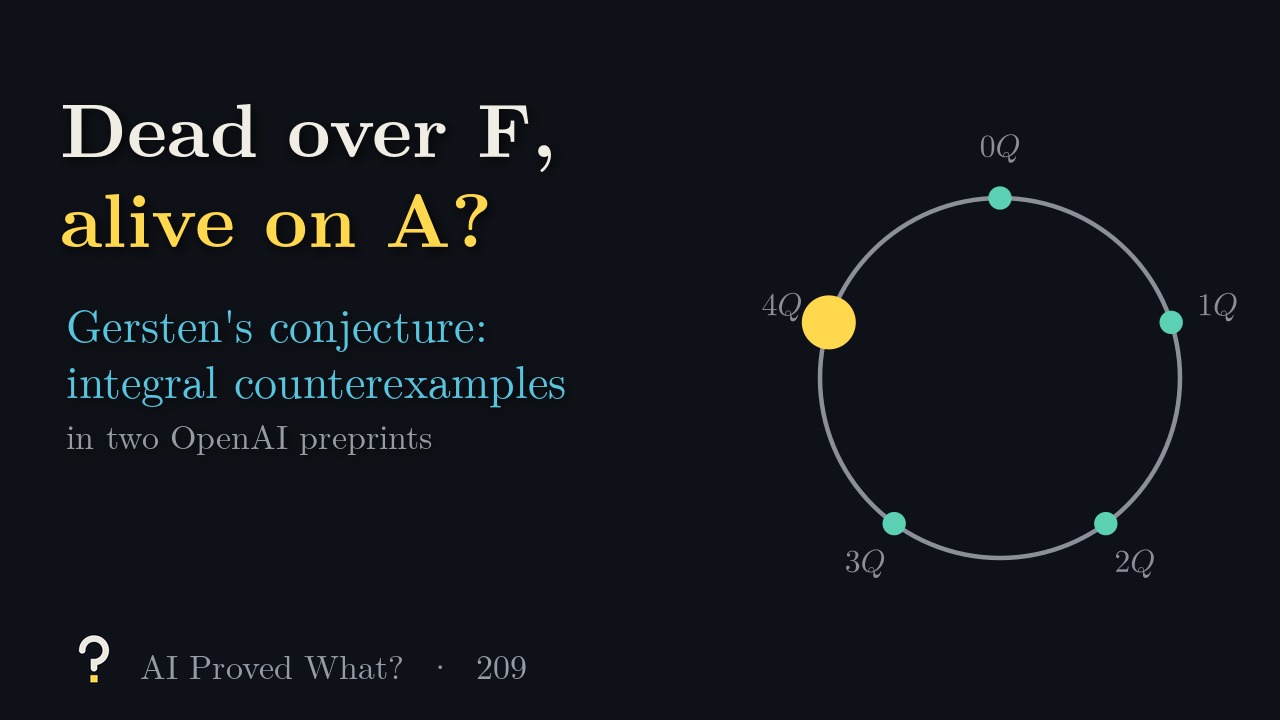
- Degree five. The class starts over the cyclotomic integers with five inverted, then moves to the ring. After an extension, the curve splits into four points on the Fermat quartic. If the class vanished, a relation among these points would become a principal divisor on the special fiber. Mapped to the elliptic curve w2 = s4 + 1, the four points land at +Q, −Q, −Q, +Q, with weights 1, 4, 4, 1; modulo five the sum is 4Q, not zero (we checked this), while the plain sum of weights, 1 + 4 + 4 + 1, would have been zero modulo five.
- Degree three. The class is a Bott element times a uniformizer on the curve y = 0; a Steinberg relation makes it integral. To show it survives, the paper compares norms modulo five: the planted curve has residue degree one and contributes one, while every other point that could cancel it has residue degree divisible by five and contributes zero.
The numbers in the video
- Point counts on w2 = s4 + 1 (ours, brute force): 4, 32, 640 and 391,680 over the fields with 5, 25, 625 and 58 elements, matching the paper’s recursion; the four points land at +Q, −Q, −Q, +Q, and the weighted sum is 4Q modulo 5.
- The degree-three model (ours): its special fibre is singular at the point, and the other special-fibre points appear only over the field with 55 elements.
Read the source
- An integral counterexample to Gersten’s conjecture (PDF), 25 pages.
- An integral degree-three Gersten counterexample (PDF), 10 pages.
- The collection’s catalog, where this is result 209.
The 2 papers in this result
OpenAI groups related papers, such as alternative proofs, supporting results and consequences, into one result; we label the first paper it lists the main paper and the others companions.
Transcript
Read the full script
0:00The question
Algebraic K-theory attaches a sequence of groups, K₀, K₁, K₂ and so on, to a ring. Take a regular local ring A: the algebraic version of a smooth point, such as polynomials in x and y near the origin. Its fraction field F is what you get by allowing division. Gersten’s conjecture, from 1973, says that the K-groups of A sit inside those of F, and more: a whole sequence of maps out of them is exact. The first part, injectivity, says a class that vanishes over F was already zero on A. As the papers tell it, the conjecture was proved for rings containing a field, by Quillen for geometric rings and by Panin in general; and with finite coefficients for rings smooth over a discrete valuation ring, and for unramified rings. In mixed characteristic, where the ring has characteristic zero but its residue field has characteristic p, the general integral case stayed open. In August 2026, Feld found a counterexample with coefficients mod three, in degree two; he noted it does not contradict the integral conjecture.
1:12The claim
Result 209 bundles two OpenAI preprints, dated September 25 and 26, 2026. Each gives a two-dimensional regular local ring of mixed characteristic zero and five, and an integral K-theory class on it that is not zero, yet vanishes over the fraction field. The first, 25 pages, works in degree five, on the surface 5 + x⁴ + y⁴ = 0, over a ring of five-adic integers. The second, 10 pages, works in degree three, on a quintic surface over the five-adic integers with fifth roots of unity. So, if they are right, the unrestricted integral conjecture fails. Not claimed: anything about rings that contain a field, rings smooth over a discrete valuation ring, or unramified rings; the version with rational coefficients; the order of these classes; or the smallest degree that fails. Both rings are ramified: five lies deep inside the maximal ideal.
2:15How the proof goes
Both proofs plant a class on a curve through the point. A class pushed forward from a curve dies automatically over the fraction field. The hard part is showing it is not zero on A. In degree five, the class starts over the cyclotomic integers with five inverted, then moves to the ring. After an extension, the curve splits into four points on the Fermat quartic. If the class vanished, a relation among these points would become a principal divisor on the special fiber. But mapped to the elliptic curve w² = s⁴ + 1, the four points land at plus Q, minus Q, minus Q, plus Q, with weights one, four, four, one. Our computer checks this: modulo five, the sum is four Q, not zero. The plain sum of weights, 1 + 4 + 4 + 1, would have been zero modulo five. In degree three, the class is a Bott element times a uniformizer on the curve y equals zero. A Steinberg relation makes it integral. To show it survives, the paper compares norms modulo five: the planted curve has residue degree one and contributes one, while every other point that could cancel it has residue degree divisible by five, and contributes zero.
3:27Where it stands
Both preprints are unrefereed and have not been revised. Neither is formalized in Lean; the release’s Lean library has no higher K-theory. Neither paper is among those OSVerify reviewed, and we found no expert reaction. One more thing: a 2015–2020 preprint by Satoshi Mochizuki, one version of which claimed Gersten’s conjecture for all regular local rings. The degree-five paper points to a gap in one of its lemmas; if the new papers are right, its general vanishing theorem cannot hold as stated. If they hold, Gersten’s conjecture fails with integer coefficients at some ramified points in mixed characteristic, while the field case and the finite-coefficient results still stand.
Spot a mistake?
This episode simplifies on purpose, but it shouldn’t be wrong. If something is, open an issue on GitHub or leave a comment on YouTube. Corrections are noted here with a date.