Sphere or tree?
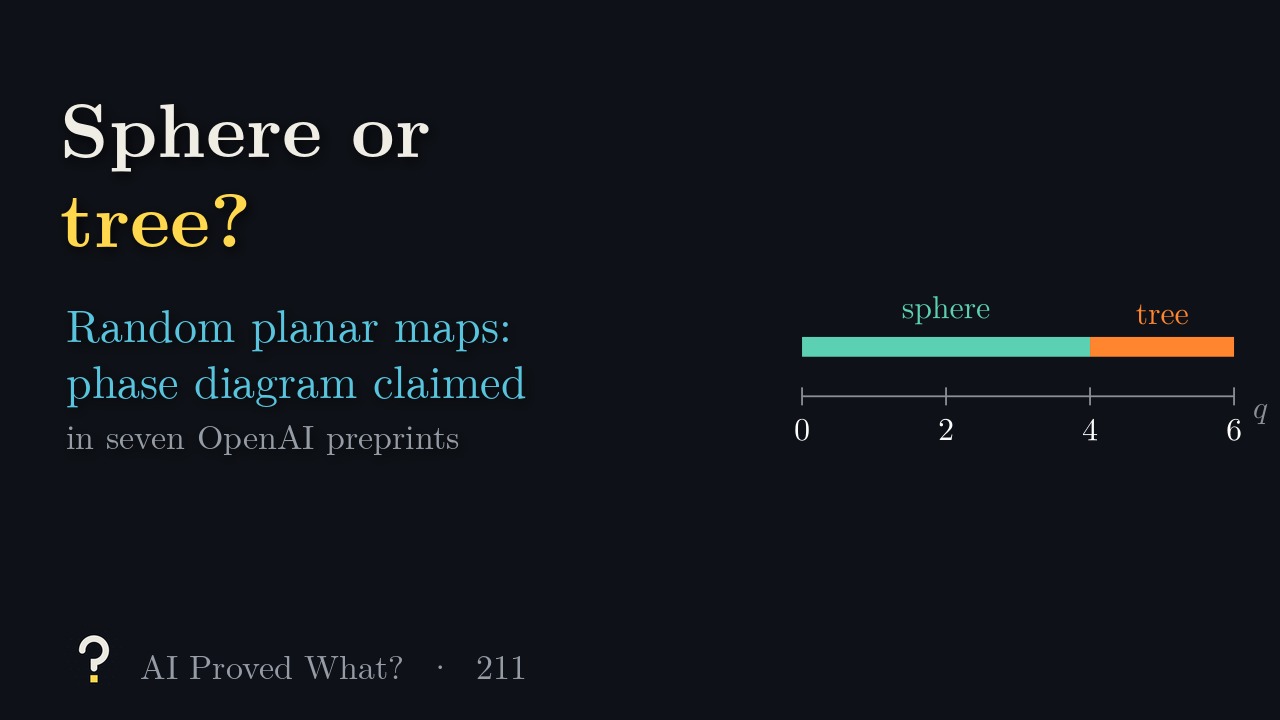
Seven preprints claim the phase diagram of decorated random planar maps: Liouville quantum gravity spheres up to q = 4, a random tree above, and random walks that become Liouville Brownian motion
Covers result 211 in OpenAI’s catalog: all 7 papers. See its connections to other results and the work it cites.
4:25. English captions available. The video loads from YouTube when you press play.
Chapters
The claim, in plain words
A planar map is a graph drawn on a sphere, its edges cutting it into faces. Pick one at random with n edges, and as n grows it looks like a random fractal surface. Decorate it with the critical Fortuin–Kasteleyn model: choose a set of edges, and give each choice the weight q to the power of half the number of loops separating clusters from dual clusters. For q = 1 the map is uniform, q = 2 is the Ising case, and spanning-tree maps sit at the q-to-zero end of the family.
Physicists and mathematicians predicted a phase diagram. Up to q = 4 the decorated map should look like a Liouville quantum gravity sphere, with a roughness parameter γ set by q (γ = √3 for Ising, 2 at q = 4); above 4 it should collapse into a random tree. A word in hamburgers and cheeseburgers, due to Sheffield, encodes these maps; our decoder reproduces Tutte’s counts of rooted maps and the weight q to the power of half the loops.
Result 211 bundles seven OpenAI preprints, 762 pages, dated September 24 and October 5, 2026. For q below 4, and for spanning trees, the maps converge to the Liouville quantum gravity sphere as metric measure spaces; a second paper adds the conformal embedding and the loops, which converge to conformal loop ensembles; at q = 4 a third first builds the critical sphere, then proves convergence; above 4 a fourth shows convergence to the Brownian continuum random tree. Three more turn to motion: on Ising maps, every eigenvalue of the random walk, times n, converges to the matching eigenvalue of the Liouville Laplacian, and the walk itself, started at equilibrium and sped up by exactly n, converges to Liouville Brownian motion, in a theorem stated given the metric limit; on spanning-tree maps the walk converges too, with the clock exactly n.
What it doesn’t claim
Rates; an explicit distance scale for the surfaces; uniformity in q; the uniform vertex measure; walks from arbitrary starting points. The spectral result covers only the Ising case.
Where it stands
- Posted as preprints
- OpenAI, seven papers, 762 pages, dated September 24 and October 5, 2026
- Peer reviewed
- Not yet
- Checked in Lean
- One paper of seven: the tree theorem above four (docs)
Last checked October 19, 2026. None of the seven preprints has been revised since they were added to the repository in its initial commit on October 6, 2026, though one cites a revision of a companion that is not in the repository. Only the tree theorem above four is formalized in Lean (the checked statement): about 40,000 lines with no unproved steps; we did not build it. The other six papers, about 740 pages, are not formalized. None is among those OSVerify reviewed, and we found no expert reaction.
How the proof goes
- Surfaces. The burger word’s two stacks converge to correlated Brownian motions, and the mating-of-trees theorem turns those into a quantum-gravity sphere. Then come homeomorphisms with small cells, local laws for shortest paths given the continuum surface, and a rigidity argument: if the best upper and lower constants differed, a local change would create a shortcut.
- Trees. Above four, the map breaks into two-connected blocks forming a critical branching tree, and distances grow like the square root of n.
- Motion. The key step is electrical: the limiting conductivity is exactly one, by a duality between the map and its dual. That is why, in the papers’ conventions, the clock is exactly n.
As an illustration, our computer sampled spanning-tree maps with up to 2,000 edges and computed n times the walk’s eigenvalues: they grow along a line of slope near 3.2, close to π, the value a known Weyl law suggests, and half the flat value, which our flat-torus control reproduces. This is a picture, not evidence: the spectral theorem itself is for Ising maps, which we could only sample at a few hundred edges.
The numbers in the video
- Map decoding (ours): Tutte’s counts 2, 9, 54, 378, 2916, 24057 and the FK weight reproduced exactly for small n; the word h c H h F c C F gives 3 vertices, 4 edges and 3 loops.
- Walk spectra on spanning-tree maps (ours): slope of n·λj about 3.22 at n = 1000 and 3.18 at n = 2000; flat torus control 6.30. The Lean line count is ours.
Read the source
- Metric-measure limits of subcritical FK and spanning-tree planar maps (PDF), 232 pages.
- Canonical conformal limits of subcritical FK planar maps (PDF), 123 pages.
- The critical Liouville quantum sphere and geometric limits of FK maps at q = 4 (PDF), 217 pages.
- Brownian continuum random tree limits of finite Fortuin–Kasteleyn maps above four (PDF), 25 pages.
- Spectral convergence for critical FK–Ising planar maps (PDF), 90 pages.
- Random walks on critical FK–Ising maps and Liouville Brownian motion (PDF), 16 pages.
- A linear clock for random walk on tree-weighted planar maps (PDF), 59 pages.
- The Lean formalization notes.
- The collection’s catalog, where this is result 211.
The 7 papers in this result
OpenAI groups related papers, such as alternative proofs, supporting results and consequences, into one result; we label the first paper it lists the main paper and the others companions.
- Random Walks on Critical FK–Ising Maps and Liouville Brownian Motion main paper
- Spectral convergence for critical FK–Ising planar maps companion
- A Linear Clock for Random Walk on Tree-Weighted Planar Maps companion
- Canonical conformal limits of subcritical FK planar maps companion
- The critical Liouville quantum sphere and geometric limits of FK maps at q=4 companion
- Metric-measure limits of subcritical FK and spanning-tree planar maps companion
- Brownian continuum random tree limits of finite Fortuin–Kasteleyn maps above four companion
Transcript
Read the full script
0:00The question
A planar map is a graph drawn on a sphere, its edges cutting it into faces. Pick one at random with n edges, and as n grows it looks like a random fractal surface. Now decorate it with a statistical physics model: choose a set of edges, and give each choice the weight q^(loops/2) that separate clusters from dual clusters. This is the critical Fortuin–Kasteleyn model on the map. For q equal to one the map is uniform, q equal to two is the Ising case, and spanning-tree maps sit at the q-to-zero end of the family. Physicists and mathematicians predicted a phase diagram. Up to q equal to four, the decorated map should look like a Liouville quantum gravity sphere, with a roughness parameter γ set by q: γ = √3 for Ising, and two at q equal to four. Above four, the map should collapse into a random tree. A word in hamburgers and cheeseburgers, due to Sheffield, encodes these maps. Our computer decodes such words and reproduces Tutte’s counts of rooted maps, and the weight q^(loops/2).
1:09The claim
Result 211 bundles seven OpenAI preprints, 762 pages in all, dated September 24 and October 5, 2026. They claim the whole geometric phase diagram. For q below four, and for spanning trees, the maps converge to the Liouville quantum gravity sphere as metric measure spaces. A second paper adds the conformal embedding and the loops, which converge to conformal loop ensembles. At q equal to four, a third paper first builds the critical sphere itself, then proves convergence. Above four, a fourth shows the maps converge to the Brownian continuum random tree. Three more papers turn to motion. On Ising-decorated maps, every eigenvalue of the random walk, times n, converges to the matching eigenvalue of the Liouville Laplacian; and the walk itself, started at equilibrium and sped up by exactly n, converges to Liouville Brownian motion, in a theorem stated given the metric limit. On spanning-tree maps, the walk converges too, with the clock exactly n. Not claimed: rates, an explicit distance scale for the surfaces, uniformity in q, or the uniform vertex measure; the spectral result covers only the Ising case.
2:28How the proof goes
The surface proofs share one skeleton. The burger word’s two stacks converge to correlated Brownian motions, and the mating-of-trees theorem turns those into a quantum-gravity sphere. Then come homeomorphisms with small cells, local laws for shortest paths given the continuum surface, and a rigidity argument: if the best upper and lower constants differed, a local change would create a shortcut. Above four, the map breaks into two-connected blocks forming a critical branching tree, and distances grow like the square root of n. For motion, the key step is electrical: the limiting conductivity is exactly one, by a duality between the map and its dual. That is why, in the papers’ conventions, the clock is exactly n. As an illustration, our computer sampled spanning-tree maps with up to 2,000 edges and computed n times the walk’s eigenvalues. They grow along a line of slope near 3.2, close to pi, the value a known Weyl law suggests, and half the flat value, which our flat torus control reproduces. This is a picture, not evidence: the spectral theorem itself is for Ising maps, which we could only sample at a few hundred edges.
3:43Where it stands
All seven preprints are unrefereed and have not been revised, though one cites a revision of a companion that is not in the repository. Only the tree theorem above four is formalized in Lean: about 40,000 lines, with no unproved steps; we did not build it. The other six papers, about 740 pages, are not formalized. None is among those OSVerify reviewed, and we found no expert reaction. If they hold, decorated random maps behave as long predicted: quantum-gravity spheres up to q equal to four, random trees above, and random walks that become Liouville Brownian motion.
Spot a mistake?
This episode simplifies on purpose, but it shouldn’t be wrong. If something is, open an issue on GitHub or leave a comment on YouTube. Corrections are noted here with a date.