How much does it wobble?
Two preprints claim the low-temperature fluctuations of the Sherrington–Kirkpatrick spin glass: the predicted n1/6 scale and a limiting law no one has named
Covers result 217 in OpenAI’s catalog: all 2 papers. See its connections to other results and the work it cites.
4:13. English captions available. The video loads from YouTube when you press play.
Chapters
The claim, in plain words
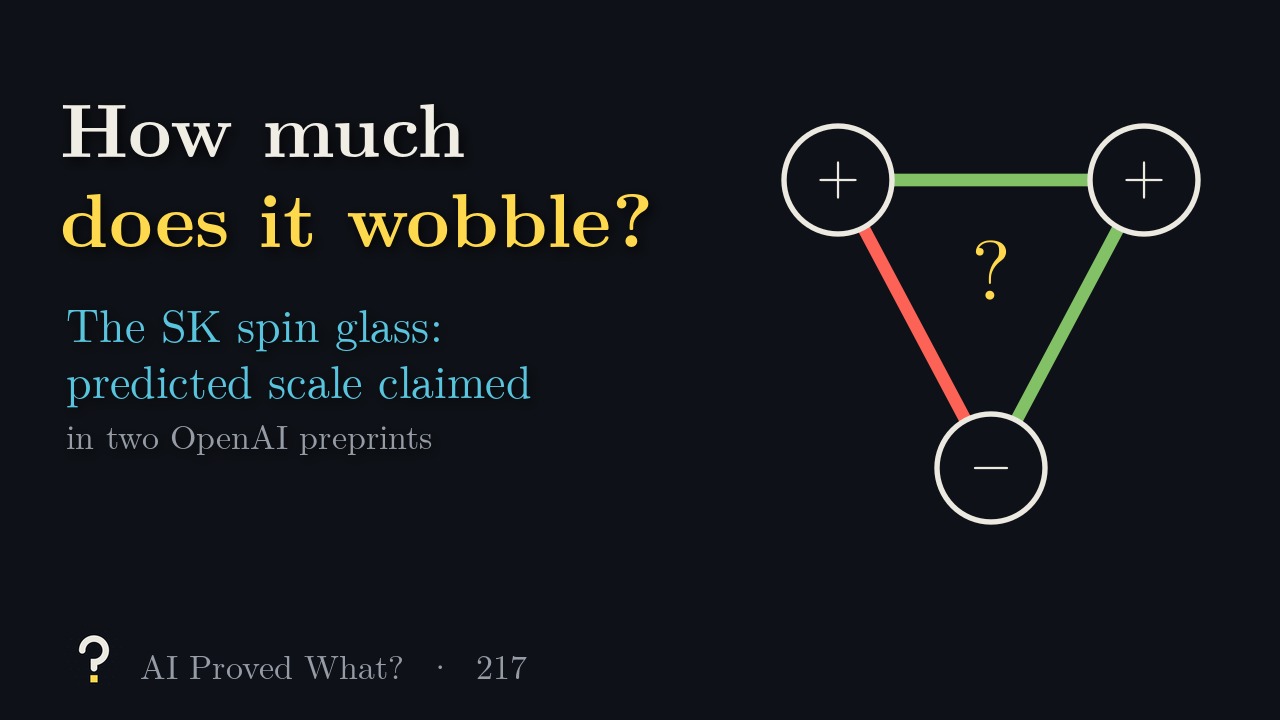
Take n spins, each plus or minus one, and connect every pair by a random Gaussian coupling, some friendly, some hostile: the Sherrington–Kirkpatrick spin glass. With three spins and our couplings, no arrangement satisfies all three bonds; the triangle is frustrated. The partition function Z sums the Boltzmann weight over all arrangements, and its logarithm, which these papers call the free energy, is the central quantity. Parisi’s formula, proved by Guerra and Talagrand, gives its average to leading order. But each sample of the couplings gives a slightly different value. How much does it wobble?
At high temperature, Aizenman, Lebowitz and Ruelle proved the wobble stays of order one. Below the critical temperature physicists predicted n1/6, but the physics argument relied on a heuristic matching step. Our computer sums all 220 arrangements exactly for many samples: at β = 1/2 the variance levels off; at β = 2 it keeps growing, but at these sizes like n0.7, nowhere near n1/3. Small systems cannot show the true law.
Result 217 bundles two OpenAI preprints dated September 24, 2026. The first (80 pages) claims that for every fixed β above one the standard deviation of log Z is n1/6, up to factors smaller than any fixed power of n. The second (126 pages) claims that the variance divided by n1/3 converges to a positive constant, and that the standardized fluctuations converge to a single limiting law.
What it doesn’t claim
The law is pinned down only by its moments, given by a series over random system sizes; the paper says no identification with a named distribution is made. The constant has no closed form. Both papers build on recent human work: methods of Aronow and Lopatto, whose bounds were posted 16 days earlier, and a theorem of Lopatto on the Parisi measure, revised since the papers were written.
Where it stands
- Posted as preprints
- OpenAI, two papers (80 and 126 pages), dated September 24, 2026
- Peer reviewed
- Not yet
- Checked in Lean
- None listed; an unlisted folder is conditional on the key estimate
Last checked October 19, 2026. Neither preprint has been revised since they were added to the repository in its initial commit on October 6, 2026. The release lists no Lean for this result, but its Lean library contains an unlisted folder of about 97,000 lines with no gaps in its proofs. It derives the first paper’s main theorem from the key estimate, taken as an assumption that nothing in the repository proves. Neither paper is among those OSVerify reviewed, and we found no expert reaction or earlier claim.
How the proof goes
- Stages. Both proofs reveal the randomness in stages and track how much each stage can move log Z; copies of the system that share early randomness and then branch echo Parisi’s ultrametric tree.
- The scale. The key estimate controls exponential moments of the free energy at scales just above n−1/6. A rigidity step shows the overlap profile is linear near zero, using Lopatto’s theorem that the Parisi measure covers a whole interval. Adding an independent exponential variable makes the density log-concave, whose tails the variance controls.
- The law. The second paper compares systems of size N and 2N at the same scale, with an error small enough to add up over all doublings. Its moment formula uses only finite systems at random sizes, yet the series returns the infinite-size answer; we checked that idea on toy sequences.
The numbers in the video
- Ours, n = 3 at β = 2 with couplings 2.04, −2.56, 0.42: log Z = 3.47 (with the papers’ 2−n normalization); Gibbs weights 0.0035, 0.4850, 0.0000, 0.0115 for each arrangement and its flip.
- Ours, exact enumeration for n = 4 to 20: variance of log Z at n = 20 is 0.016 (β = 0.5), 0.34 (β = 1) and 4.06 (β = 2); at β = 2 the log–log slope is about 0.7.
Read the source
- The low-temperature Sherrington–Kirkpatrick fluctuation scale (PDF), 80 pages.
- The low-temperature Sherrington–Kirkpatrick free-energy limiting law (PDF), 126 pages.
- The collection’s catalog, where this is result 217.
The 2 papers in this result
OpenAI groups related papers, such as alternative proofs, supporting results and consequences, into one result; we label the first paper it lists the main paper and the others companions.
Transcript
Read the full script
0:00The question
Take n spins, each plus or minus one, and connect every pair by a random Gaussian coupling, some friendly, some hostile. This is the Sherrington–Kirkpatrick spin glass. With three spins and these couplings, no arrangement satisfies all three bonds: the triangle is frustrated. The partition function Z sums the Boltzmann weight over all arrangements, and its logarithm, which these papers call the free energy, is the central quantity. Parisi’s formula, proved by Guerra and Talagrand, gives its average to leading order. But each sample of the couplings gives a slightly different value. How much does it wobble? At high temperature, Aizenman, Lebowitz and Ruelle proved the wobble stays of order one. Below the critical temperature, β > 1, physicists predicted it grows like n^(1/6), but the physics argument relied on a heuristic matching step. Our computer sums all 2^20 arrangements exactly for many samples: at β = 1/2, the variance levels off; at β = 2, it keeps growing. At these sizes, though, it grows like n^0.7, nowhere near the one third that n^(1/6) implies. Small systems cannot show the true law.
1:16The claim
Result 217 bundles two OpenAI preprints, both dated September 24, 2026. The first, 80 pages, claims that for every fixed beta above one, the standard deviation of log Z is n^(1/6), up to factors smaller than any power of n. The second, 126 pages, sharpens that: the variance divided by n^(1/3) converges to a positive constant, and the standardized fluctuations converge to a single limiting law. That law is pinned down only by its moments, given by a series over random system sizes. The paper says no identification with a named distribution is made: it is not shown to be Gaussian, Tracy–Widom, or anything else with a name. The constant has no closed form. And both papers build on recent human work: methods of Aronow and Lopatto, whose upper and lower bounds were posted 16 days earlier, and a theorem of Lopatto on the Parisi measure, revised since the papers were written.
2:22How the proof goes
Both proofs reveal the randomness in stages and track how much each stage can move log Z. Copies of the system that share early randomness and then branch echo Parisi’s ultrametric tree. The key estimate controls the exponential moments of the free energy at scales just above n^(−1/6). A rigidity step shows the overlap profile is linear near zero, using Lopatto’s theorem that the Parisi measure covers a whole interval. Then a trick turns the window into a variance bound: add an independent exponential variable to make the density log-concave, whose tails the variance controls. The second paper compares systems of size N and 2N at the same scale, with an error small enough to add up over all doublings. That turns n^(1/6), up to small powers, into an actual limit. Its moment formula is a surprise: it only ever uses finite systems at random sizes, yet the series returns the infinite-size answer. We checked that idea on toy sequences: the partial sums converge to the limit, as claimed.
3:30Where it stands
Both preprints are unrefereed and have not been revised. The release lists no Lean for this result, but its Lean library contains an unlisted folder of about 97,000 lines with no gaps in its proofs. It derives the first paper’s main theorem from the key estimate, taken as an assumption that nothing in the repository proves. Neither paper is among those OSVerify reviewed, and we found no expert reaction or earlier claim. If they hold, the spin glass’s free energy wobbles by n^(1/6) at every fixed low temperature, as physicists predicted, with a limiting shape no one has yet named.
Spot a mistake?
This episode simplifies on purpose, but it shouldn’t be wrong. If something is, open an issue on GitHub or leave a comment on YouTube. Corrections are noted here with a date.