Same curve, new rules?
Six preprints claim the critical Ising picture survives weak extra interactions and weak random bonds
Covers result 218 in OpenAI’s catalog: all 6 papers. See its connections to other results and the work it cites.
4:18. English captions available. The video loads from YouTube when you press play.
Chapters
The claim, in plain words
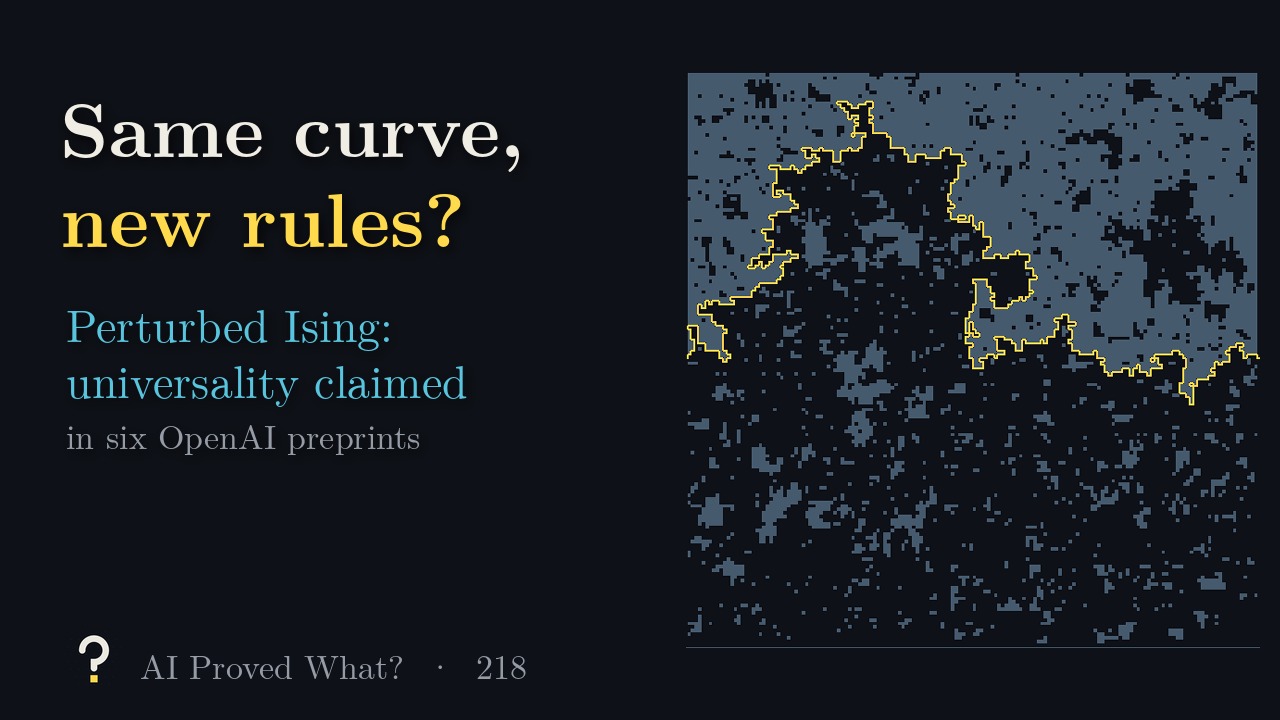
The Ising model puts a spin, up or down, on every square of a grid, and neighbours prefer to agree. At one special temperature it is critical, and since work by Smirnov and collaborators between 2010 and 2015 its large-scale picture is known exactly: spin and energy correlations have explicit conformally covariant limits, and the boundary between plus and minus regions becomes a random fractal curve, SLE3. But all of that rests on exact solvability, which only special nearest-neighbour models have.
Physics expects universality: add a weak extra interaction, or make the bonds slightly random, and the critical point moves but the large-scale picture stays. Our exact transfer-matrix computation shows it: a weak diagonal coupling moves the critical temperature by up to 14%, yet the spin and energy scaling dimensions stay within about 0.2% of 1/8 and 1. Random bonds are subtler: in two dimensions they are marginal, so physicists predicted logarithmic corrections.
Result 218 bundles six OpenAI preprints, 329 pages, dated September 23 and October 5, 2026. For weak, even, finite-range, square-symmetric extra interactions, they claim the critical bulk spin and energy correlations converge to the exact nearest-neighbour limits, up to two unknown constants, and that the plus–minus interface converges to SLE3. For weak independent random bonds of any bounded, mean-zero law, they claim the critical interface converges to the same SLE3, in probability over the environment. A sixth paper, conditional on the bulk paper’s estimates, recovers the predicted log correction for fair plus–minus bonds: E[C²]/E[C]² grows like (log r)1/4.
What it doesn’t claim
Any explicit size for the allowed perturbations; other lattices; strong disorder; correlation limits for random bonds. The correlation paper and the interface paper each construct their own critical temperature, and they are not shown to be the same. Energy correlations alone were proved earlier, by Giuliani, Greenblatt and others.
Where it stands
- Posted as preprints
- OpenAI, six papers, 329 pages, dated September 23 and October 5, 2026
- Peer reviewed
- Not yet
- Checked in Lean
- One supporting inequality only (docs)
Last checked October 19, 2026. None of the six preprints has been revised since they were added to the repository in its initial commit on October 6, 2026. Only one supporting inequality from the toolkit paper is formalized in Lean: about 3,000 lines with no unproved steps; none of the universality, interface or random-bond theorems is. We checked that 81 of 82 cross-citations between the papers point to statements that exist; the miss is a subsection title that doesn’t match. None is among those OSVerify reviewed, and we found no expert reaction; we found no earlier claim beyond the energy-only results.
How the proof goes
- A renormalization group in spins. Zoom out, replace every small interaction by its average over the exact critical model given the boundary, and check that it shrinks. Square symmetry cancels one dangerous term, so leftovers shrink like the cube of the scale ratio, which beats the two powers lost by summing over a block.
- The critical point. Only the temperature direction grows; choosing the temperature on the stable manifold fixes the critical point. For curves, a four-arm exponent of 21/8, greater than two, keeps rare changes from bending the interface.
- Random bonds. The disorder’s variance is marginal: it shrinks only like one over the log of the scale, which is enough for the curve to converge. For fair two-valued bonds, duality pins the critical point exactly; two papers’ formulas agree to 12 digits in our check.
The numbers in the video
- Ours, exact transfer matrices up to circumference 14: critical β 0.4407 (pure), 0.3866 and 0.5144 (diagonal ±0.1), 0.4194 and 0.4650 (four-spin ±0.1), with ξ/L amplitudes within 0.2% of 4/π and 1/(2π).
- Ours: the formalized inequality held on 3,000 random graphs with no violations; critical β for ±ε bonds 0.4421 (ε = 0.1), 0.4537 (0.3), 0.4812 (0.5).
Read the source
- Buffered comparison and stopping-band resolution in critical Ising (PDF), 43 pages.
- Conformal universality of bulk Ising correlations under weak interactions (PDF), 53 pages.
- SLE3 universality for weak finite-range Ising interactions (PDF), 76 pages.
- Quenched SLE3 universality for the weak random-bond Ising model (PDF), 57 pages.
- Quenched SLE3 limits for general weak random-bond Ising models (PDF), 37 pages.
- Logarithmic relative fluctuations in the weakly disordered planar Ising model (PDF), 63 pages.
- The Lean formalization notes.
- The collection’s catalog, where this is result 218.
The 6 papers in this result
OpenAI groups related papers, such as alternative proofs, supporting results and consequences, into one result; we label the first paper it lists the main paper and the others companions.
- Quenched SLE₃ limits for general weak random-bond Ising models main paper
- Quenched SLE₃ Universality for the Weak Random-Bond Ising Model companion
- Logarithmic Relative Fluctuations in the Weakly Disordered Planar Ising Model companion
- Conformal universality of bulk Ising correlations under weak interactions companion
- SLE3 universality for weak finite-range Ising interactions companion
- Buffered comparison and stopping-band resolution in critical Ising companion
Transcript
Read the full script
0:00The question
The Ising model puts a spin, up or down, on every square of a grid, and neighbours prefer to agree. At one special temperature, it is critical, and since work by Smirnov and collaborators between 2010 and 2015 we know its large-scale picture exactly: spin and energy correlations have explicit conformally covariant limits, and the boundary between plus and minus regions becomes a random fractal curve, SLE₃. But all of that rests on exact solvability, which only special nearest-neighbour models have. Physics expects universality: change the details, add a weak extra interaction, or make the bonds slightly random, and the critical point moves, but the large-scale picture stays the same. Our exact transfer-matrix computation shows both effects. A weak diagonal coupling moves the critical temperature by up to 14%, yet the measured scaling dimensions, one eighth for the spin and one for the energy, stay within about 0.2%. Random bonds are subtler: in two dimensions they are marginal, so physicists predicted logarithmic corrections.
1:09The claim
Result 218 bundles six OpenAI preprints, 329 pages, dated September 23 and October 5, 2026. For weak, even, finite-range, square-symmetric extra interactions, they claim the critical bulk spin and energy correlations converge to the exact nearest-neighbour limits, up to two unknown constants; and that the plus-minus interface converges to SLE₃. For weak independent random bonds of any bounded, mean-zero law, they claim the critical interface converges to the same SLE₃, in probability over the environment. A sixth paper, conditional on the bulk paper’s estimates, recovers the predicted log correction: for fair plus-minus bonds, the mean square of the spin correlation, divided by its squared mean, grows like (log r)^(1/4). Not claimed: any explicit size for the allowed perturbations; other lattices; strong disorder. The correlation paper and the interface paper each construct their own critical temperature, and they are not shown to be the same.
2:15How the proof goes
The engine is a renormalization group written in the spins themselves, a different route from the earlier fermion methods. Zoom out by a factor, replace every small interaction by its average over the exact critical model, conditioned on the boundary, and check that it shrinks. Square symmetry cancels one dangerous term, so leftovers shrink like the cube of the scale ratio, which beats the two powers lost by summing over a block. Only the temperature direction grows, and choosing the temperature on the stable manifold fixes the critical point. For curves, a four-arm exponent of 21/8, greater than two, keeps rare changes from bending the interface. With random bonds, the disorder’s variance is marginal: it shrinks only like one over the log of the scale, slowly, but enough for the curve to converge. For fair two-valued bonds, duality pins the critical point exactly, and our check shows two papers’ formulas agree to 12 digits. One small inequality, from the toolkit paper, is formalized in Lean; we also tested it on 3,000 random graphs, with no violations.
3:22Where it stands
All six preprints are unrefereed and have not been revised. Only that toolkit inequality is formalized in Lean: about 3,000 lines, with no unproved steps; none of the universality, interface or random-bond theorems is. We checked that 81 of 82 cross-citations between the papers point to statements that exist; the miss is a subsection title that doesn’t match. None is among those OSVerify reviewed, and we found no expert reaction. Energy correlations alone were proved earlier, by Giuliani, Greenblatt and others; we found no earlier claim of the rest. If they hold, the critical Ising picture survives weak tinkering and weak randomness: the same fractal interface in both cases, and, without randomness, the same correlations up to constants, just as physics expected.
Spot a mistake?
This episode simplifies on purpose, but it shouldn’t be wrong. If something is, open an issue on GitHub or leave a comment on YouTube. Corrections are noted here with a date.