Percolation on the square grid?
Six preprints claim SLE and CLE limits for random-cluster interfaces, and Cardy’s formula for square-lattice bond percolation
Covers result 223 in OpenAI’s catalog: all 6 papers. See its connections to other results and the work it cites.
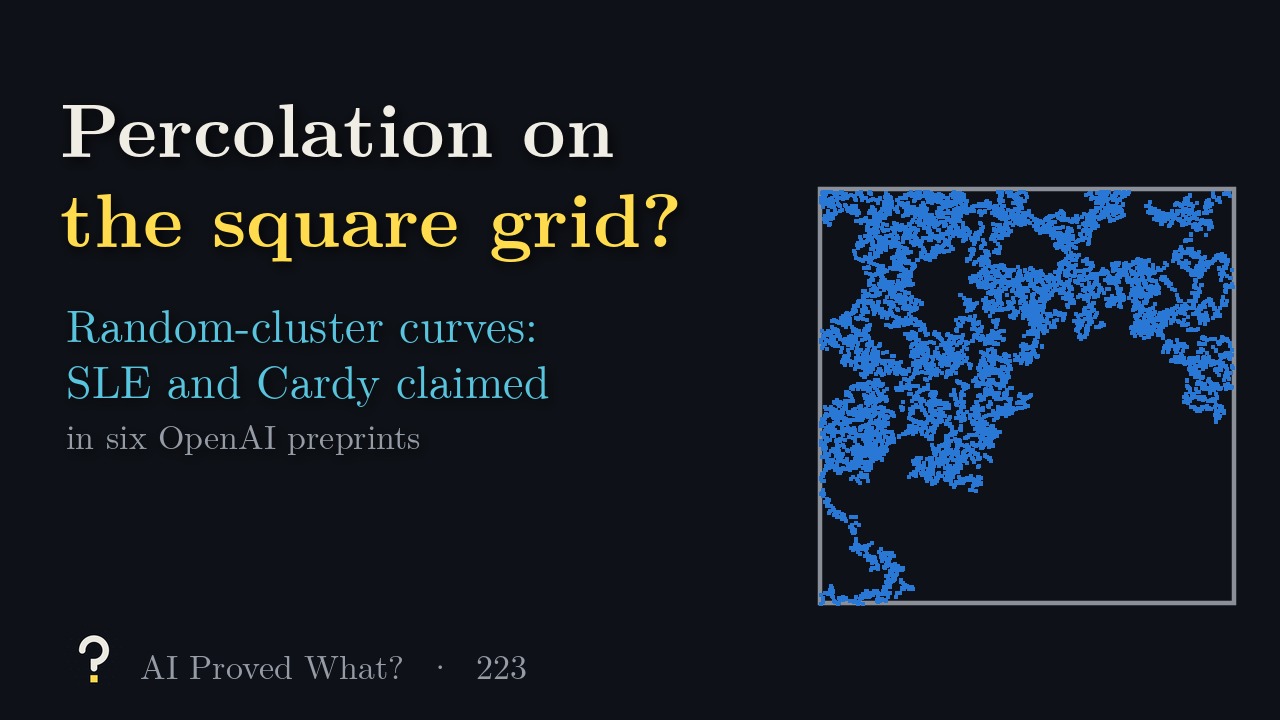
5:15. English captions available. The video loads from YouTube when you press play.
Chapters
The claim, in plain words
Keep each edge of the square grid with some probability, and reweight every configuration by q to the power of the number of clusters: the random-cluster model. q = 1 is ordinary bond percolation, q = 2 the cluster picture of the Ising magnet, and q = 3 and 4 Potts models. At the critical point, wire one side of a domain and leave the other free, and a single random curve separates the wired cluster from the rest.
Schramm showed that a limit which is conformally invariant and Markov must be an SLE curve, and Rohde and Schramm predicted κ = 4π/arccos(−√q/2) for q below four: 6 for percolation, 16/3 for Ising. It was proved at q = 2 and in the spanning-tree limit. Smirnov proved Cardy’s crossing formula in 2001, but only for sites on the triangular lattice; bonds on the square grid stayed open.
Result 223 bundles six OpenAI preprints, 602 pages, dated September 23 and October 5, 2026. The main paper claims, for every q from 1 to 4, that these interfaces converge to SLEκ in every bounded Jordan domain, and that all nested loops in the plane converge to the conformal loop ensemble; at q = 1 it states Cardy’s formula for bond percolation on the square grid, every edge open with probability one half. A September version of the same paper covers q from 1 up to 4; another paper covers q between 0 and 1, in smooth domains only. Three more treat Ising with weakly random bonds, Ising slightly off the critical point, and, in the unit square, the number of steps along the curve, which, rescaled, converges to its natural length.
What it doesn’t claim
Anything for q above 4, uniformity in q, loop ensembles below one, or rates of convergence. At q = 4 the proof switches to level lines of the Gaussian free field and rests on a March 2026 preprint by Duminil-Copin, Kozlowski, Lammers and Manolescu.
Bond percolation has a history
Tsai, Yam and Zhou posted a preliminary claim in 2011, and Zhou again in 2024, under extra conditions on the domain’s boundary. The September version credits both as overlapping claims; the October version drops that paragraph. Yu Zhang has a preprint claiming the opposite, that Cardy’s formula fails on the square lattice; no version cites it.
Where it stands
- Released as preprints
- OpenAI, six papers, 602 pages, dated September 23 and October 5, 2026
- Peer reviewed
- Not yet
- Checked in Lean
- Not formalized
Last checked October 19, 2026. None of the six preprints has changed since they were added to the repository in its initial commit on October 6, 2026. None is formalized in Lean; an unlinked folder in the repository proves one finite-graph theorem from the below-one paper (we did not build it). None is among those OSVerify reviewed, and we found no expert reaction.
How the proof goes
- An observable. Turn clusters into loops, each weighted by √q, and build a complex observable with four boundary changes whose boundary values can be computed exactly.
- Holomorphicity. The central difficulty, for q ≠ 2, is proving that its limit is holomorphic; as Riva and Cardy stressed, local identities do not supply the regularity this needs. The papers use six-vertex transfer operators, a spectral factorization of angular modes, and an estimate across a wall between two reflected copies of the field.
- Curves and loops. Squeeze any domain between easier and harder polygons on the same lattice (at q = 1 this is Cardy’s formula); the crossing probability is a martingale under exploration, and two tests identify the driving function as √κ times Brownian motion. Loops follow by peeling the plane with a tree of explorations.
The numbers in the video
- Ours: in a 3-by-3 box at the critical point, all edges open and all closed are equally likely for every q. Interface lengths in boxes up to 512 grow with exponents 1.753, 1.653 and 1.599 for q = 1, 2, 3, near 7/4, 5/3 and 8/5; q = 4 has not settled.
- Ours: bond-percolation crossings of a 2-by-1 rectangle the long way, 0.172 ± 0.010, against Cardy’s 0.17565. Checks like these go back decades and prove nothing.
Read the source
- Conformal Limits of Critical Square-Lattice Random-Cluster Interfaces (PDF), 127 pages.
- Square-lattice FK interfaces and nested loops for 1 ≤ q < 4 (PDF), 110 pages.
- Self-dual random-cluster interfaces below one (PDF), 207 pages.
- Quenched SLE Universality for Weakly Disordered FK–Ising Interfaces (PDF), 49 pages.
- Thermal FK–Ising interfaces and massive SLE (PDF), 50 pages.
- Natural Occupation Measures for Critical Square-Lattice FK Interfaces (PDF), 59 pages.
- The collection’s catalog, where this is result 223.
The 6 papers in this result
OpenAI groups related papers, such as alternative proofs, supporting results and consequences, into one result; we label the first paper it lists the main paper and the others companions.
- Square-lattice FK interfaces and nested loops for 1 <= q < 4 main paper
- Self-dual random-cluster interfaces below one companion
- Quenched SLE Universality for Weakly Disordered FK–Ising Interfaces companion
- Thermal FK–Ising interfaces and massive SLE companion
- Natural Occupation Measures for Critical Square-Lattice FK Interfaces companion
- Conformal Limits of Critical Square-Lattice Random-Cluster Interfaces companion
Transcript
Read the full script
0:00The question
Take the square grid, keep each edge with some probability, and reweight every configuration by q to the power of the number of clusters. This is the random-cluster model. q equal to one is ordinary bond percolation; q equal to two is the cluster picture of the Ising magnet; three and four are Potts models. At the critical point, wire one side of a domain and leave the other free, and a single random curve separates the wired cluster from the rest. In a 3-by-3 box at that point, all edges open and all edges closed are exactly equally likely, for every q: self-duality at work. As the mesh shrinks, what does the curve become? Schramm showed that a limit which is conformally invariant and Markov must be an SLE curve, and Rohde and Schramm predicted κ = 4π / arccos(−√q/2): six for percolation, 16/3 for Ising, tending to four as q reaches four. It was proved at q equal to two, by Smirnov and others, and in the spanning-tree limit. For percolation, Smirnov proved Cardy’s crossing formula in 2001, but only for sites on the triangular lattice. Bonds on the ordinary square grid stayed open.
1:17The claim
Result 223 bundles six OpenAI preprints, 602 pages, dated September 23 and October 5, 2026. The main paper claims, for every q from one to four, that these interfaces converge to SLE_κ in every bounded Jordan domain, and that all the nested loops in the plane converge to the conformal loop ensemble. At q equal to one, it states Cardy’s formula for bond percolation on the square grid, with every edge open with probability one half. A September version of the same paper covers q from one up to four, not including four; another paper covers q between zero and one, in smooth domains only. Three more papers treat the Ising case with weakly random bonds, the Ising case slightly off the critical point, and, in the unit square for q from one to below four, the number of steps along the curve, which, rescaled, converges to its natural length. Not claimed: anything above four, uniformity in q, loops below one, or rates. At q equal to four the proof switches to level lines of the Gaussian free field, and rests on a March 2026 preprint by Duminil-Copin and coauthors. Bond percolation has a history. Tsai, Yam and Zhou posted a preliminary claim in 2011, and Zhou again in 2024, under extra conditions on the domain’s boundary. The September version credits both as overlapping claims; the October version drops that paragraph. And Yu Zhang has a preprint claiming the opposite, that Cardy’s formula fails on the square lattice. No version cites it.
2:58How the proof goes
The proof turns clusters into loops, each loop weighted by √q, and builds a complex observable with four boundary changes, whose boundary values can be computed exactly. The central difficulty, for q other than two, is proving that its limit is holomorphic; as Riva and Cardy stressed, local identities do not supply the regularity this needs. The papers attack it with six-vertex transfer operators, a spectral factorization of angular modes, and an estimate across a wall between two reflected copies of the field. With that, Cardy’s formula comes out by squeezing any domain between easier and harder polygons on the same lattice; at q equal to one it is a special case of the general four-change formula. The formula survives exploration, so the crossing probability is a martingale, and two tests identify the driving function as √κ times Brownian motion. The loops follow by peeling the plane with a tree of explorations. As an illustration, our computer sampled critical interfaces in boxes up to 512 wide. Their length grows like the box size to the power 1.75, 1.65, and 1.6 for q equal to one, two and three, close to the SLE dimensions 7/4, 5/3 and 8/5; at q equal to four it has not settled. Bond-percolation crossings of a 2-by-1 rectangle, the long way, came out at 0.172, near Cardy’s 0.176. Checks like these go back decades, and prove nothing.
4:36Where it stands
All six preprints are unrefereed, and none has changed since release. None is formalized in Lean; an unlinked folder proves one finite-graph theorem from the below-one paper. None is among those OSVerify reviewed, and we found no expert reaction. If they hold, the square grid joins the triangular one: the same random curves, and for percolation the same crossing formula, with the Rohde and Schramm prediction settled for q from one up to four, extended to four itself, and below one only in smooth domains.
Spot a mistake?
This episode simplifies on purpose, but it shouldn’t be wrong. If something is, open an issue on GitHub or leave a comment on YouTube. Corrections are noted here with a date.