Cardy without a lattice?
Three preprints claim Cardy’s formula and near-critical universality for Voronoi percolation
Covers result 224 in OpenAI’s catalog: all 3 papers. See its connections to other results and the work it cites.
4:54. English captions available. The video loads from YouTube when you press play.
Chapters
The claim, in plain words
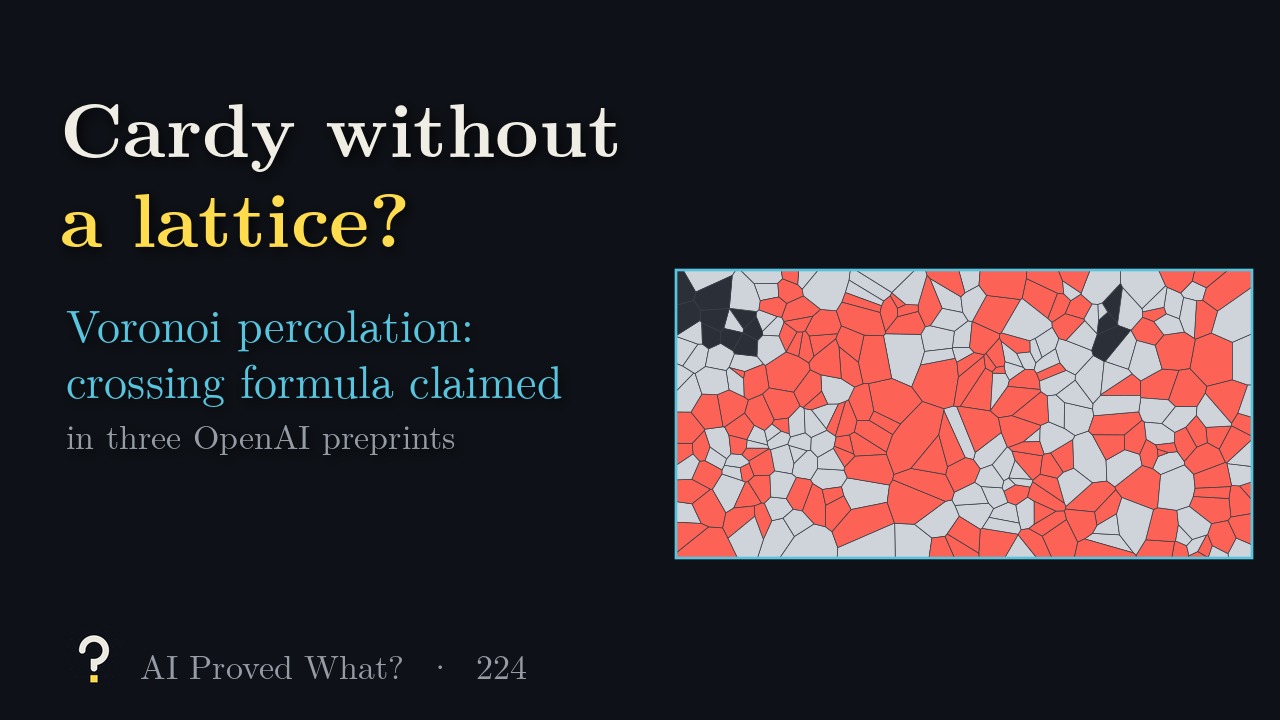
Scatter random points in the plane, give each point the region closer to it than to any other point, its Voronoi cell, and paint every cell black or white with a fair coin. This is Voronoi percolation: there is no lattice, the geometry itself is random, and fair coins are exactly critical (Bollobás and Riordan). Cardy predicted the chance that black cells connect two opposite arcs of a domain: a formula depending only on the domain’s conformal shape, 0.176 for a 2-by-1 rectangle crossed the long way. Smirnov proved it in 2001 for sites on the triangular lattice. In 2006 Schramm listed Voronoi percolation as an open problem, right after the square-grid bond case of episode 223.
Result 224 bundles three OpenAI preprints, 179 pages, dated September 23 and October 5, 2026. The first claims Cardy’s formula for Voronoi percolation in every bounded Jordan domain, for the annealed crossing probability, averaged over both the random points and the coin flips; for a fixed rectangle it adds a quenched version, for a typical frozen tessellation with only the coins random. The other two take that as a hypothesis. The second shifts the coin’s bias on the scale set by the expected number of pivotal cells and claims, with each model normalized by its own count, that the joint law of crossing thresholds for polygonal domains with rational corners is the triangular lattice’s, for a typical frozen tessellation. The third claims the expected pivotal count for a unit square grows like a constant times the mesh to the power −3/4.
What it doesn’t claim
The full law of the interface, a quenched crossing limit in arbitrary domains, rates of convergence, the value of the pivotal constant, or other tessellations. The second and third papers are conditional on the first.
Where it stands
- Released as preprints
- OpenAI, three papers, 179 pages, dated September 23 and October 5, 2026
- Peer reviewed
- Not yet
- Checked in Lean
- Not formalized
Last checked October 19, 2026. None of the three preprints has changed since they were added to the repository in its initial commit on October 6, 2026; the second depends on the first, and the third on both. None is formalized in Lean; an unlinked file defines the objects and proves that two textbook forms of Cardy’s formula agree (we did not build it). We found no earlier or competing claim and no expert reaction, and none is among those OSVerify reviewed.
How the proof goes
- An exact identity. On any triangulation with fair-coin colors, cut along each color boundary in turn and label the pieces by it. With ω a cube root of unity, certain three-spoke sums over different triangles are exactly orthogonal, each with squared norm 3/4: the chance that a triangle’s three corners are not all one color.
- Distortion. Each Delaunay triangle is a distorted equilateral one; split each side into a conformal part and a distortion part. Around a closed color boundary the total displacement sums to zero and the distortion part is small on average. The hard part, about 40 pages, carries this to open pieces of random boundaries: in the limit the distortion sum is a fixed multiple a of the total, with a never identified.
- The limit. The paper proves only that 1 − 2 Re a > 0, which is enough for a to drop out of the limiting Cauchy–Riemann equation. The limiting observable is the conformal map onto an equilateral triangle: Carleson’s form of Cardy’s formula.
The numbers in the video
- Ours: 8,000 critical Voronoi samples per shape and size, and as many on the triangular lattice. 2-by-1 rectangle, about 128 cells high: 0.180 ± 0.004 against Cardy’s 0.176; another run of ours came out a little higher, so the agreement is rough.
- Ours: with the tessellation frozen, the spread between tessellations was about a hundredth or less, within our noise. Voronoi has about 0.89 times the triangular lattice’s pivotal count, but normalized threshold curves coincide.
Read the source
- Cardy’s formula for critical Poisson–Voronoi percolation (PDF), 75 pages.
- From critical crossings to quenched near-critical universality in Voronoi percolation (PDF), 61 pages.
- A Pivotal Amplitude for Voronoi Percolation from Cardy’s Formula (PDF), 43 pages.
- The collection’s catalog, where this is result 224.
The 3 papers in this result
OpenAI groups related papers, such as alternative proofs, supporting results and consequences, into one result; we label the first paper it lists the main paper and the others companions.
Transcript
Read the full script
0:00The question
Scatter random points in the plane, give each point the region closer to it than to any other point, its Voronoi cell, and paint every cell black or white with a fair coin. This is Voronoi percolation. Unlike a lattice, the geometry itself is random, with no preferred direction. Fair coins are exactly critical: Bollobás and Riordan showed that one half is the threshold. Now draw a domain, mark four points on its boundary, and ask how likely black cells connect two opposite arcs. Cardy predicted the answer for fine meshes: a formula that depends only on the conformal shape of the domain. For a 2-by-1 rectangle crossed the long way, it gives 0.176. Smirnov proved it in 2001 for site percolation on the triangular lattice. In 2006, Schramm listed Voronoi percolation as an open problem, right after the square-grid bond case from episode 223.
0:58The claim
Result 224 bundles three OpenAI preprints, 179 pages, dated September 23 and October 5, 2026. The first claims Cardy’s formula for Voronoi percolation in every bounded Jordan domain, for the annealed crossing probability: averaged over both the random points and the coin flips. For a fixed rectangle it adds a quenched version, for a typical frozen tessellation with only the coins random. It does not claim the full law of the interface. The other two papers take that result as a hypothesis. The second looks just off the critical point, shifting the coin’s bias on the scale set by the expected number of pivotal cells, the cells whose flip changes the crossing. With each model normalized by its own pivotal count, it claims that the joint law of crossing thresholds for polygonal domains with rational corners is the same as on the triangular lattice, for a typical frozen tessellation; along the way it derives, conditionally, that on a typical frozen tessellation exploration paths converge to SLE6. The third claims that the expected pivotal count for a unit square grows like a constant times mesh^(−3/4).
2:17How the proof goes
The first paper starts from an exact identity. On any triangulation with fair-coin colors, cut along each color boundary in turn and label the pieces by that boundary. With ω a cube root of unity, certain three-spoke sums over different triangles are exactly orthogonal, each with squared norm 3/4: the chance that a triangle’s three corners are not all one color. Next, each Delaunay triangle is a distorted equilateral one, and the paper splits each side into a conformal part and a distortion part. Around a closed color boundary the total displacement sums to zero, and the distortion part is small on average. The hard part, about 40 pages, carries this over to open pieces of random boundaries: in the limit, the distortion sum is a fixed multiple a of the total, with a never identified. The paper proves only that one minus twice its real part is positive, which is enough for a to drop out of the limiting Cauchy–Riemann equation. The limiting observable is the conformal map onto an equilateral triangle: Carleson’s form of Cardy’s formula. As an illustration, our computer sampled 8,000 critical Voronoi configurations for each shape and size, and as many on the triangular lattice. For the 2-by-1 rectangle, about 128 cells high and twice that long, Voronoi crossings came out at 0.18 ± 0.004, close to Cardy’s 0.176; another run of ours came out a little higher, so the agreement is rough. With the tessellation frozen, the spread between tessellations was about a hundredth or less, within our noise. Near criticality, Voronoi had about 9/10 as many pivotal cells as the triangular lattice, but once each model is normalized by its own count, the threshold curves lie on top of each other.
4:14Where it stands
All three preprints are unrefereed and unchanged since release, the second depends on the first, and the third on both. None is formalized in Lean; an unlinked file defines the objects and proves that two textbook forms of Cardy’s formula agree. We found no earlier or competing claim and no expert reaction, and none is among those OSVerify reviewed. If they hold, Voronoi percolation, with no lattice at all, has Cardy’s crossing formula, averaged over its random geometry, and the triangular lattice’s near-critical thresholds for a typical frozen tessellation.
Spot a mistake?
This episode simplifies on purpose, but it shouldn’t be wrong. If something is, open an issue on GitHub or leave a comment on YouTube. Corrections are noted here with a date.