How fast does a spin glass mix?
Eight preprints claim how Glauber dynamics of the Sherrington–Kirkpatrick model mixes below, at and above its transition
Covers result 227 in OpenAI’s catalog: all 8 papers. See its connections to other results and the work it cites.
5:07. English captions available. The video loads from YouTube when you press play.
Chapters
The claim, in plain words
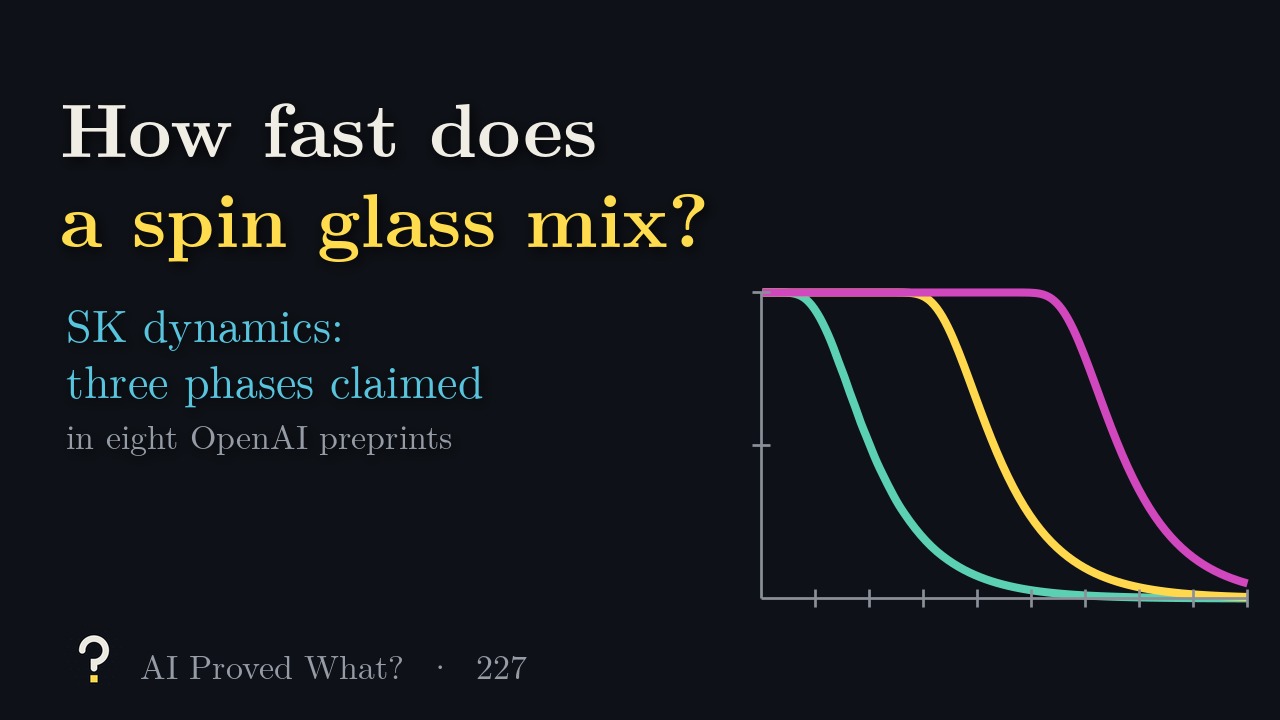
The Sherrington–Kirkpatrick model has n spins, each pair coupled at random with a strength set by the inverse temperature β; at β = 1 it has a phase transition. Under Glauber (heat-bath) dynamics, each spin carries a clock and, when it rings, is redrawn from its conditional law given the others. How long until the chain forgets where it started? Human proofs of fast mixing reached only a little past β = 1/2, and fast mixing all the way to β = 1 was a listed open problem, posed for arbitrary external fields. For independent spins our exact computation shows a cutoff: the distance to equilibrium falls off a cliff at ½ log n, and from 100 spins to a million the cliff keeps a width of about 1.28.
Result 227 is eight OpenAI preprints, 720 pages, dated September 24 to October 5, 2026, all at zero external field and in probability over the couplings. Below β = 1: a spectral gap bounded away from zero, and cutoff from the worst start at log n/(2λ), with λ defined only implicitly. At β = 1: mixing, relaxation and log-Sobolev times all of order n2/3, up to factors no(1). Above 1, from a typical equilibrium state held fixed: mixing slower than exp(n1/10000) but no slower than exp(n1−1/40,000,000). At β = 1 the rescaled correlation n1/3C(n2/3s) converges to a random function, random through the couplings, with the same law for Gaussian and ±1 couplings; after a quench from random spins it converges too, approaching the stationary one as the waiting time grows.
What it doesn’t claim
An external field, a value for λ, cutoff at β = 1, or exponential slowness above 1. The low-temperature upper bound relies on a July 2026 human preprint by Lopatto.
Where it stands
- Posted as preprints
- OpenAI, eight papers, 720 pages, dated September 24 to October 5, 2026
- Peer reviewed
- Not yet
- Checked in Lean
- In part (docs)
Last checked October 19, 2026. None of the eight preprints has been revised since release. In Lean, four of the eight papers are covered by five comparators with no unproved steps (we did not build them): the gap below 1, cutoff only as a ratio below 1/2, the critical lower bounds, and the barriers. Not formalized: the critical upper bound, the low-temperature upper bound, and both correlation papers. Three October human preprints cite the gap, cutoff or critical papers as concurrent work; none checks them. None is among those OSVerify reviewed.
How the proof goes
- The gap. Stochastic localization watches a sample through ever less noisy observations. Along the way the laws become spin glasses with random external fields; the paper controls each through a unique solution of the TAP equations, proves a gap at the end once most spins are nearly frozen, and carries it back.
- Cutoff. A heuristic familiar from Lubetzky and Sly: the slowest visible mode decays like e−λt, and the chain mixes once that signal, summed over n spins, drops below their √n noise.
- At β = 1. By symmetry the magnetization along the top eigenvector, of size n1/3, must change sign, and it diffuses on a time scale n2/3; the core idea of the lower bound is short, while the matching upper bound takes 190 pages.
- Above 1. Barriers in the overlap with reference states make crossings rare, while, for the upper bound, a constructed proposal shows every balanced cut still carries enough flow.
The numbers in the video
- Ours, exact: three spins (the slowest mode decays at rate 0.37); independent spins from 10 to a million (cliff widths 1.21, then 1.28).
- Ours, Monte Carlo up to 400 spins, 16 disorders per size: at β = 1 rescaled correlation curves roughly collapse, but disorders differ by about 30% at every size, much of it beyond run-to-run noise; at β = 1/2 the spread shrinks from 24% to 5%. The top-eigenvector magnetization variance grows like n0.62 (2/3 predicted). An illustration, not evidence for the theorems.
Read the source
- A spectral gap throughout the high-temperature Sherrington–Kirkpatrick phase (PDF), 66 pages.
- Cutoff throughout the high-temperature Sherrington–Kirkpatrick phase (PDF), 158 pages.
- Critical slowing down in the Sherrington–Kirkpatrick model (PDF), 39 pages.
- Critical mixing in the Sherrington–Kirkpatrick model (PDF), 190 pages.
- Stretched-exponential barriers for typical SK initial states (PDF), 63 pages.
- A typical-start upper bound for low-temperature SK Glauber dynamics (PDF), 22 pages.
- Functional universality of critical SK autocorrelations (PDF), 70 pages.
- Universality of critical quench autocorrelations in the Sherrington–Kirkpatrick model (PDF), 112 pages.
- The Lean formalization notes.
- The collection’s catalog, where this is result 227.
The 8 papers in this result
OpenAI groups related papers, such as alternative proofs, supporting results and consequences, into one result; we label the first paper it lists the main paper and the others companions.
- Universality of critical quench autocorrelations in the Sherrington–Kirkpatrick model main paper
- Functional universality of critical SK autocorrelations companion
- A spectral gap throughout the high-temperature Sherrington–Kirkpatrick phase companion
- Cutoff throughout the high-temperature Sherrington–Kirkpatrick phase companion
- Critical slowing down in the Sherrington–Kirkpatrick model companion
- Stretched-exponential barriers for typical SK initial states companion
- A typical-start upper bound for low-temperature SK Glauber dynamics companion
- Critical mixing in the Sherrington–Kirkpatrick model companion
Transcript
Read the full script
0:00The question
Take n magnets, each pointing up or down, and connect every pair by a random coupling, with strength set by an inverse temperature, β. This is the Sherrington–Kirkpatrick spin glass, and at β = 1 it has a phase transition: at high temperature it behaves like a simple paramagnet, at low temperature like a glass with many frozen states. Now let it move: each spin carries a clock, and when it rings, the spin is redrawn from its conditional law given the others. This is Glauber, or heat-bath, dynamics. How long until the chain forgets where it started? Before this release, human proofs of fast mixing reached only a little past β = 1/2, and fast mixing all the way to one was a listed open problem, though posed for arbitrary external fields. For three spins our computer computes everything exactly: the slowest mode decays at rate 0.37. For independent spins, the distance to equilibrium falls off a cliff at ½ log n, and from 100 spins to a million the cliff keeps the same width. That is cutoff.
1:08The claim
Result 227 bundles eight OpenAI preprints, 720 pages, dated September 24 to October 5, 2026, all at zero external field. They claim a three-phase picture. For every β below 1: a spectral gap bounded away from zero, and cutoff from the worst start at log n / (2λ), with λ defined implicitly. At β = 1: mixing, relaxation and log-Sobolev times all of order n^(2/3), up to smaller factors. Above one, from a typical equilibrium state held fixed as the start: mixing takes longer than exp(n^(1/10000)), but no longer than exp(n^(1−1/40,000,000)). At β = 1, two more papers claim that the time correlation, rescaled by n^(1/3) over times of order n^(2/3), converges to a random function, random through the couplings, with the same law for Gaussian and plus-or-minus-one couplings; after a quench from random spins, the correlation also converges, and approaches the stationary one as the waiting time grows. Not claimed: an external field, a value for λ, cutoff at β = 1, or exponential slowness above one. The low-temperature upper bound relies on a July 2026 human preprint.
2:33How the proof goes
The spectral-gap proof watches a sample through ever less noisy observations, a technique called stochastic localization. Along the way the laws become spin glasses with random external fields; the paper controls each through a unique solution of the TAP equations, proves a gap at the end, once most spins are nearly frozen, and carries it back. Cutoff matches a heuristic familiar from Lubetzky and Sly: the slowest visible mode decays like e^(−λt), and the chain mixes once that signal, summed over n spins, drops below their √n noise. At β = 1, the core idea of the lower bound is short. By symmetry, the chain must flip the sign of the magnetization along the couplings’ top eigenvector, whose typical size is n^(1/3), and diffusion covers that distance only in time n^(2/3). The matching upper bound takes 190 pages. Above one, barriers in the overlap with reference states make crossings slow, while, for the upper bound, a constructed proposal shows that every balanced cut still carries enough flow. As an illustration, our computer ran the dynamics for up to 400 spins. At β = 1, rescaled correlation curves for 50 to 400 spins roughly collapse, yet different disorders differ by about 30% at every size, much of it beyond run-to-run noise, while at β = 1/2 the disagreement shrinks from 24% to 5%: the randomness of the limit, made visible. The variance of the top-eigenvector magnetization grew like n^0.62, against 2/3.
4:16Where it stands
All eight preprints are unrefereed and unchanged since release. Lean covers four of them through five comparators, with no unproved steps: the gap below one, cutoff only as a ratio below one half, the critical lower bounds, and the barriers. The critical upper bound, the low-temperature upper bound and both correlation papers are not formalized, and we did not build any of it. Three October human preprints cite the gap, cutoff or critical papers as concurrent work; none checks them, and none is among those OSVerify reviewed. If they hold, Glauber dynamics for the zero-field SK model has a three-phase map: fast, with a sharp cutoff, below the transition; slow, by n^(2/3), at it; and glassy above.
Spot a mistake?
This episode simplifies on purpose, but it shouldn’t be wrong. If something is, open an issue on GitHub or leave a comment on YouTube. Corrections are noted here with a date.