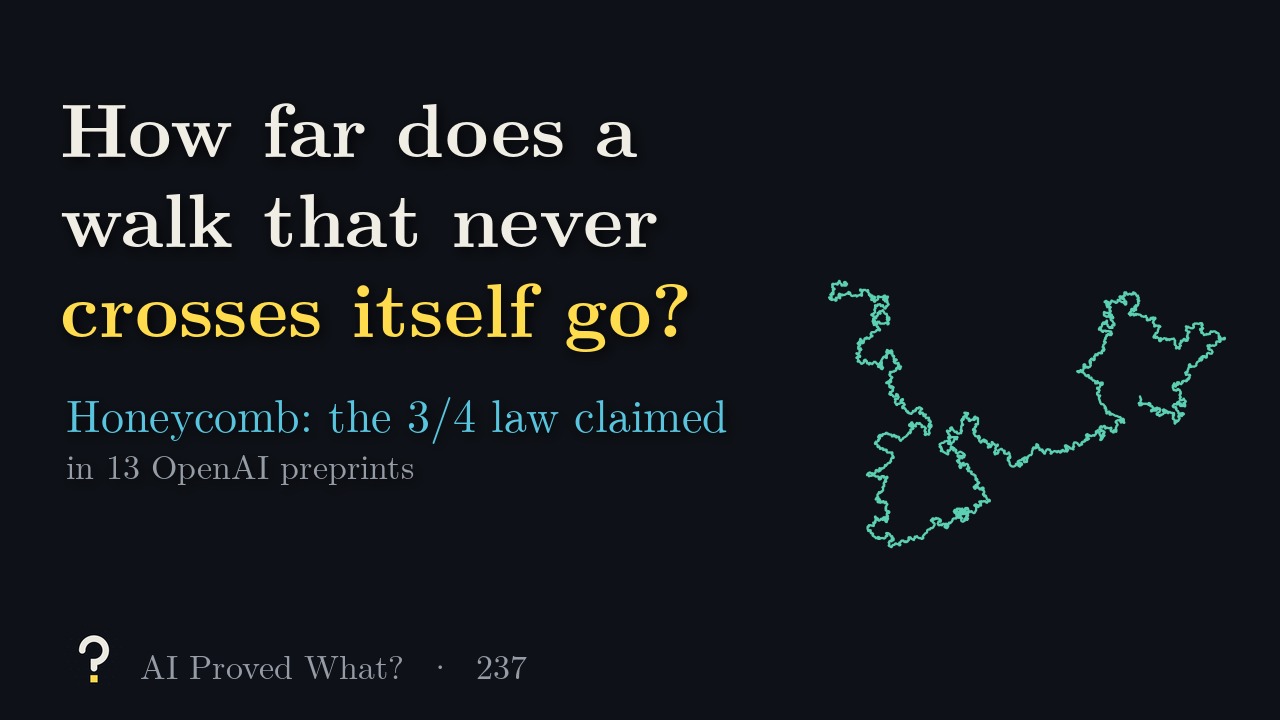
How far does a walk that never crosses itself go?
Thirteen preprints claim the three-quarter law for self-avoiding walk on the honeycomb lattice
Covers result 237 in OpenAI’s catalog: all 13 papers. See its connections to other results and the work it cites.
4:34. English captions available. The video loads from YouTube when you press play.
Chapters
The claim, in plain words
A self-avoiding walk is a path on a lattice that never visits the same point twice, a simple model of a polymer chain. On the honeycomb lattice every vertex has three neighbours; from one vertex there are 90 walks of six steps (96 paths that never step straight back, minus the 6 that close a hexagon). Pick an n-step walk uniformly at random: how far does it spread? A random walk spreads like n1/2, a straight line like n. Flory guessed in 1949, and Nienhuis derived in 1982, that planar self-avoiding walks spread like n3/4; numerical work confirms it to many digits. Rigorously almost nothing was known: on the honeycomb the best bound, by Krachun and Panagiotis in 2023, was a constant times n/log n. Duminil-Copin and Smirnov proved in 2012 that each extra step multiplies the number of walks by √(2+√2) ≈ 1.85.
Result 237 is thirteen OpenAI preprints, 1,067 pages, dated September 26, 2026. The headline paper claims that a uniformly chosen n-step self-avoiding walk on the honeycomb lattice has diameter between n3/4−δ and n3/4+δ, except with probability smaller than any fixed power of n, at every large length; around every point of the walk a ball of radius s holds about s4/3 of it. If correct, these are the first rigorous three-quarter laws for self-avoiding walk on a planar lattice that we could find.
What it doesn’t claim
The classical end-to-end form at every length (a large diameter does not force the endpoints apart; a sibling paper gets that form only on a set of lengths of density one), a scaling limit or convergence to SLE8/3, anything on the square lattice, or limiting constants.
Where it stands
- Posted as preprints
- OpenAI, 13 papers, 1,067 pages, dated September 26, 2026
- Peer reviewed
- Not yet (OSVerify reviewed three of the papers)
- Checked in Lean
- In part: supporting facts (docs)
Last checked October 19, 2026. The papers were posted on October 6 and have not been revised. OSVerify reviewed three of them: one major issue, a kernel bound in the cylinder nesting paper (which the headline relies on), with a proposed repair it says keeps the rest of the argument intact, and two minor issues in other papers. In Lean, four comparators check supporting facts, including the h−1/4 strip law: about 135,000 lines with no unproved steps (we did not build them). The three-quarter theorem itself is not formalized. We found no public reaction.
How the proof goes
- Exact inputs. Three companion papers use Duminil-Copin and Smirnov’s boundary identity, together with integrable loop-model weights from work by Glazman, Manolescu and others. They show that the critical weight of walks crossing a strip of height h decays like h−1/4 up to constants; earlier bounds only pinned it between 1/h and 100·h−10−10. They also get a planar nesting exponent of 1/12 from loops on a cylinder, and a bound on polygon sizes.
- All lengths mixed. In the ensemble that weights a walk of length ℓ by 0.5412ℓ, the headline paper shows that bridges of height h have length about h4/3. It also shows that any piece of a walk that is too fast or too slow for its size is rarer than any power of the box size.
- One length. The number of n-step walks times 0.5412n is at least 1. That inequality transfers every estimate to one fixed length, with no averaging.
The numbers in the video
- Ours: every honeycomb self-avoiding walk up to 28 steps, 229,483,600 in all; c28 = 106,794,084, matching the published table (OEIS A001668). The product cn·0.5412n goes from 1.62 at one step to 3.65 at 28 and is always above 1.
- Ours: a pivot-algorithm sampler up to 10,000 steps, 1,000 samples per length. The mean diameter has log-log slope 0.751 (95 percent interval 0.747 to 0.755). This is numerical evidence for a law no one doubted, not a test of the proof.
Read the source
- Mass and covering exponents for fixed-length honeycomb walks (PDF), 66 pages.
- Critical strip-crossing mass on the honeycomb lattice (PDF), 29 pages.
- Cylinder loop weights and planar nesting (PDF), 94 pages.
- Marked polygon correlations and one-arc bounds (PDF), 61 pages.
- Cap-selected amplitudes and triangle chords for honeycomb walks (PDF), 92 pages.
- Critical honeycomb chords with prescribed boundary endpoints (PDF), 44 pages.
- Cylinder amplitudes and logarithmic bridge-length windows on the honeycomb lattice (PDF), 96 pages.
- Disk transfer representations and confined bridge mass (PDF), 81 pages.
- Polynomial vacuum representations and bridge mass for honeycomb walks (PDF), 69 pages.
- Radial transfer estimates and polygon length laws for honeycomb walks (PDF), 100 pages.
- Renewal and changes of law for critical honeycomb walks (PDF), 98 pages.
- Signed cylinder propagation and marked polygons on the honeycomb lattice (PDF), 128 pages.
- Uniform marked-polygon estimates and sharp finite bridge moments (PDF), 109 pages.
- The Lean formalization notes.
- OSVerify’s case studies, three of which are papers in this result.
- The collection’s catalog, where this is result 237.
The 13 papers in this result
OpenAI groups related papers, such as alternative proofs, supporting results and consequences, into one result; we label the first paper it lists the main paper and the others companions.
- Radial transfer estimates and polygon length laws for honeycomb walks main paper
- Critical honeycomb chords with prescribed boundary endpoints companion
- Cylinder loop weights and planar nesting companion
- Mass and covering exponents for fixed-length honeycomb walks companion
- Signed cylinder propagation and marked polygons on the honeycomb lattice companion
- Cylinder amplitudes and logarithmic bridge-length windows on the honeycomb lattice companion
- Marked polygon correlations and one-arc bounds companion
- Disk transfer representations and confined bridge mass companion
- Polynomial vacuum representations and bridge mass for honeycomb walks companion
- Renewal and changes of law for critical honeycomb walks companion
- Critical strip-crossing mass on the honeycomb lattice companion
- Uniform marked-polygon estimates and sharp finite bridge moments companion
- Cap-selected amplitudes and triangle chords for honeycomb walks companion
Transcript
Read the full script
0:00The question
A self-avoiding walk is a path on a lattice that never visits the same point twice: a model for a polymer chain. On the honeycomb lattice each vertex has three neighbors. From one vertex there are 90 walks of 6 steps: 96 paths that never step straight back, minus the 6 that close a hexagon. Pick an n-step walk uniformly at random. How far does it spread? A random walk spreads like the square root of n; a straight line, like n. Flory guessed in 1949, and Nienhuis derived in 1982, that self-avoiding walks in the plane spread like n^(3/4). Numerical work confirms it to many digits. But rigorously, almost nothing was known: on the honeycomb lattice the best bound, by Krachun and Panagiotis in 2023, was spread at most a constant times n/log n. In 2012 Duminil-Copin and Smirnov proved the honeycomb growth rate: each extra step multiplies the number of walks by √(2+√2), about 1.85. Our computer counted every honeycomb walk up to 28 steps, about 230 million in all, matching the published table. Then a pivot algorithm sampled walks of up to 10,000 steps: the diameter grows with slope 0.75 on a log-log plot, the expected three quarters. That is numerical evidence for a law no one doubted; the question is a proof.
1:28The claim
Result 237 is 13 OpenAI preprints, about 1,000 pages, dated September 26, 2026. The headline paper claims that a uniformly chosen n-step self-avoiding walk on the honeycomb lattice has diameter between n^(3/4−δ) and n^(3/4+δ), except with probability smaller than any fixed power of n, at every large length. Around every point of the walk, a ball of radius s holds about s^(4/3) of it: the walk looks four-thirds dimensional across scales. Not claimed: the classical end-to-end form at every length, since a large diameter does not force the endpoints apart; a sibling paper gets that form only for almost all lengths. Also not claimed: a scaling limit, any result on the square lattice, or limiting constants. If correct, these are the first rigorous three-quarter laws for self-avoiding walk on a planar lattice that we could find.
2:28How the proof goes
The headline rests on three companion papers. Using Duminil-Copin and Smirnov’s exact boundary identity, together with integrable loop-model weights from work by Glazman, Manolescu and others, they compute the critical weight of walks crossing a strip of height h: it decays exactly like h^(−1/4), up to constants, where earlier bounds only pinned it between 1/h and a power that barely decays at all. They also work out loops on a cylinder, which gives a nesting exponent of 1/12 for loops around a point, and a bound on polygon sizes. From these, the headline shows that, in the ensemble mixing all lengths, bridges of height h have length about h^(4/3), and that every piece of a walk too fast or too slow for its size is rarer than any power of the box size. A one-line inequality, that the number of n-step walks times the critical weight to the n is at least one, transfers all this to one fixed length, with no averaging. That last step is elementary, and our counts show it: the product is 1.6 at one step and 3.65 at 28, always above one. Everything rests on the companions’ exact computations, and on the long geometric core in between.
3:46Where it stands
The preprints are unrefereed and unchanged since release. OSVerify reviewed three of them: it found one major issue, a kernel bound in the cylinder nesting paper that the headline relies on, and proposed a repair it says keeps the rest of the argument intact; and two minor issues elsewhere. In Lean, four comparators check supporting facts, including the h^(−1/4) strip law, about 135,000 lines with no unproved steps; the three-quarter theorem itself is not formalized. We found no public reaction. If they hold, the planar self-avoiding walk, at least on the honeycomb, spreads like n^(3/4), more than 70 years after Flory’s guess.
Spot a mistake?
This episode simplifies on purpose, but it shouldn’t be wrong. If something is, open an issue on GitHub or leave a comment on YouTube. Corrections are noted here with a date.