One model per size, eventually?
Two preprints on Shelah’s eventual categoricity conjecture: a ZFC proof with an unnamed threshold, and a counterexample to his explicit threshold under CH
Covers result 240 in OpenAI’s catalog: all 2 papers. See its connections to other results and the work it cites.
5:05. English captions available. The video loads from YouTube when you press play.
Chapters
The claim, in plain words
A class of structures is categorical in a size if all its members of that size are copies of one another. Vector spaces over the rationals are: once a space is uncountable, its size fixes its dimension. Dense linear orders without endpoints are the opposite: one countable model, many of every uncountable size. In 1965 Morley proved that for a complete first-order theory in a countable language, categoricity in one uncountable size forces it in all of them. In the late 1970s Shelah conjectured an infinitary-logic version; he then built a broader framework, abstract elementary classes, where the eventual form asks that categoricity in one large enough size force it in every larger one. It was proved with large cardinals, with extra set theory plus amalgamation, or for special classes; Espíndola posted claims of a proof in plain set theory in 2022, not yet refereed.
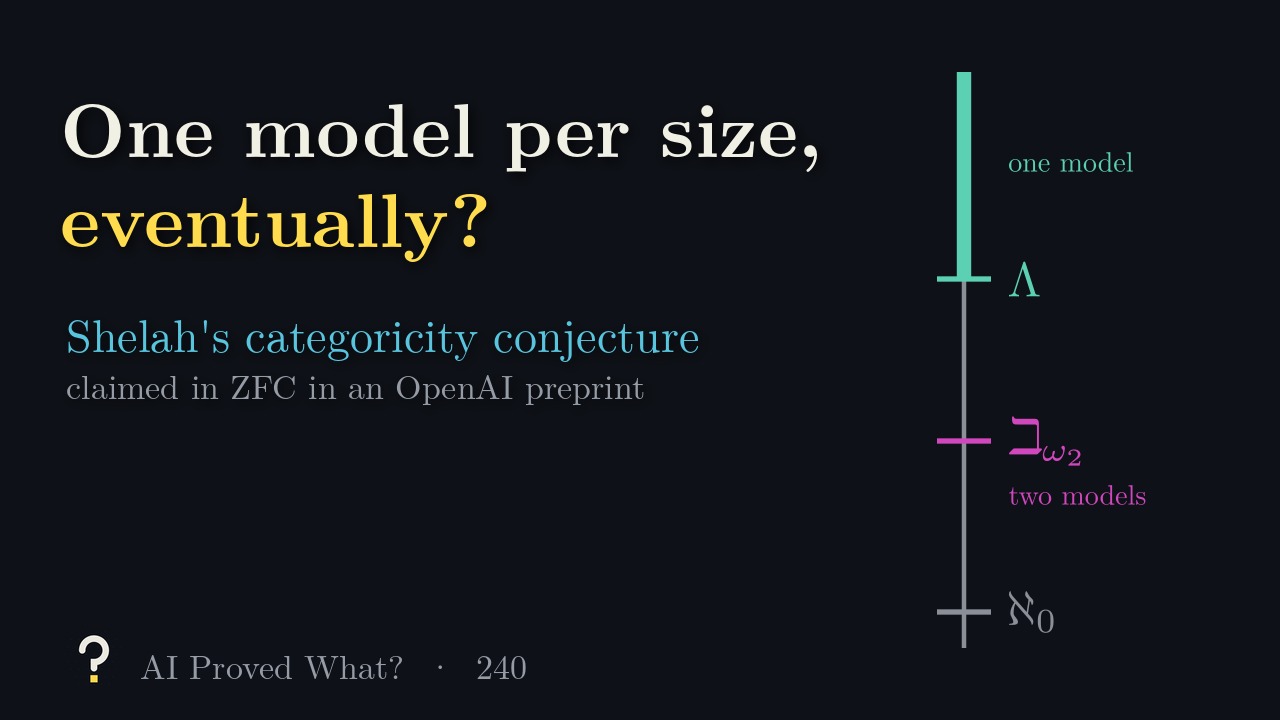
Result 240 is two OpenAI preprints dated September 24, 2026. The first (121 pages) claims the conjecture in ZFC: for each bound on the Löwenheim–Skolem number there is a threshold μ such that categoricity in one cardinal ≥ μ implies categoricity in every cardinal ≥ μ, with no amalgamation or large cardinals; the threshold has no stated value, since it comes from the axiom of replacement. The second (31 pages) targets Shelah’s explicit Hanf-number threshold ℶ(2LS)+, which he called probably more realistic, which Grossberg had doubted and which Espíndola claimed as a theorem in 2023. Assuming the continuum hypothesis, it builds a class with two different models at ℶω2, exactly that threshold, yet categorical in every size from Λ = ℶ(2ℵ1)+ onward. So, if ZFC is consistent, it cannot prove that this threshold works.
What it doesn’t claim
A value for the threshold; Shelah’s separate ℶω1 conjecture for infinitary logic; or that the explicit threshold fails without CH. The counterexample class is itself eventually categorical, so it does not contradict the conjecture.
Where it stands
- Posted as preprints
- OpenAI, 2 papers, 152 pages, dated September 24, 2026
- Peer reviewed
- Not yet
- Checked in Lean
- In part: the counterexample only (docs)
Last checked October 19, 2026. The preprints have not been revised since release. In Lean, only the counterexample is formalized, with CH as an assumption: about 5,000 lines with no unproved steps (we did not build it). The 121-page eventual categoricity proof is not formalized. OSVerify has not reviewed them. One community site lists the main claim as unreviewed and the counterexample as contested, because it conflicts with Espíndola’s claimed theorem. We found no comment from model theorists.
How the proof goes
- The counterexample. Each model hides grids of bits, with countably many rows and one column for each point of a base order; allowed moves flip finitely many bits in a row or a column. With a countable base, rows clear the lower triangle and columns the upper one, so models of the same size are copies. With an uncountable base, most columns keep a pattern that no finite moves erase, giving a second model at ℶω2, which under CH is exactly the threshold. Far above, a partition argument rules out uncountable bases. The class has no amalgamation, which is why earlier theorems that give this threshold do not apply.
- The positive paper. It reduces to a class categorical in unboundedly many sizes, reverses strong maps directly (sidestepping a gap in Shelah’s book found by Boney and Vasey), then builds amalgamation and types at selected levels from categoricity alone. A minimal type behaves like a dimension, so a large model’s size equals its basis size, and two models of the same size match.
The numbers in the video
- Ours: model counts by size. A set split into two infinite colours has 1, 3, 5, 7 models at ℵ0, ℵ1, ℵ2, ℵ3 (2a + 1 at ℵa); rational vector spaces have one at every uncountable size.
- Ours: the counterexample’s triangular moves, replayed on a seeded 8 × 8 grid and 200 more random grids; all cleared to zero. Cardinal bookkeeping: under CH the threshold is ℶω2 and Λ is larger.
Read the source
- Eventual Categoricity for Abstract Elementary Classes (PDF), 121 pages.
- A CH Obstruction to a Prescribed Categoricity Threshold (PDF), 31 pages.
- The Lean formalization notes.
- The collection’s catalog, where this is result 240.
The 2 papers in this result
OpenAI groups related papers, such as alternative proofs, supporting results and consequences, into one result; we label the first paper it lists the main paper and the others companions.
Transcript
Read the full script
0:00The question
A class of mathematical structures is called categorical in a size if all its members of that size are copies of one another. Vector spaces over the rationals are a good example: once a space is uncountable, its size fixes its dimension, so in each uncountable size there is just one. Dense linear orders without endpoints are the opposite: one countable model, but many of every uncountable size. In 1965 Morley proved that for a complete first-order theory in a countable language, categoricity in one uncountable size forces it in all of them. In the late 1970s Shelah conjectured an infinitary-logic version. He then built a broader framework, abstract elementary classes, where the eventual form asks that categoricity in one large enough size force it in every larger one. It was proved with large cardinals, with extra set theory plus amalgamation, or for special classes. Espíndola posted claims of a proof in plain set theory in 2022, not yet refereed. Counting models size by size is the whole game. For a set split into two infinite colours, there is one countable model, then three, five, seven at the next sizes: never categorical again. For the rationals’ vector spaces the count is one at every uncountable size.
1:24The claim
Result 240 is two OpenAI preprints dated September 24, 2026. The first, 121 pages, claims Shelah’s eventual categoricity conjecture in ZFC (Zermelo–Fraenkel set theory with choice): for each bound on the Löwenheim–Skolem number there is a threshold, so that categoricity in one cardinal at or above it implies categoricity in every cardinal at or above it. No amalgamation, no large cardinals. But the threshold has no stated value: it comes from the axiom of replacement. The second, 31 pages, targets one specific threshold, ℶ_{(2^LS)⁺}: Shelah’s Hanf-number form, which he called probably more realistic, though Grossberg had doubted it, and which Espíndola claimed as a theorem in 2023. Assuming the continuum hypothesis, the paper builds a class with two different models at exactly that size, ℶ_ω₂, yet categorical in every size from a larger ℶ onward. So, if set theory is consistent, it cannot prove that this threshold works. Not claimed: a value for the threshold; Shelah’s separate ℶ_ω₁ conjecture for infinitary logic; or that the specific threshold fails without the continuum hypothesis. And the counterexample class is itself eventually categorical, so it does not contradict the conjecture.
2:54How the proof goes
The counterexample hides a grid of bits in each model, with countably many rows and one column for each point of a base order. Allowed moves flip finitely many bits in a row or in a column. If the base is countable, flip rows to clear the lower triangle and columns to clear the upper one: every grid becomes all zeros, so models of the same size are copies of one another. We replayed this on 200 random grids. With an uncountable base, most columns keep a pattern that no finite moves can erase, and these patterns let the paper build a second model at ℶ_ω₂. Under the continuum hypothesis, ℶ_ω₂ is exactly the threshold. Far above, a partition argument rules out uncountable bases, so all models agree. The class has no amalgamation, which is why earlier theorems that give this threshold do not apply. The positive paper reduces to a class categorical in unboundedly many sizes. It first reverses strong maps directly, sidestepping a gap in Shelah’s book found by Boney and Vasey. Then, from categoricity alone, it builds amalgamation and types at selected levels. Then it finds a minimal type whose realizations behave like a dimension, as in a vector space, so a large model’s size equals its basis size, and two models of the same size match.
4:16Where it stands
The preprints are unrefereed and unchanged since release. In Lean, only the counterexample is formalized, with the continuum hypothesis as an assumption, about 5,000 lines with no unproved steps; the 121-page eventual categoricity proof is not. OSVerify has not reviewed them. One community site lists the main claim as unreviewed and the counterexample as contested, because it conflicts with Espíndola’s claimed theorem. We found no comment from model theorists. If they hold, Shelah’s eventual categoricity conjecture is true in plain set theory, with a threshold no one can yet name, and the explicit threshold Shelah proposed cannot be proved to work.
Spot a mistake?
This episode simplifies on purpose, but it shouldn’t be wrong. If something is, open an issue on GitHub or leave a comment on YouTube. Corrections are noted here with a date.