If every program can finish, must it?
A preprint claims that weak normalization implies strong normalization in every pure type system
Covers result 245 in OpenAI’s catalog: its one paper. See its connections to other results and the work it cites.
4:22. English captions available. The video loads from YouTube when you press play.
Chapters
The claim, in plain words
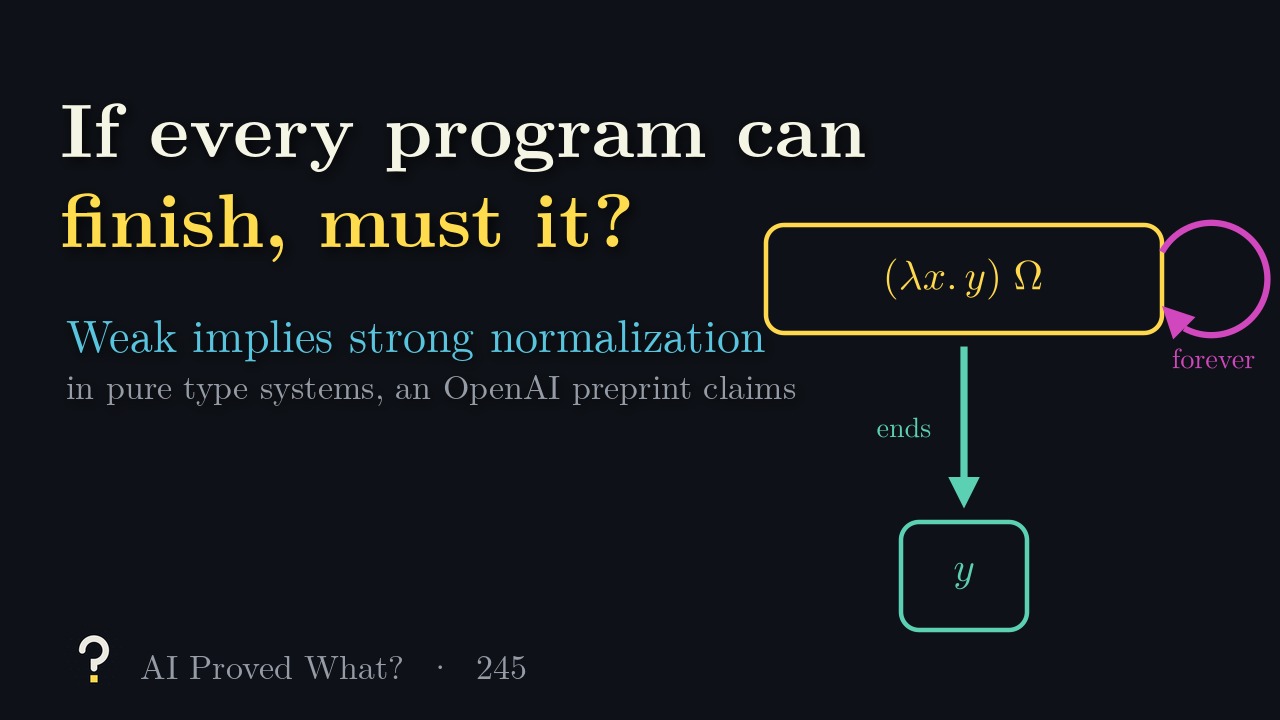
In the lambda calculus a program runs by rewriting, and a term may offer several places to rewrite. The function that ignores its argument, applied to Ω (a term that rewrites to itself forever), finishes at once if you rewrite the outside first, but never finishes if you keep rewriting inside Ω: it is weakly normalizing (some route ends) but not strongly normalizing (every route ends). Type systems are meant to rule out such terms. Pure type systems, introduced by Berardi and Terlouw, generalize Barendregt’s lambda cube, whose eight corners include the simply typed lambda calculus, System F and the calculus of constructions. In his 1993 thesis Herman Geuvers stated the conjecture that if every legal term of a pure type system has a normal form, every reduction terminates; credited to Barendregt, Geuvers and Klop, it is problem 9 on the TLCA list. Partial results covered classes without dependent types, from Xi and Sørensen in the late 1990s to Mull in 2023.
Result 245 is one OpenAI preprint, 72 pages, dated September 25, 2026. It claims the conjecture for β-reduction, for every pure type system: if every legal expression in every valid context has a β-normal form, every β-reduction sequence of a legal expression terminates. No assumption that a sort has only one type or that each rule fixes one sort for a function type; open contexts allowed; reduction inside type annotations counts.
What it doesn’t claim
That a single term with a normal form is strongly normalizing; the version with η-reduction, which Geuvers also conjectured; normalization of any particular system; extensions with inductive types, as in Coq or Lean.
Where it stands
- Posted as a preprint
- OpenAI, 72 pages, dated September 25, 2026
- Peer reviewed
- Not yet
- Checked in Lean
- Yes (docs)
Last checked October 19, 2026. The preprint has not been revised since release. In Lean, the theorem is formalized with de Bruijn terms, reduction in annotations and arbitrary specifications, about 29,500 lines with no unproved steps, and the weak-normalization hypothesis is genuinely used (we did not build it). OSVerify has not reviewed it, and we found no expert reaction.
How the proof goes
- Profiles. Reduce to finitely many sorts, give each normal type a profile (the set of sorts it inhabits), and arrange the profiles in a graph with signed edges: function domains negative, codomains positive. A Tait–Girard reducibility argument runs one strongly connected piece at a time.
- Easy and hard pieces. Pieces with no odd cycle of signs use a fixed point; pieces with no function type entirely inside them use a simpler choice. The hard case needs a forbidden configuration to be absent: if present, the system could encode Hurkens’s version of Girard’s paradox as a legal term in an open context with no normal form, contradicting the hypothesis. So weak normalization is used twice: to normalize types, and to rule out the paradox.
The numbers in the video
- Ours: 3 applied to 2 as Church numerals in System F has about 493 billion reduction orders (493,156,871,088), from 12 to 24 steps, all ending in the same normal form.
- Ours: transcribing the paper’s graph conditions for 11 known systems, the forbidden configuration appears in exactly the 3 paradoxical systems on our list (λU⁻, λU, Type : Type) and in none of the 8 normalizing ones. That is consistent with the theorem, not a check of its proof.
Read the source
- Weak and strong normalization in pure type systems (PDF), 72 pages.
- The Lean formalization notes.
- The collection’s catalog, where this is result 245.
The paper
OpenAI groups related papers into one result; this one has a single paper.
Transcript
Read the full script
0:00The question
In the lambda calculus, a program runs by rewriting: wherever a function meets its argument, substitute. A term may offer several places to rewrite. Take the function that ignores its argument, applied to Omega, a term that rewrites to itself forever. Rewrite the outside first and you finish at once; keep rewriting inside Omega and you never finish. So the term is weakly normalizing, some route ends, but not strongly normalizing, where every route ends. Type systems are meant to rule out terms like Omega. Pure type systems, introduced by Berardi and Terlouw, generalize Barendregt’s lambda cube, whose eight corners include the simply typed lambda calculus, System F and the calculus of constructions. Even a tiny typed program has many routes: our count for 3 applied to 2, as Church numerals in System F, is about 493 billion reduction orders, from 12 to 24 steps, all ending in the same normal form. In his 1993 thesis Herman Geuvers stated the conjecture: if every legal term of a pure type system has a normal form, then every reduction terminates. Credited to Barendregt, Geuvers and Klop, it is problem 9 on the list of open problems in typed lambda calculus. Partial results, by translations into a calculus where nothing is thrown away, covered classes of systems without dependent types, from Xi and Sørensen in the late 1990s to Mull in 2023.
1:32The claim
Result 245 is one OpenAI preprint, 72 pages, dated September 25, 2026. It claims the conjecture for beta reduction, for every pure type system: if every legal expression in every valid context has a beta normal form, every beta reduction sequence of a legal expression terminates. No assumption that a sort has only one type, or that each rule fixes one sort for a function type; open contexts allowed; and reduction inside type annotations counts. Not claimed: that a single term with a normal form is strongly normalizing; the version with eta reduction, which Geuvers also conjectured; normalization of any particular system; or extensions with inductive types, as in Coq or Lean.
2:23How the proof goes
First, reduce to finitely many sorts. Then give each normal type a profile, the set of sorts it inhabits, and arrange the profiles in a graph with signed edges: function domains negative, codomains positive. A reducibility argument in the style of Tait and Girard then runs one strongly connected piece of the graph at a time. Two cases are easy: pieces with no odd cycle of signs, handled with a fixed point, and pieces with no function type entirely inside them. The hard case needs a certain forbidden configuration to be absent. If it were present, the system could encode Hurkens’s version of Girard’s paradox as a legal term in an open context, and that term has no normal form, contradicting the hypothesis. So weak normalization is used twice: to normalize types, and to rule out the paradox. We transcribed the paper’s graph conditions and ran them on 11 known systems. The forbidden configuration appears in exactly the three paradoxical systems on our list, System U⁻, System U and Type : Type, and in none of the 8 normalizing ones, including the calculus of constructions. That is consistent with the theorem, not a check of its proof.
3:40Where it stands
The preprint is unrefereed and unchanged since release. In Lean, the theorem is formalized with de Bruijn terms, reduction in annotations and arbitrary specifications, about 29,500 lines with no unproved steps, and the weak normalization hypothesis is genuinely used. We did not build it. OSVerify has not reviewed it, and we found no expert reaction. If it holds, for every pure type system, a guarantee that every legal term can finish already guarantees that every legal term always finishes, the beta half of a conjecture from 1993.
Spot a mistake?
This episode simplifies on purpose, but it shouldn’t be wrong. If something is, open an issue on GitHub or leave a comment on YouTube. Corrections are noted here with a date.