Boundary a sphere, so the group is 3D hyperbolic?
An AI preprint claims Cannon’s conjecture on hyperbolic groups with a 2-sphere boundary
Covers result 246 in OpenAI’s catalog: its one paper. See its connections to other results and the work it cites.
4:42. English captions available. The video loads from YouTube when you press play.
Chapters
The claim, in plain words
A hyperbolic group is a finitely generated group that is negatively curved on large scales: geodesic triangles in its Cayley graph are uniformly thin. It has a boundary at infinity, the directions in which you can walk off forever: a Cantor set for free groups on two or more generators, a circle for surface groups, a 2-sphere for the fundamental groups of closed hyperbolic 3-manifolds. Jim Cannon asked, around 1990, the converse: if the boundary is a 2-sphere, must the group come from hyperbolic 3-space? The circle case was settled by Tukia, Gabai, and Casson and Jungreis. For spheres, Cannon (with Swenson, Floyd and Parry) and then Bonk and Kleiner turned it into an analytic question about the boundary; Bourdon and Kleiner settled it for Coxeter groups; Markovic and Haïssinsky showed it would follow from enough surface subgroups or from a cubulation. In general it stayed open.
Result 246 is one OpenAI preprint, 31 pages, dated September 23, 2026. It claims that every hyperbolic group whose boundary is homeomorphic to the 2-sphere acts properly and cocompactly by isometries on hyperbolic 3-space, with finite kernel (orientation-reversing isometries allowed). So every torsion-free one is the fundamental group of a closed hyperbolic 3-manifold, possibly nonorientable.
What it doesn’t claim
A faithful action in general (a finite kernel is unavoidable), a new uniformization theorem (that step is cited from Bonk and Kleiner, and Bourdon and Kleiner), or the relative and higher-dimensional versions. It also does not follow from Perelman’s proof of Thurston’s hyperbolization conjecture, which starts from a 3-manifold rather than a group; Kleiner called the two logically independent.
Where it stands
- Posted as a preprint
- OpenAI, 31 pages, dated September 23, 2026
- Peer reviewed
- Not yet
- Checked in Lean
- The main theorem (docs)
Last checked October 19, 2026. The preprint has not been revised. In Lean, the main theorem is formalized with hyperbolic groups, their boundary and hyperbolic space defined explicitly: about 70,000 lines with no unproved steps (we did not build it). It also proves the uniformization step that the paper cites, for this boundary. The corollaries are not formalized. OSVerify has not reviewed the paper, and we found no expert reaction.
How the proof goes
- One number. By Bonk and Kleiner, and Bourdon and Kleiner, it is enough that a combinatorial modulus of the boundary, M(n), stays bounded as the scale shrinks. Modulus is the cheapest way to tax small balls, cost measured by the sum of squared taxes, so that every long path pays at least one.
- Exponential growth. If M(n) were unbounded, record scales and duality give a limit function whose level sets cross a small rectangle on the sphere. If the growth is exponential, magnifying with the group’s symmetries and an energy comparison give two copies that vary in the same places, a contradiction.
- Slower growth. A probability flow on a tree of small balls and a count of pairs give an exponential lower bound against a quadratic upper bound. So M(n) is bounded, the boundary is a round sphere in disguise, and Sullivan and Tukia’s averaging, with Ahlfors and Bers, turns the action into isometries of hyperbolic 3-space.
The numbers in the video
- Ours: the group generated by reflections in the faces of a right-angled dodecahedron, built as 12 four-by-four matrices with its relations checked. Elements by length 1, 12, 102, 812, 6,402, 50,412, 396,902, matching the growth series (1+t)³/((1−t)(1−8t+t²)), growth rate 4+√15 ≈ 7.873. A torsion-free subgroup of index 16 has first homology ℤ⁸.
- Ours: the images of one point fill the sphere at infinity. Every direction is within 37.2°, 20.6°, 9.5°, 4.9° and 2.6° of an image point after one to five layers.
- Ours: discrete modulus for left-to-right paths is exactly 1 on square grids of side 4, 8 and 16, and exactly k on cubes of side k = 4, 6, 8.
Read the source
- A Modulus Proof of Cannon's Conjecture (PDF), 31 pages.
- The Lean formalization notes.
- The collection’s catalog, where this is result 246.
The paper
OpenAI groups related papers into one result; this one has a single paper.
Transcript
Read the full script
0:00The question
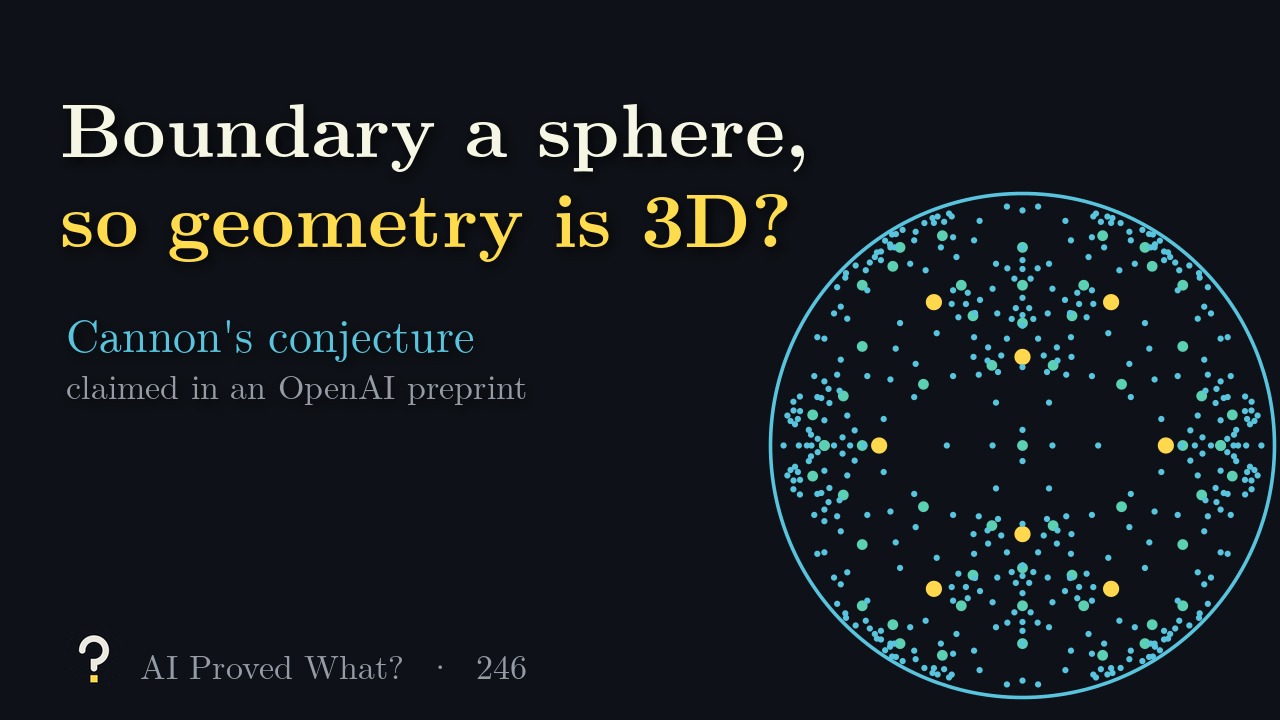
A hyperbolic group is a finitely generated group whose Cayley graph is negatively curved on large scales, the way hyperbolic space is: its geodesic triangles are uniformly thin. Such a group has a boundary at infinity, made of the directions in which you can walk off forever. Free groups on two or more generators have a Cantor set as boundary; surface groups have a circle; and the fundamental groups of closed hyperbolic 3-manifolds have a 2-sphere. Here is a group with a sphere boundary: the group generated by reflections in the faces of a right-angled dodecahedron in hyperbolic space; 16 copies of the dodecahedron glue into a closed hyperbolic 3-manifold. Our computer built its 12 reflections as 4-by-4 matrices, checked the relations, and counted elements by length: 1, 12, 102, 812, and so on, matching the growth formula. The images of a point spread over the whole sphere at infinity: every direction comes within 37 degrees of an image point, and after five layers within three. Jim Cannon asked, around 1990, the converse: if a hyperbolic group’s boundary is a 2-sphere, must the group come from hyperbolic 3-space? For circle boundaries, the analogous question was settled by Tukia, Gabai, and Casson and Jungreis. For spheres, Cannon, with Swenson, Floyd and Parry, and then Bonk and Kleiner, turned it into an analytic question about the boundary; Bourdon and Kleiner settled it for reflection-type Coxeter groups; Markovic and Haïssinsky showed it would follow from enough surface subgroups or from a cubulation. But in general it stayed open.
1:44The claim
Result 246 is one OpenAI preprint, 31 pages, dated September 23, 2026. It claims Cannon’s conjecture: every hyperbolic group whose boundary is homeomorphic to the 2-sphere acts properly and cocompactly by isometries on hyperbolic 3-space, with finite kernel. So every torsion-free one is the fundamental group of a closed hyperbolic 3-manifold, possibly nonorientable. Not claimed: a faithful action in general, since a finite kernel is unavoidable; a new uniformization theorem, since that step is cited from Bonk and Kleiner, and Bourdon and Kleiner; or the relative and higher-dimensional versions. And it does not follow from Perelman’s proof of Thurston’s hyperbolization conjecture: that starts from a 3-manifold, Cannon’s starts from just a group; Kleiner called the two logically independent.
2:40How the proof goes
The reduction: by Bonk and Kleiner, and Bourdon and Kleiner, it is enough to show that a combinatorial modulus of the boundary, M(n), stays bounded as the scale shrinks. Modulus asks how cheaply you can tax small balls so that every long path pays at least one, with cost measured by the sum of the squared taxes. On a flat square grid, for paths crossing from side to side, the answer stays at one at every resolution; on a 3-dimensional cube of side k it is exactly k, our toy computation. So suppose M(n) were unbounded. Choose record scales, and use duality to build a limit function whose level sets cross a small rectangle on the sphere. If the growth is exponential, magnify using the group’s own symmetries: an energy comparison shows that a copy with a different puncture must stay constant wherever the first one varies, and a second magnification produces two copies that both vary in the same two places, a contradiction. If the growth is slower, a probability flow on a tree of small balls, and a count of pairs, give an exponential lower bound against a quadratic upper bound: a contradiction. So M(n) is bounded, the boundary is a round sphere in disguise, and Sullivan and Tukia’s averaging, with Ahlfors and Bers, turns the group’s action into isometries of hyperbolic 3-space.
4:04Where it stands
The preprint is unrefereed and unchanged since release. In Lean, the main theorem is formalized, with hyperbolic groups, their boundary and hyperbolic space defined explicitly, about 70,000 lines with no unproved steps; it even proves the uniformization step that the paper cites. We did not build it. OSVerify has not reviewed it, and we found no expert reaction. If it holds, a sphere at infinity means, up to a finite kernel, symmetries of hyperbolic 3-space: more than three decades after Cannon asked.
Spot a mistake?
This episode simplifies on purpose, but it shouldn’t be wrong. If something is, open an issue on GitHub or leave a comment on YouTube. Corrections are noted here with a date.