Trapped, or free?
Two AI preprints claim localization in two dimensions and free states in three and up for the Anderson model
Covers result 261 in OpenAI’s catalog: all 2 papers. See its connections to other results and the work it cites.
4:16. English captions available. The video loads from YouTube when you press play.
Chapters
The claim, in plain words
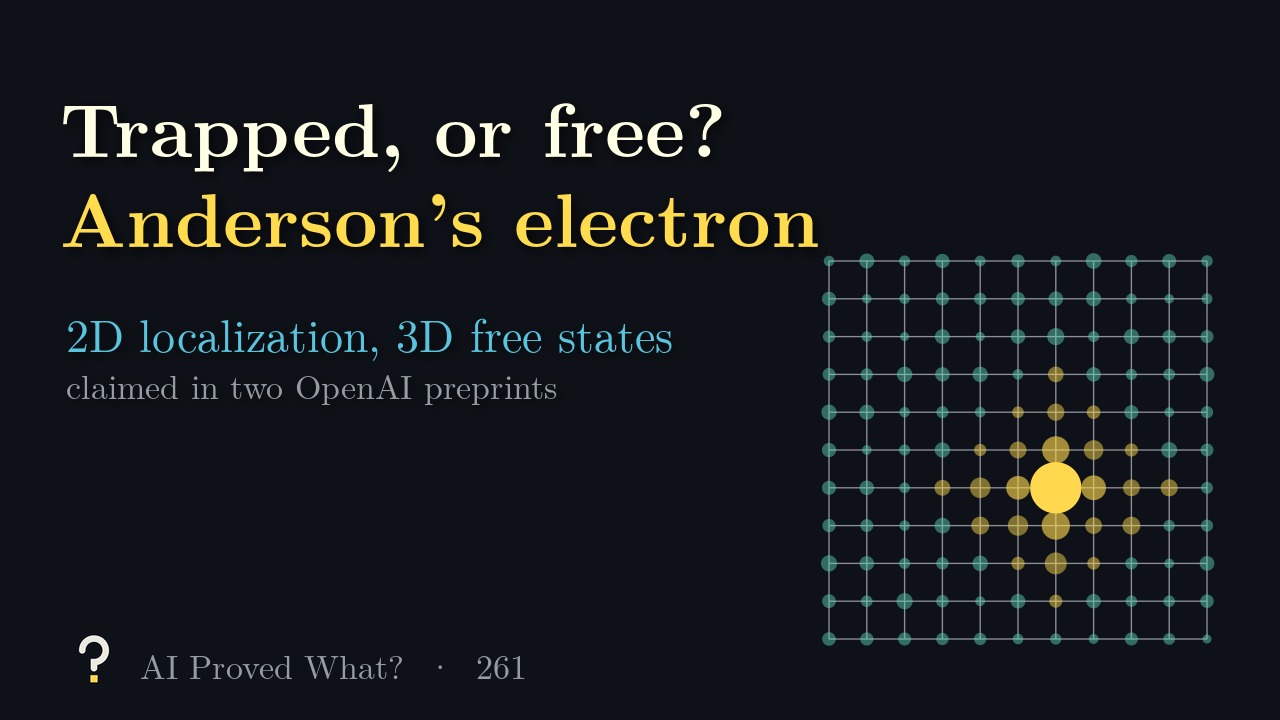
An electron moving through a perfect crystal travels freely. In 1958 Philip Anderson argued that random impurities can trap it: its waves stop spreading and stay localized. The model is a lattice, a hopping term between neighbours, and an independent random energy at every site, uniform between −h and h. In one dimension any disorder traps everything. Physicists predicted in 1979 that in two dimensions every amount of disorder eventually traps, while in three dimensions weak disorder leaves some states free.
In spectral terms, trapping is usually read as pure-point spectrum, a complete set of eigenfunctions, and freedom as absolutely continuous spectrum. Localization at strong disorder and near band edges was proved in the 1980s and 1990s. But Barry Simon’s 2000 list of problems called proving purely absolutely continuous spectrum on some energy range in three dimensions “the big kahuna”, and two-dimensional localization at weak disorder was also open. Two papers from September 2026 still called these problems open.
Result 261 is two OpenAI preprints, both dated September 23, 2026. The first, 78 pages, claims that in two dimensions, for every positive disorder strength, the spectrum is almost surely pure point, with eigenvalues dense in the whole spectrum. The second, 93 pages, claims that in every dimension 3 or more, for small enough disorder, the spectrum is almost surely purely absolutely continuous on a fixed interval, with nonzero weight there. At the very bottom of the spectrum, below the band, the same disorder gives pure point, so both kinds coexist.
What it doesn’t claim
The two-dimensional paper does not claim dynamical localization or exponential decay of eigenfunctions. The higher-dimensional paper’s interval is a thin sliver just above the bottom of the band, a few hundredths of a percent of it or less. Its disorder threshold is at most about 0.002 from four dimensions up, and no value is given in three. It claims nothing about the mobility edge, diffusion, or the band centre.
Where it stands
- Posted as preprints
- OpenAI, two papers, 78 and 93 pages, dated September 23, 2026
- Peer reviewed
- Not yet
- Checked in Lean
- Only a long-known fact (docs)
Last checked October 19, 2026. Neither preprint has been revised. Lean formalizes only the location of the two-dimensional spectrum, a long-known fact; neither main theorem is formalized. OSVerify has not reviewed them. Jakšić and Last posted a paper on tree models whose appendix shortens the last step of the higher-dimensional argument, leaving the rest unchanged. We found no specialist comment on the two-dimensional paper.
How the proofs go
- Two dimensions. The proof plants rare resonant cells inside the true randomness and controls them through a hierarchy of comparisons on finite tori. The planar step is a capacity argument: in the plane, a logarithmic profile costs almost nothing, which forces the transport energy to zero. It ends with a fractional-moment bound and a rank-one perturbation argument of Simon and Wolff.
- Three dimensions and up. The proof writes each uniform potential as infinitely many coin flips and reveals them one binary digit at a time. It tracks three controls on the resolvent and sets aside failed local trials as pending sites to be cleared later. It ends with a finite-volume certificate that becomes absolutely continuous spectrum; its threshold uses boxes at least 10⁴⁸¹ sites on a side.
The numbers in the video
- Ours: in three dimensions, a particle released at one site keeps spreading at disorder h = 2 and freezes at h = 12.
- Ours: our computer cannot see the two-dimensional result. At disorder 1, eigenvectors spread over more sites as the box grows, from about 80 to over 2,300, and the level statistics look like free states. The predicted trapping happens only on scales far beyond any box we can diagonalize.
Read the source
The 2 papers in this result
OpenAI groups related papers, such as alternative proofs, supporting results and consequences, into one result; we label the first paper it lists the main paper and the others companions.
Transcript
Read the full script
0:00The question
An electron moving through a perfect crystal travels freely. Add random impurities, and in 1958 Philip Anderson argued that it can become trapped: its waves stop spreading and stay localized. The model is simple: a lattice, a hopping term between neighbours, and an independent random energy at every site, here uniform between −h and h. In one dimension, any disorder traps everything. Our computer shows the contrast in three dimensions: a particle released at one site keeps spreading at weak disorder, and freezes at strong disorder. Physicists predicted in 1979 that in two dimensions every amount of disorder eventually traps, while in three dimensions weak disorder leaves some states free. Mathematically, trapping is usually read as pure-point spectrum, a complete set of eigenfunctions, and freedom as absolutely continuous spectrum. Localization at strong disorder and near band edges was proved in the 1980s and 1990s. But Barry Simon’s 2000 list called proving purely absolutely continuous spectrum on some energy range in three dimensions the big kahuna, and two-dimensional localization at weak disorder was also open; two papers from September 2026 still called these problems open.
1:21The claims
Result 261 is two OpenAI preprints, both dated September 23, 2026. The first, 78 pages, claims that in two dimensions, for every positive disorder strength, the spectrum is almost surely pure point, with eigenvalues dense in the whole spectrum. It does not claim dynamical localization or exponential decay of eigenfunctions. The second, 93 pages, claims that in every dimension 3 or more, for small enough disorder, the spectrum is almost surely purely absolutely continuous on a fixed interval, with nonzero weight there. The interval is a thin sliver just above the bottom of the band, a few hundredths of a percent of it or less; the disorder threshold is at most about 0.002 in 4 dimensions and up, with no value given in three. At the very bottom of the spectrum, below the band, the same disorder gives pure point, so both kinds coexist. Our computer cannot see the two-dimensional result. At disorder 1, eigenvectors spread over more sites as the box grows, from about 80 to over 2,300, and the level statistics look like free states. The predicted trapping happens only on scales far beyond any box we can diagonalize.
2:41How the proofs go
The two-dimensional proof plants rare resonant cells inside the true randomness and controls them through a hierarchy of comparisons on finite tori. The planar step is a capacity argument: in the plane, a logarithmic profile costs almost nothing, which forces the transport energy to zero. It ends with a fractional-moment bound and a rank-one perturbation argument of Simon and Wolff. The higher-dimensional proof writes each uniform potential as infinitely many coin flips and reveals them one binary digit at a time. It tracks three controls on the resolvent, sets aside failed local trials as pending sites to be cleared later, and ends with a finite-volume certificate that becomes absolutely continuous spectrum. Its threshold uses boxes at least 10⁴⁸¹ sites on a side.
3:34Where it stands
Both preprints are unrefereed and unchanged since release. Lean formalizes only the location of the two-dimensional spectrum, a long-known fact; neither main theorem is formalized. OSVerify has not reviewed them. Jakšić and Last posted a paper on tree models whose appendix shortens the last step of the higher-dimensional argument, leaving the rest unchanged; we found no specialist comment on the two-dimensional paper. If they hold, Anderson’s picture is right at both ends: in the plane, any disorder traps a quantum particle, and in three dimensions and more, very weak disorder leaves at least some energies free.
Spot a mistake?
This episode simplifies on purpose, but it shouldn’t be wrong. If something is, open an issue on GitHub or leave a comment on YouTube. Corrections are noted here with a date.