A gap for spin one, proved at last?
Two AI preprints claim the Haldane gap for the spin-one Heisenberg chain
Covers result 268 in OpenAI’s catalog: all 2 papers. See its connections to other results and the work it cites.
3:54. English captions available. The video loads from YouTube when you press play.
Chapters
The claim, in plain words
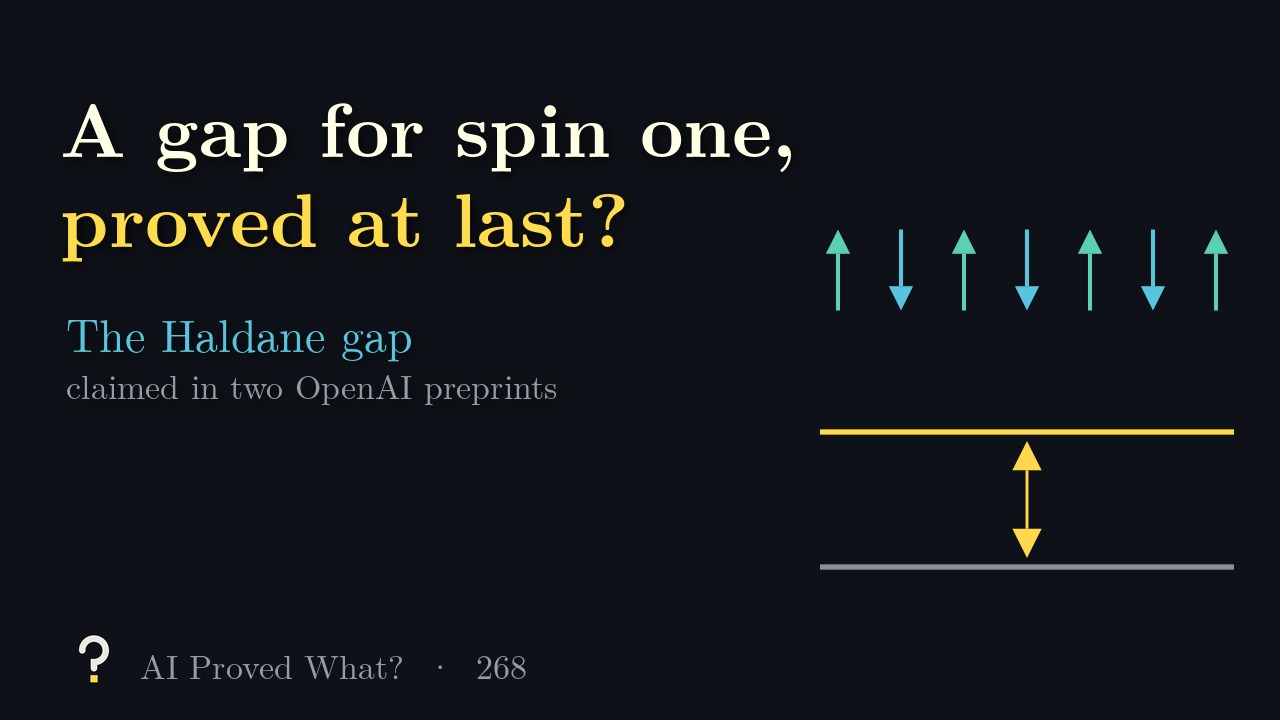
Take a chain of quantum spins, each coupled to its neighbours so that they prefer to point opposite ways: the Heisenberg antiferromagnet. Spin one half was known to be gapless: its lowest excitations cost almost nothing on a long chain. In the early 1980s Duncan Haldane predicted that for spin one, and integer spins generally, there should be a gap, a fixed minimum energy however long the chain. Affleck, Kennedy, Lieb and Tasaki proved a gap in 1987 for a modified spin-one chain, but the pure Heisenberg chain resisted. In 2025 Tasaki wrote that a rigorous proof seemed far beyond reach, and called it a challenge to find a strategy for a computer-aided proof.
Result 268 is two OpenAI preprints, 58 pages, dated September 24, 2026. The first claims the conjecture in a finite-volume form. For the pure spin-one Heisenberg chain on even periodic rings of 60 sites or more, the ground state is unique and the gap is larger than (4/105)·log(80/79) ≈ 0.0005; from 2,304 sites on, larger than log(20)/784 ≈ 0.004. The second treats odd open chains with a field of 3/5 applied at both ends. It proves a gap above log(10)/392 ≈ 0.006 for long enough chains, and boundary-selected infinite states with Tasaki’s twist index −1. That gap is exactly the assumption Tasaki made in 2025, with field 3/5 instead of the suggested value 1.
What it doesn’t claim
The actual size of the gap, which these bounds undershoot by a factor of 70 or more; odd rings, free ends or other fields; spin 2 and higher; or uniqueness of the infinite-volume ground state.
Where it stands
- Posted as preprints
- OpenAI, two papers, 58 pages, dated September 24, 2026
- Peer reviewed
- Not yet
- Checked in Lean
- No
Last checked October 19, 2026. The preprints have not been revised. There is no Lean formalization, and OSVerify has not reviewed them. The authors’ verification programs ran and passed on our machine. Tasaki has revised an earlier paper to build on the second preprint, noting “no logical gap” so far in the portions examined, but that the verification is “not yet complete”.
How the proofs go
- One partition function, two distributions. The proof writes the thermal partition function in two ways: as a sum over energy levels, and as the trace of a spatial transfer operator built from a bond expansion of Aizenman and Nachtergaele. Each gives a probability distribution. Doubling the chain length or the inverse temperature squares one of them and makes it more concentrated, and exact identities link the two. Once both are concentrated, the leftover error shrinks doubly exponentially, and a gap follows.
- Seeded by exact computation. The seeds are traces in integer arithmetic with proven error bounds, on twisted rings of up to 12 sites, and a matrix-product trial state at 72 and 120 sites whose energy beats a threshold by about 10−7 per site.
The numbers in the video
- Ours: exact diagonalization of spin-one rings: gap 1 at 4 sites, 0.432 at 18, extrapolating to about 0.41 (accepted value 0.4105). Spin-one-half rings: the gap keeps falling, 0.183 at 24 sites.
- Ours: the spin profile of a 13-site open chain with field 3/5 at both ends.
- Ours: the paper’s bootstrap table reproduces exactly in rational arithmetic; one error first grows, then both fall below 1% at 2,304 sites.
Read the source
- The Periodic Spin-One Haldane Gap (PDF), 30 pages.
- A Boundary-Field Gap for the Spin-One Heisenberg Chain (PDF), 28 pages.
- The collection’s catalog, where this is result 268.
The 2 papers in this result
OpenAI groups related papers, such as alternative proofs, supporting results and consequences, into one result; we label the first paper it lists the main paper and the others companions.
- The periodic spin-one Haldane gap main paper
- A boundary-field gap for the spin-one Heisenberg chain companion
Transcript
Read the full script
0:00The question
A chain of quantum spins, each coupled to its neighbours so that they prefer to point opposite ways: the Heisenberg antiferromagnet. In the early 1980s Duncan Haldane predicted a surprise. Spin one half was known to be gapless, its lowest excitations costing almost nothing on a long chain, but for spin one, and integer spins generally, there should be a gap: a fixed minimum energy, however long the chain. Our computer shows the difference on small rings. For spin one half, the gap keeps falling, roughly in proportion to one over the length. For spin one it falls from 1 at 4 sites to 0.432 at 18, and extrapolates to about 0.41, close to the accepted value, 0.4105, from large numerical studies. Affleck, Kennedy, Lieb and Tasaki proved a gap in 1987 for a modified spin-one chain, but the pure Heisenberg chain resisted. In 2025 Tasaki wrote that a rigorous proof seemed far beyond reach, and called it a challenge to find a strategy for a computer-aided proof.
1:09The claims
Result 268 is two OpenAI preprints, 58 pages, dated September 24, 2026. The first claims the conjecture in a finite-volume form: for the pure spin-one Heisenberg chain on even periodic rings of 60 sites or more, the ground state is unique and the gap is larger than about 0.0005; from 2,304 sites on, larger than about 0.004. The second treats odd open chains with a field of 3/5 applied at both ends, proving a gap of about 0.006 for long enough chains, and boundary-selected infinite states with Tasaki’s twist index −1. That gap is exactly the assumption Tasaki made in 2025, with field 3/5 instead of the value one suggested there. Not claimed: the actual size of the gap, which these bounds undershoot by a factor of 70 or more; odd rings, free ends or other fields; spin two and higher; or uniqueness of the infinite-volume ground state.
2:14How the proofs go
The proof writes the thermal partition function in two ways: as a sum over energy levels, and as the trace of a spatial transfer operator built from a bond expansion of Aizenman and Nachtergaele. Each gives a probability distribution; doubling the chain length or the inverse temperature squares one of them and makes it more concentrated, and exact identities link the two. Once both are concentrated, the leftover error shrinks doubly exponentially, and a gap follows. The seeds are finite computations: traces in integer arithmetic with proven error bounds, on twisted rings of up to 12 sites, and a matrix-product trial state at 72 and 120 sites whose energy beats a threshold by about 10⁻⁷ per site. Our check: the paper’s bootstrap table reproduces exactly in rational arithmetic, with one error first growing, then both collapsing to below 1% at 2,304 sites.
3:12Where it stands
The preprints are unrefereed and unchanged since release. There is no Lean formalization, and OSVerify has not reviewed them. The authors’ verification programs ran and passed on our machine. Tasaki has revised an earlier paper to build on the second preprint, noting that no logical gap has been found so far in the portions examined, but that the verification is not yet complete. If they hold, Haldane’s prediction is now a theorem for the spin-one Heisenberg chain on even rings: spin one really does open a gap, even if the proven gap is at least 100 times smaller than the real one.
Spot a mistake?
This episode simplifies on purpose, but it shouldn’t be wrong. If something is, open an issue on GitHub or leave a comment on YouTube. Corrections are noted here with a date.