Scale implies conformal, proved at last?
An AI preprint claims scale symmetry forces local conformal symmetry for 4D theories meeting its axioms
Covers result 282 in OpenAI’s catalog: its one paper. See its connections to other results and the work it cites.
4:12. English captions available. The video loads from YouTube when you press play.
Chapters
The claim, in plain words
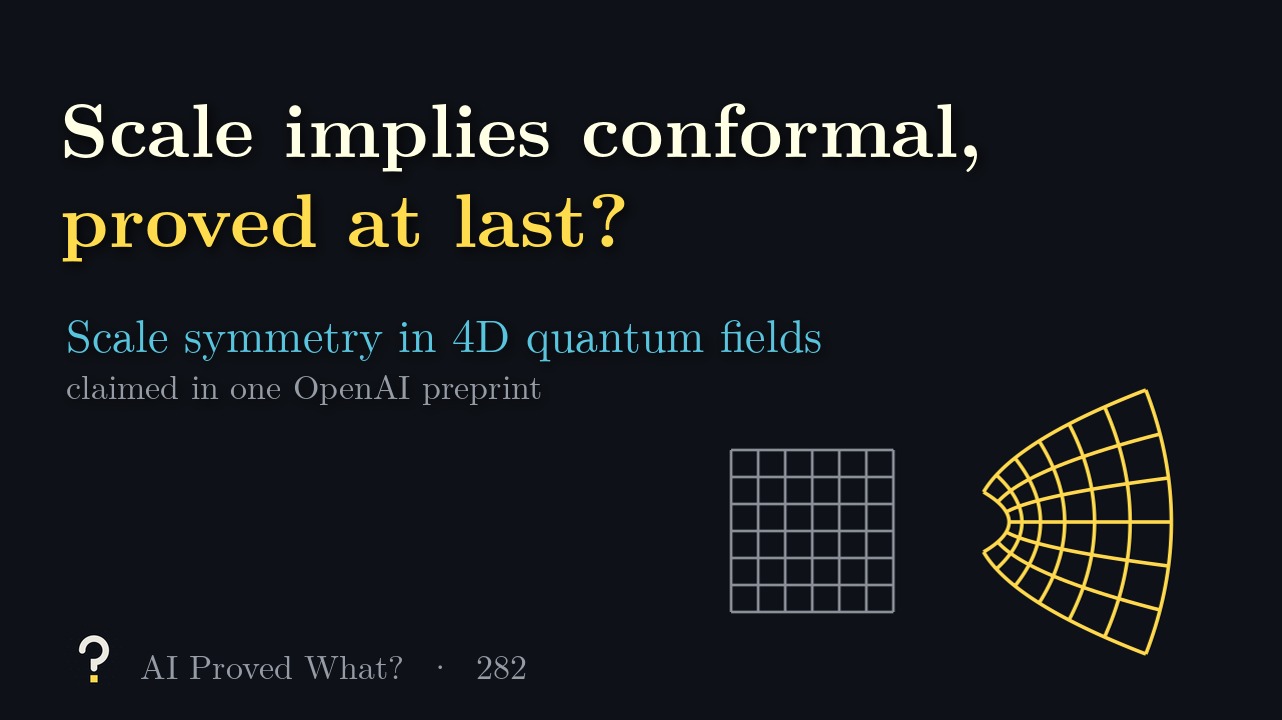
Zoom in on a fluid at its critical point and it looks the same at every scale: that is scale symmetry. Conformal symmetry is stronger: the theory also looks the same under maps that zoom by different amounts at different places while keeping angles. The test is the stress tensor. Scale symmetry makes its trace the divergence of a current, the virial current; conformal symmetry means the tensor can be improved until the trace vanishes. For a free massless field the textbook trace is minus the spacetime square of the field’s gradient, and adding exactly 1/6 of a correction built from the field squared removes it, an improvement known since 1970.
Does scale symmetry always force conformal symmetry? In two dimensions, Zamolodchikov and Polchinski showed it does for unitary theories, under broad conditions; Polchinski’s 1988 paper said that in three or more dimensions, neither a general proof nor a counterexample had been found. In four dimensions, proofs in perturbation theory came in 2012. Non-perturbative arguments from 2012 and 2013 rest on assumptions their authors flag, and a proof claimed in 2013 was later withdrawn.
Result 282 is one OpenAI preprint, 112 pages, dated September 26, 2026. It considers four-dimensional unitary theories with positive energy and a scale-invariant vacuum, whose fields sit compatibly in a bounded local net of observables, with a discrete spectrum of scaling dimensions, finite multiplicities and finite scaling support, and physical local stress tensor and virial current. For these it claims that scale symmetry implies local conformal symmetry: a physical scalar field of dimension 2 exists that improves the stress tensor to a traceless one with the same energy, momentum and angular momentum.
What it doesn’t claim
A global conformal action on the whole net, which the paper treats as a separate question; theories outside its hypotheses; or curved spacetime. We know of no interacting theory shown to satisfy the hypotheses. The free scalar does, and it was already conformal. Maxwell’s theory in other dimensions shows what the hypotheses fence off: its trace, proportional to (1 − d/4)F², vanishes only in four dimensions, and elsewhere no gauge-invariant field of the right dimension exists to remove it.
Where it stands
- Posted as a preprint
- OpenAI, 112 pages, dated September 26, 2026
- Peer reviewed
- Not yet
- Checked in Lean
- No
Last checked October 19, 2026. The preprint has not been revised. There is no Lean formalization. OSVerify has not reviewed it, and we found no comment from specialists; one catalogue calls it major if the proof holds, another says the hypotheses carry much of the weight.
How the proof goes
- Let the vacuum speak. The proof uses no Lagrangian and no scattering theory. It uses modular theory: the vacuum, restricted to a region of spacetime, defines a canonical flow. The paper shows that for a light cone this flow is pure zooming, and builds from it an action of time-Möbius transformations on diamond-shaped regions.
- Building the fixing field. From these it extracts a candidate scalar of dimension 2, whose box matches the divergence of the virial current, and proves over many pages that it is a genuine physical local field. Adding a third of a combination of its second derivatives to the stress tensor removes the trace.
The numbers in the video
- Ours: for the free scalar, the paper’s formula with L = −φ²/2 reproduces the classic 1/6 improvement, and the improved trace is zero.
- Ours: Maxwell’s trace coefficient 1 − d/4 for d = 3 to 6, zero only at d = 4.
- Ours: independent free-scalar field components at dimensions 0 to 8: 1, 1, 5, 14, 40, 101, 266, 649, 1593.
Read the source
- Scale and Conformal Symmetry in Four-Dimensional Operational Quantum Field Theory (PDF), 112 pages.
- The collection’s catalog, where this is result 282.
The paper
OpenAI groups related papers into one result; this one has a single paper.
Transcript
Read the full script
0:00The question
Zoom in on a fluid at its critical point and it looks the same at every scale. That is scale symmetry. Conformal symmetry is stronger: the theory also looks the same under maps that zoom by different amounts at different places while keeping angles. The test is the stress tensor. Scale symmetry makes its trace the divergence of a current, called the virial current; conformal symmetry means the tensor can be improved until the trace vanishes. For a free massless field, our computer finds that the textbook stress tensor has a trace equal to minus the spacetime square of the field’s gradient. Adding exactly 1/6 of a correction built from the field squared removes it, an improvement known since 1970. Does scale symmetry always force conformal symmetry? In two dimensions, Zamolodchikov and Polchinski showed it does for unitary theories, under broad conditions, and Polchinski’s 1988 paper said that in three or more dimensions, neither a general proof nor a counterexample had been found. In four dimensions, proofs in perturbation theory came in 2012. Non-perturbative arguments from 2012 and 2013 rest on assumptions their authors flag, and a proof claimed in 2013 was later withdrawn.
1:18The claims
Result 282 is one OpenAI preprint, 112 pages, dated September 26, 2026. It considers four-dimensional unitary theories with positive energy and a scale-invariant vacuum, whose fields sit compatibly in a bounded local net of observables, with a discrete spectrum of scaling dimensions, finite multiplicities and finite scaling support, and physical local stress tensor and virial current. For these it claims that scale symmetry implies local conformal symmetry: a physical scalar field of dimension 2 exists that improves the stress tensor to a traceless one with the same energy, momentum and angular momentum. Not claimed: a global conformal action on the whole net, which the paper treats as a separate question; theories outside its hypotheses; or curved spacetime. And we know of no interacting theory shown to satisfy the hypotheses. The free scalar does, and it was already conformal. The hypotheses fence off known escapes. Our computer checks Maxwell’s theory in other dimensions: its trace, proportional to (1 − d/4)F², vanishes only in four dimensions. Elsewhere no gauge-invariant field of the right dimension exists to remove it, so the theory is scale invariant but not conformal. Its virial current is not a physical field, and in four dimensions the hypotheses rule that out.
2:47How the proof goes
The proof uses no Lagrangian and no scattering theory. It uses modular theory: the vacuum, restricted to a region of spacetime, defines a canonical flow. The paper shows that for a light cone this flow is pure zooming, and builds from it an action of time-Möbius transformations on diamond-shaped regions. From these it extracts a candidate scalar of dimension 2, whose box matches the divergence of the virial current, and proves over many pages that it is a genuine physical local field. Here the finite multiplicities are a hypothesis: for the free scalar our computer counts 1, 1, 5, 14 and 40 independent field components at dimensions 0 to 4. Adding a third of a combination of the candidate’s second derivatives to the stress tensor removes the trace.
3:39Where it stands
The preprint is unrefereed and unchanged since release. There is no Lean formalization. OSVerify has not reviewed it, and we found no comment from specialists; one catalogue calls it major if the proof holds, another says the hypotheses carry much of the weight. If it holds, then in four dimensions, for every theory meeting these axioms, symmetry under zooming forces local conformal symmetry. Whether interacting theories meet them is still open.
Spot a mistake?
This episode simplifies on purpose, but it shouldn’t be wrong. If something is, open an issue on GitHub or leave a comment on YouTube. Corrections are noted here with a date.