Kadison’s question answered, proved at last?
An AI preprint claims Kadison’s 1955 similarity conjecture
Covers result 288 in OpenAI’s catalog: its one paper. See its connections to other results and the work it cites.
3:51. English captions available. The video loads from YouTube when you press play.
Chapters
The claim, in plain words
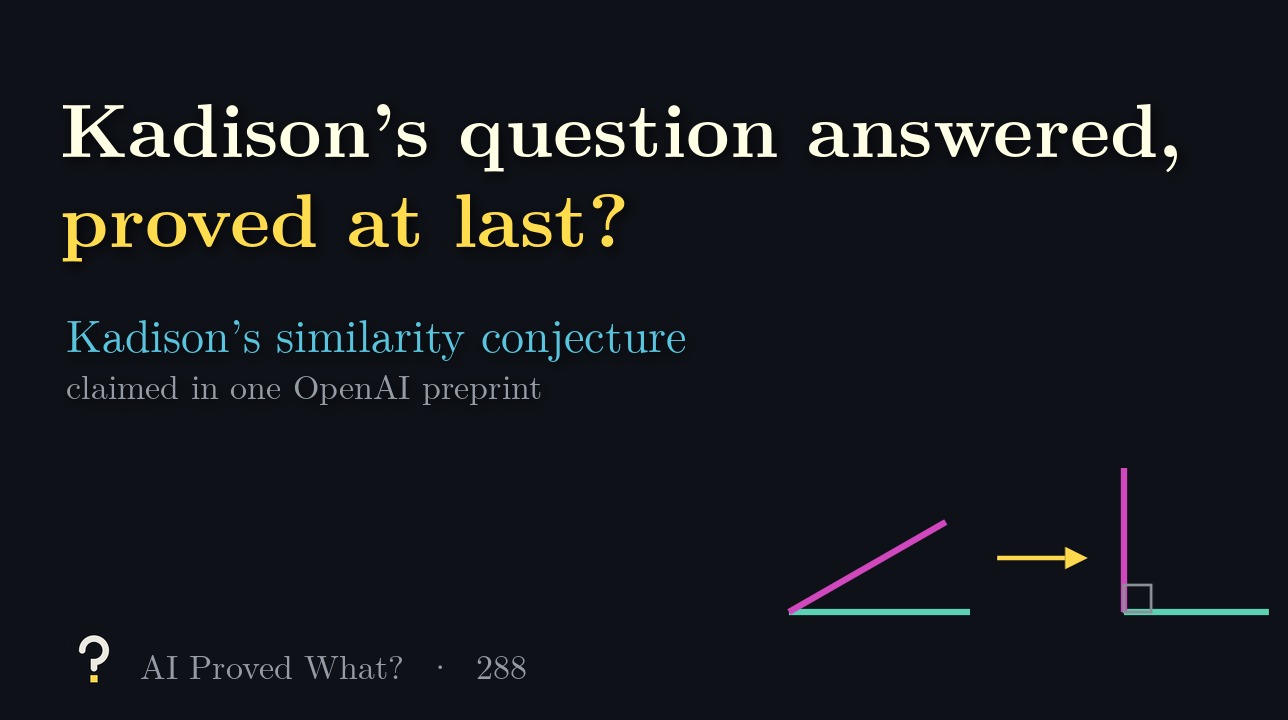
A C*-algebra is an algebra of operators, closed in norm and under taking adjoints, and its *-representations send adjoints to adjoints. A bounded homomorphism may forget the adjoint, for example a *-representation seen in a skewed coordinate system. For an oblique projection, an idempotent whose range and kernel meet at an angle, the best straightening has condition number the cotangent of half that angle, about 1.7 at 60 degrees and 7.6 at 15. Kadison asked in 1955 whether every bounded homomorphism from a C*-algebra into operators on a Hilbert space can be straightened this way. Haagerup showed in 1983 that this happens exactly when the map’s norms at all matrix levels share one bound, and Kirchberg showed in 1996 that the question is equivalent to a question about derivations. Averaging settles the amenable cases; the hardest open ones were factors without property Γ, like the free group factor. Pisier conjectured in 1997 that some C*-algebra, probably the reduced C*-algebra of a free group on infinitely many generators, has infinite similarity degree.
Result 288 is one OpenAI preprint, 31 pages, dated September 23, 2026. It claims Kadison’s conjecture is true: every bounded unital homomorphism from any unital complex C*-algebra into operators on a Hilbert space becomes a *-homomorphism after conjugation by a bounded invertible operator. The engine is one absolute constant, about 1.2 million by our arithmetic from the paper, bounding matrix-level commutators with any von Neumann algebra by scalar-level ones. A corollary: every von Neumann algebra is hyperreflexive, with constant at most about 2.4 million.
What it doesn’t claim
A value for Pisier’s similarity degree, any bound on how much the conjugation distorts, or anything about Dixmier’s separate problem for groups. The scope is unital complex C*-algebras and unital homomorphisms.
Where it stands
- Posted as a preprint
- OpenAI, 31 pages, dated September 23, 2026
- Peer reviewed
- Not yet
- Formalized in Lean
- Twice: the full theorem and the key estimate (docs)
Last checked October 19, 2026. The preprint has not been revised. It is formalized in Lean twice: the full theorem in about 128,000 lines, along a partly different route, and the commutator estimate in about 67,000 lines, with a constant of 9,368. Our scan finds no unproved steps, but we did not rebuild them. OSVerify has not reviewed it, and we found no comment from specialists.
How the proof goes
- From similarity to derivations to free words. Kirchberg’s equivalence turns the problem into one about derivations, and the hard part becomes one constant that works for all finite factors at once. There the proof builds a free companion inside an ultrapower, following Popa, and reads off estimates from long words in the free product, using Schur–Weyl duality to reduce the operator to rearrangements of letters.
- A norm that will not shrink. The key step is a Hankel matrix test whose norm does not shrink as the corner shrinks. The paper proves it stays above 1/(2π²); our computer finds 0.417 for corners from 1/10 down to 1/10,000. So the corner size cancels, and later steps carry one constant to every algebra.
The numbers in the video
- Ours: the best condition number for an oblique projection at angle θ is cot(θ/2): 1.732 at 60°, 7.596 at 15°.
- The paper’s constants, step by step (our arithmetic): 558, 132,293, 396,882 and C ≈ 1,190,648; the Lean commutator proof’s steps: 16, 1,040, 3,122 and 9,368.
- Ours: the Hankel norm is 0.417 for corners of trace 1/10 down to 1/10,000, against the paper’s lower bound of about 0.05.
Read the source
- Kadison’s Similarity Theorem through Uniform Derivation Estimates (PDF), 31 pages.
- The Lean formalization notes.
- The collection’s catalog, where this is result 288.
The paper
OpenAI groups related papers into one result; this one has a single paper.
Transcript
Read the full script
0:00The question
A C*-algebra is an algebra of operators, closed in norm and under taking adjoints, and its *-representations send adjoints to adjoints. A bounded homomorphism may forget the adjoint, for example a *-representation seen in a skewed coordinate system. Our computer checks the simplest case: for an oblique projection, an idempotent whose range and kernel meet at an angle, the best straightening has condition number the cotangent of half that angle, about 1.7 at 60 degrees and 7.6 at 15. Kadison asked in 1955 whether every bounded homomorphism from a C*-algebra into operators on a Hilbert space can be straightened this way, made into a *-homomorphism by conjugating with a bounded invertible operator. Haagerup showed in 1983 that this happens exactly when the map’s norms at all matrix levels share one bound, and Kirchberg showed in 1996 that the question is equivalent to a question about derivations. Averaging settles the amenable cases. The hardest open ones were factors without a property called Gamma, like the free group factor. Some experts suspected a counterexample: Pisier conjectured in 1997 that some C*-algebra, probably the reduced C*-algebra of a free group on infinitely many generators, has infinite similarity degree.
1:29The claims
Result 288 is one OpenAI preprint, 31 pages, dated September 23, 2026. It claims Kadison’s conjecture is true: every bounded unital homomorphism from any unital complex C*-algebra into operators on a Hilbert space becomes a *-homomorphism after conjugation by a bounded invertible operator. The engine is one absolute constant, about 1.2 million by our arithmetic from the paper, bounding matrix-level commutators with any von Neumann algebra by scalar-level ones. A corollary: every von Neumann algebra is hyperreflexive, with constant at most about 2.4 million. Not claimed: a value for Pisier’s similarity degree, any bound on how much the conjugation distorts, or anything about Dixmier’s separate problem for groups.
2:25How the proof goes
Kirchberg’s equivalence turns the problem into one about derivations, and the hard part becomes one constant that works for all finite factors at once. There the proof builds a free companion inside an ultrapower, following Popa, and reads off estimates from long words in the free product, using Schur–Weyl duality to reduce the operator to rearrangements of letters. The key step is a Hankel matrix test whose norm does not shrink as the corner shrinks. The paper proves it stays above 1/(2π²); our computer finds 0.417 for corners from 1/10 down to 1/10,000. So the corner size cancels, and later steps carry one constant to every algebra.
3:10Where it stands
The preprint is unrefereed and unchanged since release. It is formalized in Lean twice: the full theorem in about 128,000 lines, along a partly different route, and the commutator estimate in about 67,000 lines, with a constant of 9,368. Our scan finds no unproved steps, but we did not rebuild them. OSVerify has not reviewed it, and we found no comment from specialists. If it holds, every bounded unital representation of a unital C*-algebra is a *-representation in disguise, straightened by an equivalent inner product.
Spot a mistake?
This episode simplifies on purpose, but it shouldn’t be wrong. If something is, open an issue on GitHub or leave a comment on YouTube. Corrections are noted here with a date.