No room they all respect?
Two AI preprints claim a counterexample to the hyperinvariant subspace problem; the invariant subspace problem stays open
Covers result 293 in OpenAI’s catalog: all 2 papers. See its connections to other results and the work it cites.
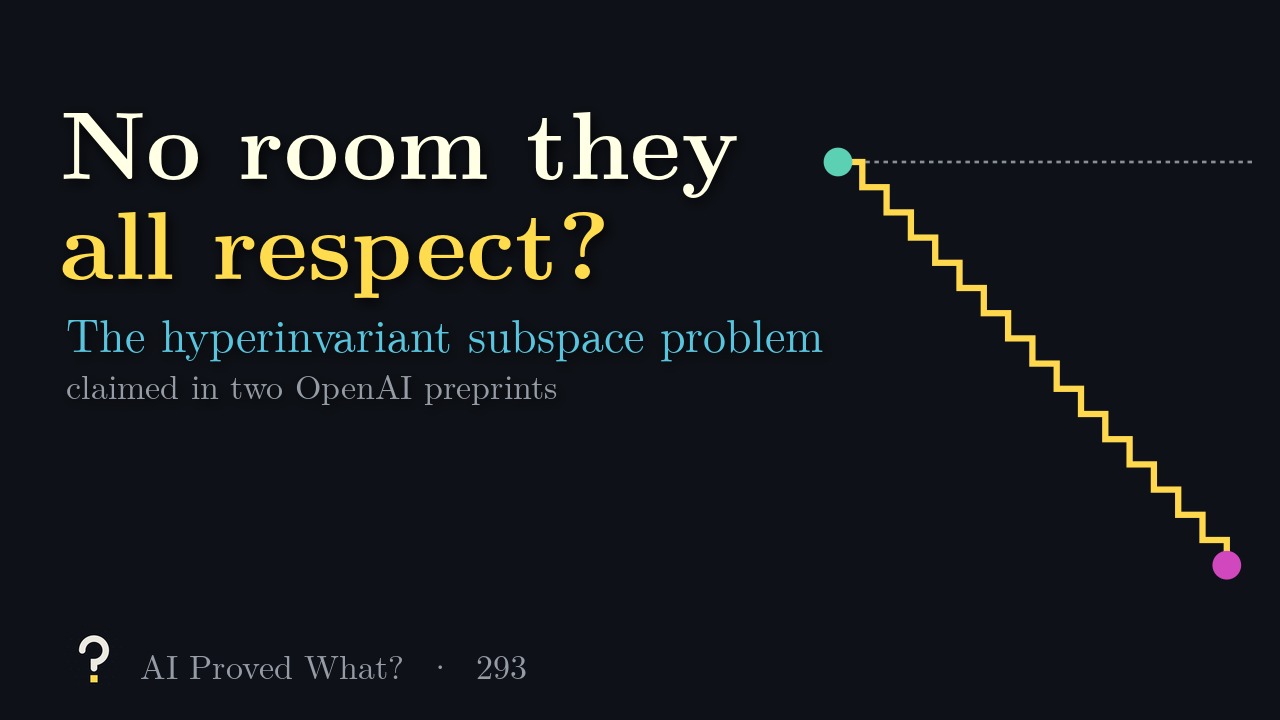
4:45. English captions available. The video loads from YouTube when you press play.
Chapters
The claim, in plain words
Every complex square matrix has an eigenvector, so in finite dimensions every operator maps some line into itself. The invariant subspace problem asks whether every operator on an infinite-dimensional Hilbert space has a nontrivial closed invariant subspace. In Banach spaces Enflo and Read showed the answer can be no; on Hilbert space it is still open (Enflo posted a claimed proof in 2023 that no one has confirmed). A stronger demand is a hyperinvariant subspace: one respected by every operator that commutes with the given one. Douglas and Pearcy studied it in 1972, linking it to transitive algebras, and Lomonosov proved in 1973 that every nonscalar operator commuting with a nonzero compact operator has one. A July 2025 survey still called the general question unknown. Inside the hyperfinite II₁ factor, Haagerup and Schultz proved in 2009 that an operator has invariant projections whenever its Brown measure is not concentrated at one point.
Result 293 is two OpenAI papers, 63 pages, dated September 27, 2026, and published October 6. Both prove what amounts to a negative answer to the hyperinvariant subspace problem: on every infinite-dimensional separable Hilbert space, a nonzero quasinilpotent operator whose commuting operators share no nonzero proper closed invariant subspace. Its commutant is then a proper transitive algebra, closed in the strong operator topology, which would answer the transitive algebra problem negatively too. The longer paper’s main theorem lives in the hyperfinite factor: for every irrational rotation angle, a weighted rotation with no nontrivial invariant projection in the factor, answering a question of Zhu, Fang and Shi; that in turn gives the Hilbert-space result.
What it doesn’t claim
The invariant subspace problem itself. The shorter paper’s operator even has many ordinary invariant subspaces, and that problem stays open.
Where it stands
- Posted as preprints
- OpenAI, two papers, 63 pages, dated September 27, 2026
- Peer reviewed
- Not yet
- Formalized in Lean
- The headline twice, plus four more statements (docs)
Last checked October 19, 2026. The papers have not been revised. In Lean, six comparators state results from both papers, and the headline is formalized twice: directly, in about 5,800 lines, and through the factor, in about 23,000. All six together use about 130,000 lines with no unproved steps in our scan; we built none of them. OSVerify has not reviewed them. No expert has commented on the proofs; one outside reviewer checked only a Lean statement.
How the proof goes
- Rigid ladders. The shorter paper stacks ladders over the 2-adic odometer, a clock that adds one with carries. Each ladder is a two-sided weighted shift whose weights shrink so fast both ways that their running product falls like e−5n²; its only invariant subspaces are tails. The nth power has norm at most e−10⌊(n+1)²/4⌋, at most e−300 by n = 10.
- A staircase that always goes down. As the clock ticks the weights drift, and a commuting operator can carry each tail one rung down on the next ladder. A proper hyperinvariant subspace would need a tail label that drops by at least one at every tick, impossible on a clock that preserves measure and mixes.
The numbers in the video
- Ours: for the Volterra operator, n! times the norm of its nth power is 0.5085 at n = 15, settling toward 1/2.
- Ours: for a weighted rotation whose weight has logarithm integrating to −∞, the nth root of the norm of the nth power is 7×10⁻⁶ at n = 100,000; for a positive weight it tends to 0.622.
- Ours: on a 16-step clock, the forced labels come back at least 16 rungs lower; cut to finitely many rungs, every tail is hyperinvariant.
Read the source
- Backward Intertwiners and a Transitive Commutant (PDF), 16 pages.
- Invariant-Projection Counterexamples for Every Irrational Rotation (PDF), 47 pages.
- Chalendar and Partington’s survey (arXiv, July 2025).
- The Lean formalization notes.
- The collection’s catalog, where this is result 293.
The 2 papers in this result
OpenAI groups related papers, such as alternative proofs, supporting results and consequences, into one result; we label the first paper it lists the main paper and the others companions.
Transcript
Read the full script
0:00The question
Every complex square matrix has an eigenvector, so in finite dimensions every operator maps some line into itself. The invariant subspace problem asks whether every operator on an infinite-dimensional Hilbert space has a nontrivial closed invariant subspace. In Banach spaces, Enflo and Read showed the answer can be no; on Hilbert space it is still open, though Enflo posted a claimed proof in 2023 that no one has confirmed. The Volterra integration operator is quasinilpotent: our computer finds n! times the norm of its nth power settling toward 1/2, so its powers die faster than any exponential. Yet it maps a whole chain of subspaces into themselves. A stronger demand is a hyperinvariant subspace: one respected by every operator that commutes with the given one. Douglas and Pearcy studied it in 1972, linking it to transitive algebras, and Lomonosov proved in 1973 that every nonscalar operator commuting with a nonzero compact operator has one. As recently as July 2025, a survey called it still unknown whether every Hilbert space operator does. There is a version inside the hyperfinite type II₁ factor, an algebra with a trace. Haagerup and Schultz proved in 2009 that an operator there has invariant projections whenever its Brown measure, a spread of generalized eigenvalues, is not concentrated at one point. That left the one-point case. Our computer tries a weighted rotation of that kind: when the logarithm of the weight integrates to minus infinity, the n-th root of the norm of its nth power sinks below 0.00001 after 100,000 steps.
1:48The claims
Result 293 is two OpenAI papers, 63 pages, dated September 27 and published October 6, 2026. Both prove what amounts to a negative answer to the hyperinvariant subspace problem: on every infinite-dimensional separable Hilbert space, a nonzero quasinilpotent operator whose commuting operators share no nonzero proper closed invariant subspace. Its commutant is then a proper transitive algebra, closed in the strong operator topology, which would answer the transitive algebra problem negatively too. The longer paper’s main theorem lives in the hyperfinite factor: for every irrational rotation angle, a weighted rotation with no nontrivial invariant projection in the factor, answering a question of Zhu, Fang and Shi, and that in turn gives the Hilbert space result. Not claimed: the invariant subspace problem itself. The shorter paper’s operator even has many ordinary invariant subspaces, and that problem stays open.
2:52How the proof goes
The shorter paper stacks ladders over the 2-adic odometer, a clock that adds one with carries. Each ladder is a two-sided weighted shift whose weights shrink so fast both ways that their running product falls like e^(−5n²), so rigid that its only invariant subspaces are tails. The operator’s powers collapse: the nth power has norm at most e^(−10⌊(n+1)²/4⌋), at most e^(−300) by n = 10. As the clock ticks, the weights drift, and a commuting operator can carry each tail one rung down on the next ladder. A proper hyperinvariant subspace would need a tail label that drops by at least one at every tick, impossible on a clock that preserves measure and mixes. Our computer runs the finite picture: a 16-step cycle comes back at least 16 rungs below where it started. Cut to finitely many rungs, the trick fails, as it must: in finite dimensions every nonscalar matrix has a hyperinvariant subspace.
3:59Where it stands
Both papers are unrefereed and unchanged since release. In Lean, six comparators state results from both papers, and the headline is formalized twice: directly, in about 5,800 lines, and through the factor, in about 23,000. All six together use about 130,000 lines; our scan finds no unproved steps, but we built none of them. OSVerify has not reviewed them, and no expert has commented on the proofs; one outside reviewer checked only a Lean statement. If it holds, an operator can have subspaces of its own but none that all its partners respect, and whether every operator has a subspace of its own is still open.
Spot a mistake?
This episode simplifies on purpose, but it shouldn’t be wrong. If something is, open an issue on GitHub or leave a comment on YouTube. Corrections are noted here with a date.