Every MASA, quadratically?
Two AI preprints claim the Popa–Vaes paving conjecture, with about 1/ε² blocks
Covers result 300 in OpenAI’s catalog: all 2 papers. See its connections to other results and the work it cites.
4:04. English captions available. The video loads from YouTube when you press play.
Chapters
The claim, in plain words
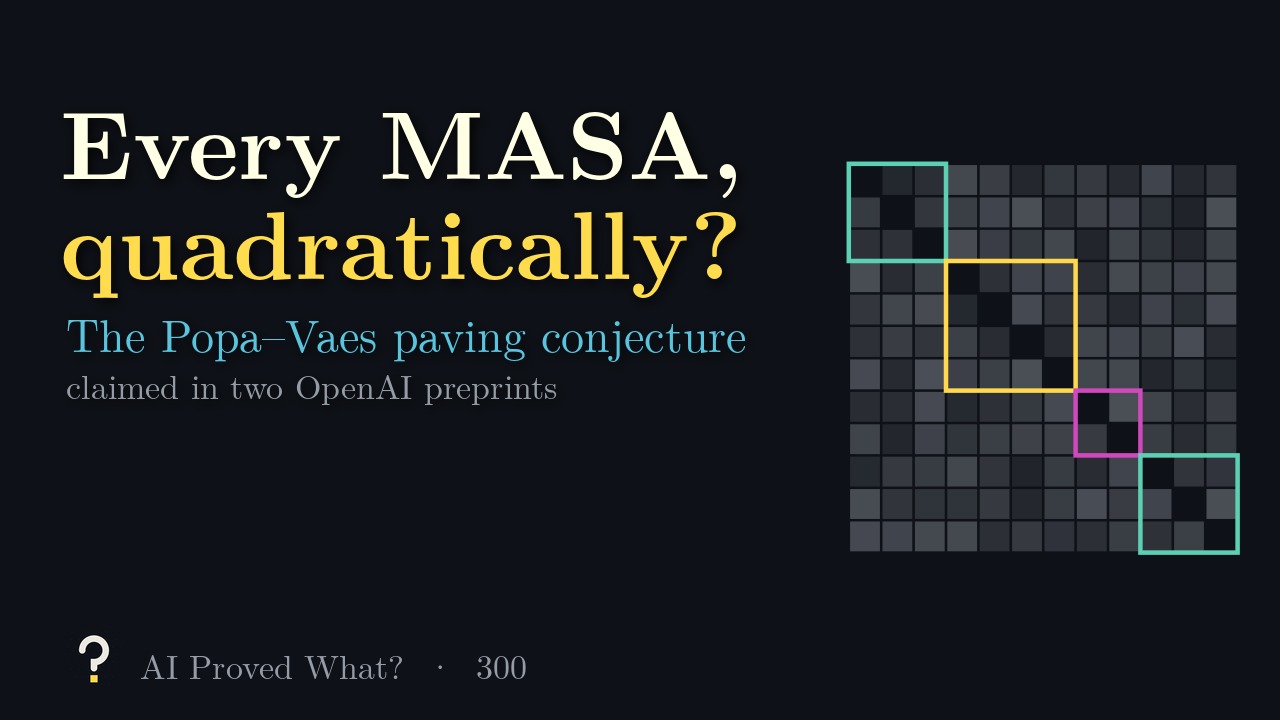
In 1959 Kadison and Singer asked whether pure states on the diagonal operators on ℓ² extend uniquely to states on all bounded operators. Anderson turned it into paving: can every zero-diagonal self-adjoint matrix be cut by diagonal blocks into a number of pieces depending only on the accuracy, each of small norm? Marcus, Spielman and Srivastava answered yes in 2013, and about 1/ε² blocks are needed. Popa and Vaes asked the same question in any von Neumann algebra, over any maximal abelian subalgebra, the analogue of the diagonal. Norm paving can fail there, so they used two weaker forms: strong-operator paving, which allows compression by a projection close to the identity, and approximation paving, which paves a nearby operator. In 2015 they conjectured both forms for subalgebras with a normal conditional expectation, said arbitrary ones ought to have them too, and conjectured about 1/ε² strong-operator blocks, a part they called more speculative.
Result 300 is two OpenAI papers, 102 pages, dated September 25, 2026, and published October 6. The main paper claims strong-operator paving of every self-adjoint element over every maximal abelian subalgebra of every von Neumann algebra, with at most 5×10⁸/ε² blocks: quadratic, the optimal exponent, though with a large constant. The companion paper claims approximation paving over every such subalgebra, with at most Cε−6 blocks, and quadratic when a normal conditional expectation exists, a step that uses the main paper.
What it doesn’t claim
Norm paving of the operator itself, which can fail; operators that are not self-adjoint; or good constants. There is no Lean formalization for this item.
Where it stands
- Posted as preprints
- OpenAI, two papers, 102 pages, dated September 25, 2026
- Peer reviewed
- Not yet
- Checked in Lean
- No formalization for this item
Last checked October 19, 2026. The papers have not been revised. There is no Lean formalization for this item, OSVerify has not reviewed it, and we found no expert comment or reported error.
How the proof goes
- Interlacing polynomials. Average characteristic polynomials over random colorings, show the average is real-rooted with a small largest root, and conclude that some coloring does at least as well. The main paper uses Ravichandran and Srivastava’s version, with one coloring for both signs.
- Into the von Neumann algebra. Measured graphs and free products carry the matrix argument into the von Neumann algebra, and a spectral cut supplies the projection.
The numbers in the video
- Ours: paving a 102×102 conference matrix, the best norm found stays near √(2/r) with r blocks, and a simple bound shows no paving beats about 1/√r.
- Blocks at ε = 0.1: the lower bound is 100; Ravichandran and Srivastava’s matrix result gives about 3,600 (our arithmetic); Marcus, Spielman and Srivastava’s original count 13 million; the new strong-operator bound 40 billion; the approximation bound at least 1021. Only the first is a requirement; the rest are proven upper bounds.
Read the source
- Quadratic Strong-Operator Paving over Arbitrary Maximal Abelian Subalgebras (PDF), 54 pages.
- Approximation Paving over Arbitrary Maximal Abelian Subalgebras (PDF), 48 pages.
- Popa and Vaes, “Paving over arbitrary MASAs in von Neumann algebras” (arXiv, 2014; Anal. PDE 2015).
- The collection’s catalog, where this is result 300.
The 2 papers in this result
OpenAI groups related papers, such as alternative proofs, supporting results and consequences, into one result; we label the first paper it lists the main paper and the others companions.
Transcript
Read the full script
0:00The question
In 1959 Kadison and Singer asked whether pure states on the diagonal operators on ℓ² extend uniquely to states on all bounded operators. Anderson turned it into paving: can every zero-diagonal self-adjoint matrix be cut by diagonal blocks into a number of pieces depending only on the accuracy, each of small norm? Marcus, Spielman and Srivastava answered yes in 2013. Our computer paves a conference matrix of size 102: the best norm it finds stays near the √(2/r), and a simple bound shows no paving beats about 1/√r, so about 1/ε² blocks are needed. Popa and Vaes asked the same question in any von Neumann algebra, over any maximal abelian subalgebra, the analogue of the diagonal. Norm paving can fail there, so they used two weaker forms: strong-operator paving, which allows compression by a projection close to the identity, and approximation paving, which paves a nearby operator. In 2015 they conjectured both forms for subalgebras with a normal conditional expectation, said arbitrary ones ought to have them too, and conjectured about 1/ε² strong-operator blocks, a part they called more speculative. They proved quartic bounds for type I algebras and for some Cartan subalgebras, and quadratic bounds for ultraproducts of singular ones. In general, the conjecture stayed open.
1:34The claims
Result 300 is two OpenAI papers, 102 pages, dated September 25 and published October 6, 2026. The main paper claims strong-operator paving of every self-adjoint element over every maximal abelian subalgebra of every von Neumann algebra, with at most 5 × 10⁸/ε² blocks: quadratic, the optimal exponent, though with a large constant. The companion paper claims approximation paving over every such subalgebra, with at most a constant times ε⁻⁶ blocks, and quadratic when a normal conditional expectation exists, a step that uses the main paper. Not claimed: norm paving of the operator itself, which can fail; operators that are not self-adjoint; or good constants. There is no Lean formalization for this item.
2:26How the proof goes
The engine is the interlacing-polynomial method of Marcus, Spielman and Srivastava: average characteristic polynomials over random colorings, show the average is real-rooted with a small largest root, and conclude that some coloring does at least as well. Our computer checks this on small examples: the expected polynomial is real-rooted, and the best partition beats its largest root. The main paper uses Ravichandran and Srivastava’s version, with one coloring for both signs. Measured graphs and free products then carry the matrix argument into the von Neumann algebra, and a spectral cut supplies the projection. The cost shows in the numbers. At ε = 0.1, the lower bound is 100 blocks; Ravichandran and Srivastava’s matrix result gives about 3,600; Marcus, Spielman and Srivastava’s original count is 13 million; the new strong-operator bound is 40 billion; and the approximation bound is at least 10²¹.
3:31Where it stands
Both papers are unrefereed and unchanged since release. There is no Lean formalization for this item, OSVerify has not reviewed it, and we found no expert comment or reported error. If it holds, every self-adjoint element of every von Neumann algebra can be paved over every maximal abelian subalgebra, in the strong-operator sense, with a number of blocks growing only like 1/ε², the best possible exponent.
Spot a mistake?
This episode simplifies on purpose, but it shouldn’t be wrong. If something is, open an issue on GitHub or leave a comment on YouTube. Corrections are noted here with a date.