Stem 322 survives?
An AI preprint claims to settle the Kervaire invariant problem at the prime three
Covers result 309 in OpenAI’s catalog: its one paper. See its connections to other results and the work it cites.
4:34. English captions available. The video loads from YouTube when you press play.
Chapters
The claim, in plain words
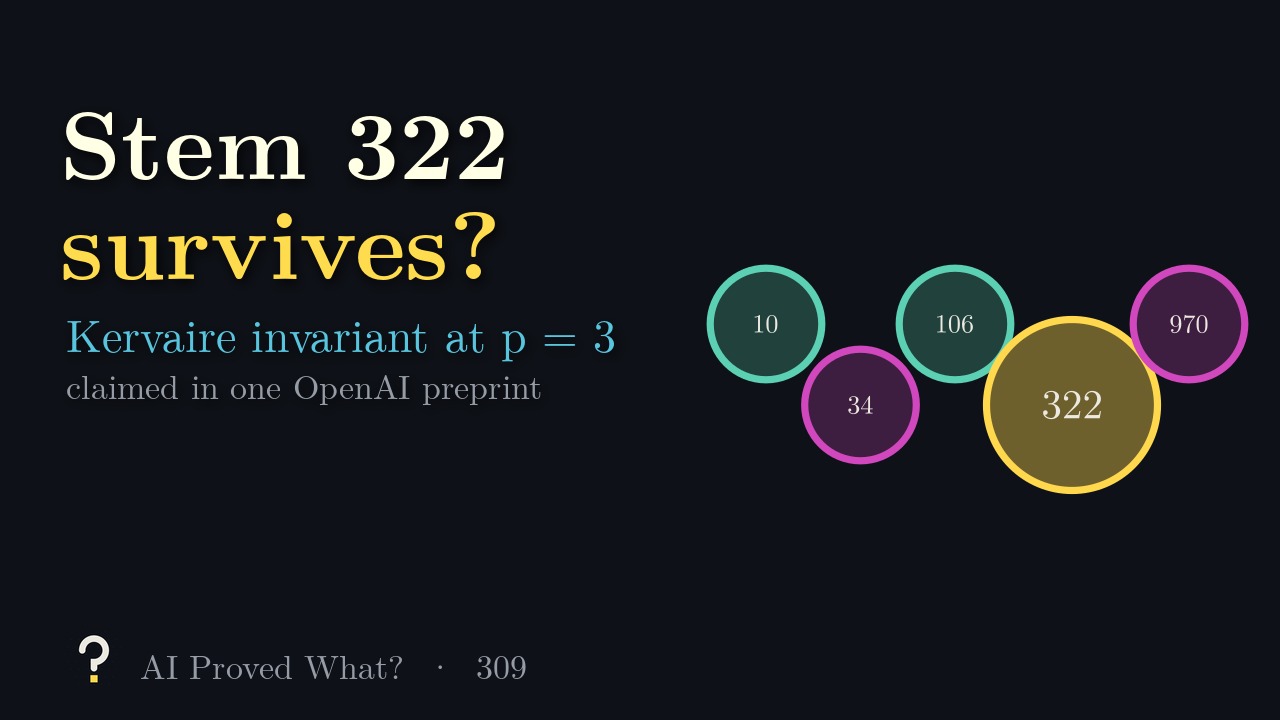
At the prime two, the Kervaire invariant problem asks in which dimensions a framed manifold can have Kervaire invariant one. Browder turned it into whether certain classes, h_j², survive the Adams spectral sequence, and the answer is dimensions 2, 6, 14, 30, 62 and 126 only: Mahowald and Tangora settled 30, Barratt, Jones and Mahowald 62, Hill, Hopkins and Ravenel ruled out everything beyond 126 in 2016, and a 2024 computer-assisted preprint by Lin, Wang and Xu settled 126. At odd primes there is an analogous family, the classes b_j on the Adams two-line, a homotopy question rather than one about manifolds; at the prime three their stems are 10, 34, 106, 322, 970 and on. The first survives; Toda showed the second dies at every odd prime; Ravenel showed in 1978 that at primes 5 and up all but the first die, and noted that at three the class in stem 106 survives. Ravenel’s book still says the fate of the higher ones at three is unknown.
Result 309 is one OpenAI paper, 90 pages, dated September 24, 2026, and made public October 6. It claims that at the prime three, exactly the standard classes with indices 0, 2 and 3 survive, in stems 10, 106 and 322, and that each surviving coset contains an element of order exactly 3. The new parts are that stem 322 survives and that every class from stem 970 on dies. Along the way it proves a conjecture of Belmont and Ray about a symmetry of order 9, refutes one clause of another conjecture as they stated it, and draws unstable consequences.
What it doesn’t claim
Other primes, anything about manifolds, the whole homotopy group in stem 322, or that every element of the coset has order 3.
Where it stands
- Posted as a preprint
- OpenAI, 90 pages, dated September 24, 2026
- Peer reviewed
- Not yet
- Checked in Lean
- No formalization for this item
Last checked October 19, 2026. The paper has not been revised; there is no Lean formalization and no code for its large calculations. OSVerify has not reviewed it. In the first twelve days we found no public specialist assessment and no reported error. The topologist Kyle Ormsby noted on Bluesky that the 90-page computation contains no charts; that is a remark on presentation, not a verdict on correctness.
How the proof goes
- Killing the higher classes. The paper detects them in a homotopy fixed point spectrum of Morava E-theory with a cyclic group of order 9. Euler class bounds make the localized spectral sequences die out by differentials of length at most 157 or 469, and the known survivor in stem 106 forces a differential of length 93, which forces every higher detector to support a differential too. The stem-322 detector has a different key, so this argument does not touch it.
- Building the stem-322 class. A Toda-style construction built from the stem-106 class lands in stem 3 × 10⁸ − 2 = 322, and is then corrected, using a large finite linear-algebra calculation; the paper reports eliminations such as about 137,000 equations of rank about 23,000, but supplies no code.
The numbers in the video
- Ours: the stems from 970 on are all two less than a multiple of 972, and their detectors have key 0 mod 9, while the stem-322 detector has key 6.
- Ours: we rebuilt the mod-3 cobar complex from scratch and reproduced the paper’s small checkpoints exactly: dimensions 12 and 470, ranks 11 and 456, leaving a three-dimensional group. That checks only the small numbers, not the large calculation or the topology.
Read the source
- The Kervaire Invariant Problem at the Prime Three (PDF), 90 pages.
- The collection’s catalog, where this is result 309.
The paper
OpenAI groups related papers into one result; this one has a single paper.
Transcript
Read the full script
0:00The question
At the prime two, the Kervaire invariant problem asks in which dimensions a framed manifold can have Kervaire invariant one. Browder turned it into a question about whether certain classes, h_j², survive the Adams spectral sequence. The answer is dimensions 2, 6, 14, 30, 62 and 126 only: Mahowald and Tangora settled 30, Barratt, Jones and Mahowald 62, Hill, Hopkins and Ravenel ruled out everything beyond 126 in 2016, and a 2024 preprint by Lin, Wang and Xu, computer-assisted, settled 126. At odd primes there is an analogous family, the classes b_j on the Adams two-line, a homotopy question rather than one about manifolds. Our computer lists their stems at the prime three: 10, 34, 106, 322, 970 and on. The first survives. Toda showed the second dies at every odd prime. Ravenel showed in 1978 that at primes 5 and up all but the first die, and noted that at three the stem 106 class survives. Ravenel’s book still says they do not know the fate of the higher ones at three. Hill, Hopkins and Ravenel wrote an unfinished three-primary note in 2011, and expected their method to leave stem 322 open. Our computer draws a small corner of the mod-3 Adams chart, where the first class sits in stem 10.
1:31The claim
Result 309 is one OpenAI paper, 90 pages, dated September 24 and made public October 6, 2026. It claims that at the prime three, exactly the classes with indices 0, 2 and 3 survive, in stems 10, 106 and 322, and that each surviving coset contains an element of order exactly 3. The new parts are that stem 322 survives and that every class from stem 970 on dies. Along the way it proves a conjecture of Belmont and Ray about a symmetry of order 9, refutes one clause of another conjecture as they stated it, and draws unstable consequences. Not claimed: other primes, anything about manifolds, the whole homotopy group in stem 322, or that every element of the coset has order 3.
2:26How the proof goes
For the higher classes, the paper detects them in a homotopy fixed point spectrum of Morava E-theory with a cyclic group of order 9. Euler class bounds make the localized spectral sequences die out by differentials of length at most 157 or 469, and the known survivor in stem 106 forces a differential of length 93, which forces every higher detector to support a differential too. Our computer checks the bookkeeping: the stems from 970 on are all two less than a multiple of 972, and their detectors have key 0 mod 9, while the stem 322 detector has key 6, so this argument does not touch it. For stem 322, a Toda-style construction built from the stem 106 class lands in stem 3 × 10⁸ − 2, and is then corrected, using a large finite linear-algebra calculation. The paper reports eliminations such as about 137,000 equations of rank about 23,000, but supplies no code. Our computer rebuilt the mod-3 cobar complex from scratch and reproduced the paper’s small checkpoints exactly: dimensions 12 and 470, ranks 11 and 456, leaving a three-dimensional group. That checks only the small numbers, not the large calculation or the topology.
3:53Where it stands
The paper is unrefereed and unchanged since release, with no Lean formalization and no code. In the first 12 days we found no public specialist assessment and no reported error. The topologist Kyle Ormsby noted on Bluesky that the 90-page computation contains no charts; that is a remark on presentation, not a verdict on correctness. If it holds, the Kervaire problem at the prime three is closed for the standard classes: exactly those in stems 10, 106 and 322 survive, and the one in stem 322 is new.
Spot a mistake?
This episode simplifies on purpose, but it shouldn’t be wrong. If something is, open an issue on GitHub or leave a comment on YouTube. Corrections are noted here with a date.