Heights lost?
An AI preprint claims the chromatic fixed-point loss of a finite p-group equals its cyclic length
Covers result 314 in OpenAI’s catalog: its one paper. See its connections to other results and the work it cites.
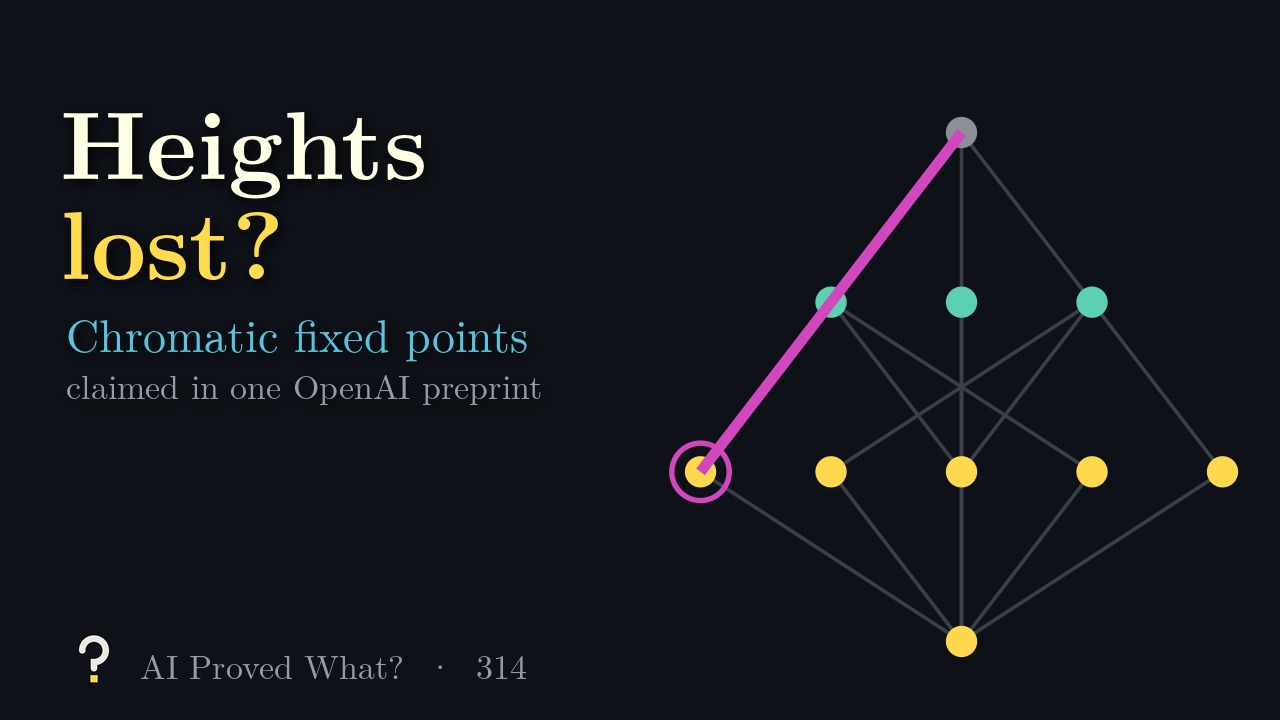
5:06. English captions available. The video loads from YouTube when you press play.
Chapters
The claim, in plain words
Smith theory, from the 1940s, says that when a finite p-group acts on a finite complex that looks like a point in mod p homology, the fixed points look like a point too. Chromatic homotopy theory replaces mod p homology by a ladder of Morava K-theories, K(0), K(1), K(2) and so on, each one a finer lens, called a height. The chromatic version of Smith’s question: if the fixed points of a subgroup H are invisible at one height, at which height must the fixed points of the whole group G be invisible? The number of heights lost is the loss from H to G.
In 2015 Balmer and Sanders showed that these losses describe the topology of a space of primes, and guessed that the loss is the number of prime-order steps from H to G. In 2017, Barthel, Hausmann, Naumann, Nikolaus, Noel and Stapleton showed that for abelian groups it is the number of generators of the quotient, so a cyclic group of order p² loses one height, not two. For nonabelian groups, Kuhn and Lloyd found in 2020 that a reflection subgroup of the dihedral group of order 8 loses two heights, although the easy lower bound gives one, and expressed cautious hope that in general the loss is the length of the shortest chain from H to G, each step normal in the next with a cyclic quotient: the cyclic length. In 2023 Balderrama and Kuhn asked whether the loss for a reflection in the dihedral group of order 16 is two or three.
Result 314 is one OpenAI paper, 30 pages, dated September 24, 2026, and made public October 6. It claims that for every prime, every finite p-group G, every subgroup H and every height, the loss from H to G is exactly the cyclic length. So the loss does not depend on the height, and for the reflection in the dihedral group of order 16, the formula gives three. Combined with Balmer and Sanders’ earlier reduction, it gives the finite-height inclusion test for the space of primes of every finite group.
What is new, and what isn’t claimed
Only the lower bound is new, beyond abelian groups and Kuhn and Lloyd’s family; the upper bound, one height per cyclic step, was already known. The spectra that show the bound is sharp are proved to exist by contradiction, not built. Not claimed: compact Lie groups, or the parts of the space of primes that Balmer and Sanders had already settled.
Where it stands
- Posted as a preprint
- OpenAI, 30 pages, dated September 24, 2026
- Peer reviewed
- Not yet
- Checked in Lean
- No formalization for this item
Last checked October 19, 2026. The paper has not been revised, and there is no Lean formalization for this item. OSVerify has not reviewed it. On October 10, Nick Kuhn, co-author of the question, wrote on the algebraic topology mailing list, about this paper and one other: “To the extent I have looked, I would not bet any money that either has a correct proof,” adding that the first hint of the logical flow of the main proof occurs on page 28 of the 30. The introduction does sketch the proof in about a page. The message names no error, nobody replied, and we found no competing claim or other expert comment on this paper.
How the proof goes
- A profinite group from the chromatic data. For the lower bound, the paper builds a profinite group out of which finite groups the height-local sphere can see, and integrates over finite groupoids to get two arithmetic facts about it. One says that the number of homomorphisms into any finite group, divided by that group’s order, has no p in its denominator.
- Group theory, then every height. Pure group theory then shows that such a group is built from at most as many copies of the p-adic integers as the height, so its finite quotients have short cyclic chains. Nilpotence and ambidexterity carry the bound from rational information to every height, and a Balmer–Sanders-style argument finishes: a prime breaking the bound would split an irreducible closed set in two.
The numbers in the video
- Ours: the cyclic length for all 385 conjugacy classes of subgroups in 30 small p-groups. It equals the number of generators of the quotient in every abelian case, and is smaller than the number of prime-order steps in 81 classes: the cyclic group of order 16 is one step, not four.
- Ours, by our bookkeeping: 216 classes in abelian groups, 80 in Kuhn and Lloyd’s family, 64 forced by known bounds, and 25 not settled before. The reflection in the dihedral group of order 16 has cyclic length 3.
- Ours: the p-adic integers pass the homomorphism-count test for all 38 small targets we tried, while a cyclic group of order p fails it for 23.
- Ours: subgroup counts in the plane over the 2-adic integers, 1, 3, 7, 15, …, converge 2-adically to −1.
Read the source
- Cyclic Length and Chromatic Fixed-Point Loss (PDF), 30 pages.
- The collection’s catalog, where this is result 314.
The paper
OpenAI groups related papers into one result; this one has a single paper.
Transcript
Read the full script
0:00The question
Smith theory, from the 1940s, says that when a finite p-group acts on a finite complex that looks like a point in mod p homology, the fixed points look like a point too. Chromatic homotopy theory replaces mod p homology by a ladder of Morava K-theories, K(0), K(1), K(2) and so on, each one a finer lens, called a height. The chromatic version of Smith’s question: if the fixed points of a subgroup H are invisible at one height, at which height must the fixed points of the whole group G be invisible? The number of heights lost is the loss from H to G. In 2015 Balmer and Sanders showed that these losses describe the topology of a space of primes, and guessed that the loss is the number of prime-order steps from H to G. In 2017, Barthel, Hausmann, Naumann, Nikolaus, Noel and Stapleton showed that for abelian groups it is the number of generators of the quotient, so a cyclic group of order p² loses one height, not two. For nonabelian groups, Kuhn and Lloyd found in 2020 that a reflection subgroup of the dihedral group of order 8 loses two heights, although the easy lower bound gives one, and expressed cautious hope that in general the loss is the length of the shortest chain from H to G, each step normal in the next with a cyclic quotient. Our computer finds that chain inside the dihedral group. Call the length of that shortest chain the cyclic length. Our computer finds it for all 385 conjugacy classes of subgroups in 30 small p-groups. It equals the number of generators of the quotient in every abelian case, and it is smaller than the number of prime-order steps in 81 classes: the cyclic group of order 16 is one step, not four. By our bookkeeping, 25 classes in all were not settled by earlier results. One is a test case Balderrama and Kuhn posed in 2023: is the loss for a reflection in the dihedral group of order 16 equal to two or three?
2:03The claim
Result 314 is one OpenAI paper, 30 pages, dated September 24 and made public October 6, 2026. It claims that for every prime, every finite p-group G, every subgroup H and every height, the loss from H to G is exactly the cyclic length. So the loss does not depend on the height, and for the reflection in the dihedral group of order 16, the formula gives three. Combined with Balmer and Sanders’ earlier reduction, it gives the finite-height inclusion test for the space of primes of every finite group. Only the lower bound is new, beyond abelian groups and Kuhn and Lloyd’s family; the upper bound, one height per cyclic step, was already known. The spectra that show the bound is sharp are proved to exist by contradiction, not built. Not claimed: compact Lie groups, or the parts of the space of primes that Balmer and Sanders had already settled.
3:03How the proof goes
For the lower bound, the paper builds a profinite group out of which finite groups the height-local sphere can see, and integrates over finite groupoids to get two arithmetic facts about it. One says that the number of homomorphisms into any finite group, divided by that group’s order, has no p in its denominator. Our computer shows why that matters: the p-adic integers pass this test for all 38 small targets we tried, while a cyclic group of order p fails it for 23. Pure group theory then shows that such a group is built from at most as many copies of the p-adic integers as the height, so its finite quotients have short cyclic chains. A key step counts subgroups: in the plane over the 2-adic integers, the counts are 1, 3, 7, 15, which our computer shows converge 2-adically to −1. The arithmetic facts would force a related count to zero, and that clash yields the next copy of the p-adic integers. Nilpotence and ambidexterity then carry the bound from rational information to every height, and a Balmer–Sanders-style argument finishes: a prime breaking the bound would split an irreducible closed set in two.
4:15Where it stands
The paper is unrefereed and unchanged since release, and there is no Lean formalization. On October 10, Nick Kuhn, co-author of the question, wrote on the algebraic topology mailing list, about this paper and one other, “To the extent I have looked, I would not bet any money that either has a correct proof”, and that the first hint of the logical flow of the main proof occurs on page 28 of the 30. The introduction does sketch the proof in about a page. The message names no error, nobody replied, and we found no competing claim or other expert comment on this paper. If it holds, passing from H-fixed points to G-fixed points costs exactly one height per step of the shortest cyclic chain, at every height and for every finite p-group.
Spot a mistake?
This episode simplifies on purpose, but it shouldn’t be wrong. If something is, open an issue on GitHub or leave a comment on YouTube. Corrections are noted here with a date.