Never negative?
An AI preprint claims the Singer conjecture in dimension four
Covers result 315 in OpenAI’s catalog: its one paper. See its connections to other results and the work it cites.
4:48. English captions available. The video loads from YouTube when you press play.
Chapters
The claim, in plain words
A space is aspherical when its universal cover is contractible, like the torus, whose cover is flat space, or a surface of higher genus, whose cover is the hyperbolic plane. Then its fundamental group determines it up to homotopy. In the early 1970s Thurston suggested that for a closed aspherical manifold, the dimension decides which sign the Euler characteristic may have, with zero allowed; in dimension 4, it should never be negative. Our computer lists known examples: the 4-torus and surface times torus have 0, a product of two genus-2 surfaces has 4, a fake projective plane has 3.
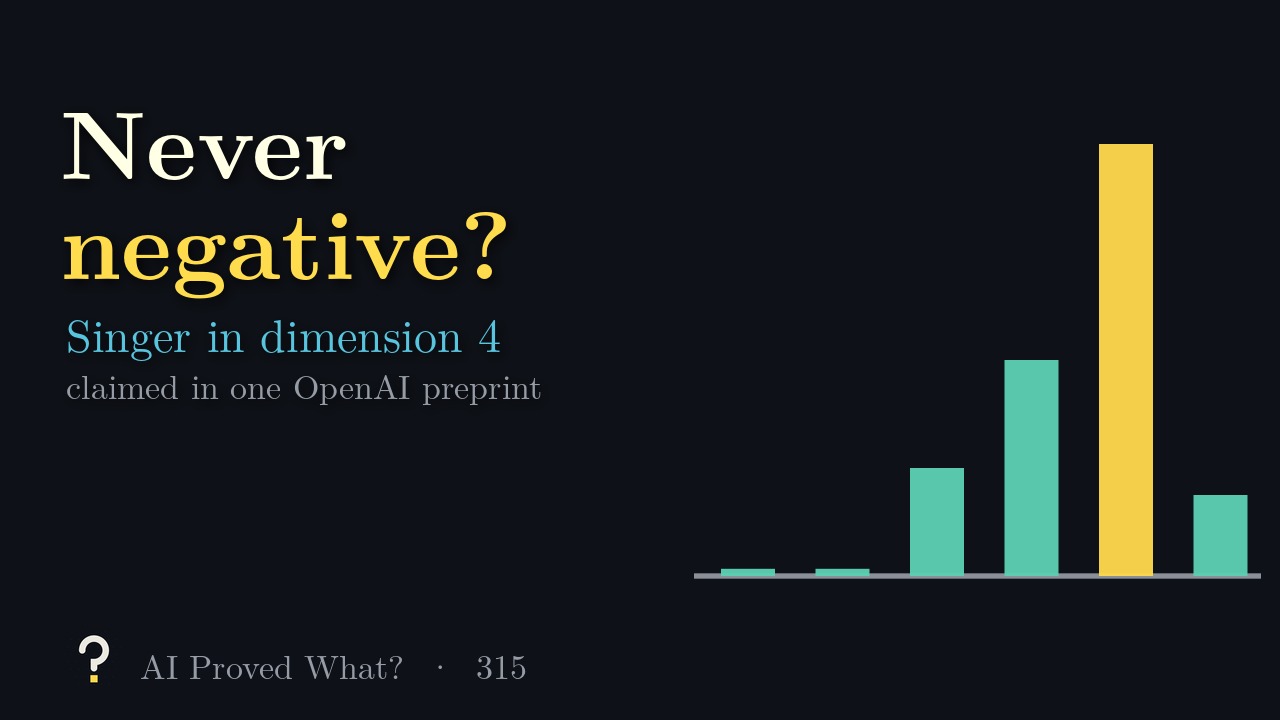
In the 1970s Isadore Singer suggested a route through square-integrable harmonic forms on the universal cover. In modern form, L²-Betti numbers measure the square-integrable homology of the universal cover per copy of the fundamental domain, and the Euler characteristic is their alternating sum. The Singer conjecture says that for a closed aspherical manifold they vanish except in the middle degree. In dimension 4 that forces the Euler characteristic to equal the middle number, so it cannot be negative. Our computer shows the pattern on a product of two genus-2 surfaces: Betti numbers of bigger and bigger covers, divided by the degree, drift toward 0, 0, 4, 0, 0.
Dimensions up to three were known, the third through Lott and Lück’s work and geometrization. In dimension 4, special families were known, among them Kähler surfaces through Gromov’s work, complex surfaces with residually finite fundamental group by Albanese, Di Cerbo and Lombardi, right-angled reflection-group manifolds by Davis and Okun, groups with hierarchies by Okun and Schreve, and branched covers by Avramidi, Okun and Schreve. The general case stayed open; in 2023 Kirstein, Kremer and Lück wrote of the conjecture that no promising proof strategy is known.
Result 315 is one OpenAI paper, 45 pages, dated September 25 and made public October 6, 2026. It claims that for every closed aspherical topological 4-manifold, the L²-Betti numbers vanish outside degree 2, and more generally for every finite aspherical Poincaré complex of formal dimension 4, including nonorientable ones, a wider version Lück had formulated. So the Euler characteristic is never negative, and for oriented manifolds it is at least the absolute value of the signature, a consequence Lück had shown follows.
What it doesn’t claim
Only degree 1 is hard: duality handles the rest. Not claimed: any other dimension, the signature bound for Poincaré complexes, or anything about the middle number beyond its equalling the Euler characteristic.
Where it stands
- Posted as a preprint
- OpenAI, 45 pages, dated September 25, 2026
- Peer reviewed
- Not yet
- Checked in Lean
- No formalization of the theorem; a 235-line file checks part of one lemma
Last checked October 19, 2026. The paper is unrefereed and unchanged since release. A 235-line Lean file checks an elementary fact about finite-energy gradients on graphs, part of one lemma, not the theorem. In the first 12 days we found no expert verdict, no reported error and no competing claim. On October 11, Grigori Avramidi, who works on this conjecture, offered to post a summary of it, if someone set up a forum for such summaries. OSVerify has not reviewed it.
How the proof goes
- Energy at infinity. The proof is by contradiction, and it uses no Riemannian metric and no differential forms. If the first L²-Betti number were positive, the Cayley graph of the fundamental group would carry a function of finite energy that tells directions at infinity apart. Our computer shows the contrast: on the tree of a free group, separating one branch costs energy that settles at 1/2, while on the grids of ℤ² and ℤ⁴ the cost keeps growing.
- A dendrite with no cut points. From that function the paper builds a boundary at infinity, on which the group acts as a convergence group. Poincaré duality makes the boundary free of loops mod 2, and finite energy keeps it at most one-dimensional. Bowditch’s cut-point trees then reduce it to a piece with no cut points, and a long path-pushing argument shows that piece is locally connected. That makes it a dendrite, a tree-like continuum, and every dendrite has cut points: a contradiction. Our own reading, which a specialist would need to check: after the opening reductions, the argument seems to use only properties that groups of finite aspherical Poincaré complexes share in every dimension from 3 up, so either dimension 4 enters somewhere we missed, or the method would prove more than the paper claims.
The numbers in the video
- Ours: Euler characteristics of known aspherical 4-manifolds: the 4-torus and a surface times a torus have 0, a product of two genus-2 surfaces has 4, genus 2 and 3 has 8, two genus-3 surfaces 16, and a fake projective plane 3.
- Ours: covers of a product of two genus-2 surfaces; Betti numbers divided by the degree are (0.04, 0.96, 5.84, 0.96, 0.04) at degree 25, drifting toward (0, 0, 4, 0, 0).
- Ours: the energy needed to separate one direction at infinity settles at 1/2 on the free group’s tree, and keeps growing on the grids ℤ² (3.13 at radius 64) and ℤ⁴ (10.0, 39.3, 94.7 at radius 2, 3, 4).
Read the source
- The Singer Conjecture in Dimension Four (PDF), 45 pages.
- The collection’s catalog, where this is result 315.
The paper
OpenAI groups related papers into one result; this one has a single paper.
Transcript
Read the full script
0:00The question
A space is aspherical when its universal cover is contractible, like the torus, whose cover is flat space, or a surface of higher genus, whose cover is the hyperbolic plane. Then its fundamental group determines it up to homotopy. In the early 1970s Thurston suggested that for a closed aspherical manifold, the dimension decides which sign the Euler characteristic may have, with zero allowed; in dimension 4, it should never be negative. Our computer lists known examples: the 4-torus and surface times torus have 0, a product of two genus-2 surfaces has 4, a fake projective plane has 3. In the 1970s Isadore Singer suggested a route through square-integrable harmonic forms on the universal cover. In modern form, L²-Betti numbers measure the square-integrable homology of the universal cover per copy of the fundamental domain, and the Euler characteristic is their alternating sum. The Singer conjecture says that for a closed aspherical manifold they vanish except in the middle degree. In dimension 4 that forces the Euler characteristic to equal the middle number, so it cannot be negative. Our computer shows the pattern on a product of two genus-2 surfaces: Betti numbers of bigger and bigger covers, divided by the degree, drift toward 0, 0, 4, 0, 0. Dimensions up to three were known, the third through Lott and Lück’s work and geometrization. In dimension 4, special families were known, among them Kähler surfaces through Gromov’s work, complex surfaces with residually finite fundamental group by Albanese, Di Cerbo and Lombardi, right-angled reflection-group manifolds by Davis and Okun, groups with hierarchies by Okun and Schreve, and branched covers by Avramidi, Okun and Schreve. The general case stayed open; in 2023 Kirstein, Kremer and Lück wrote of the conjecture that no promising proof strategy is known.
2:00The claim
Result 315 is one OpenAI paper, 45 pages, dated September 25 and made public October 6, 2026. It claims that for every closed aspherical topological 4-manifold, the L²-Betti numbers vanish outside degree 2, and more generally for every finite aspherical Poincaré complex of formal dimension 4, including nonorientable ones, a wider version Lück had formulated. So the Euler characteristic is never negative, and for oriented manifolds it is at least the absolute value of the signature, a consequence Lück had shown follows. Only degree 1 is hard: duality handles the rest. Not claimed: any other dimension, the signature bound for Poincaré complexes, or anything about the middle number beyond its equalling the Euler characteristic.
2:53How the proof goes
The proof is by contradiction, and it uses no Riemannian metric and no differential forms. If the first L²-Betti number were positive, the Cayley graph of the fundamental group would carry a function of finite energy that tells directions at infinity apart. Our computer shows the contrast: on the tree of a free group, separating one branch costs energy that settles at 1/2, while on the grids of ℤ² and ℤ⁴ the cost keeps growing. From that function the paper builds a boundary at infinity, on which the group acts as a convergence group. Poincaré duality makes the boundary free of loops mod 2, and finite energy keeps it at most one-dimensional. Bowditch’s cut-point trees then reduce it to a piece with no cut points, and a long path-pushing argument shows that piece is locally connected. That makes it a dendrite, a tree-like continuum, and every dendrite has cut points: a contradiction. Our own reading, which a specialist would need to check: after the opening reductions, the argument seems to use only properties that groups of finite aspherical Poincaré complexes share in every dimension from 3 up, so either dimension 4 enters somewhere we missed, or the method would prove more than the paper claims.
4:08Where it stands
The paper is unrefereed and unchanged since release. A 235-line Lean file checks an elementary fact about finite-energy gradients on graphs, part of one lemma, not the theorem. In the first 12 days we found no expert verdict, no reported error and no competing claim. On October 11, Grigori Avramidi, who works on this conjecture, offered to post a summary of it, if someone set up a forum for such summaries. If it holds, every closed aspherical 4-manifold has its L²-Betti numbers only in the middle degree, so its Euler characteristic is never negative.
Spot a mistake?
This episode simplifies on purpose, but it shouldn’t be wrong. If something is, open an issue on GitHub or leave a comment on YouTube. Corrections are noted here with a date.