Finitely built?
An AI preprint claims counterexamples to the Hahn–Wilson conjecture at height two
Covers result 319 in OpenAI’s catalog: its one paper. See its connections to other results and the work it cites.
3:41. English captions available. The video loads from YouTube when you press play.
Chapters
The claim, in plain words
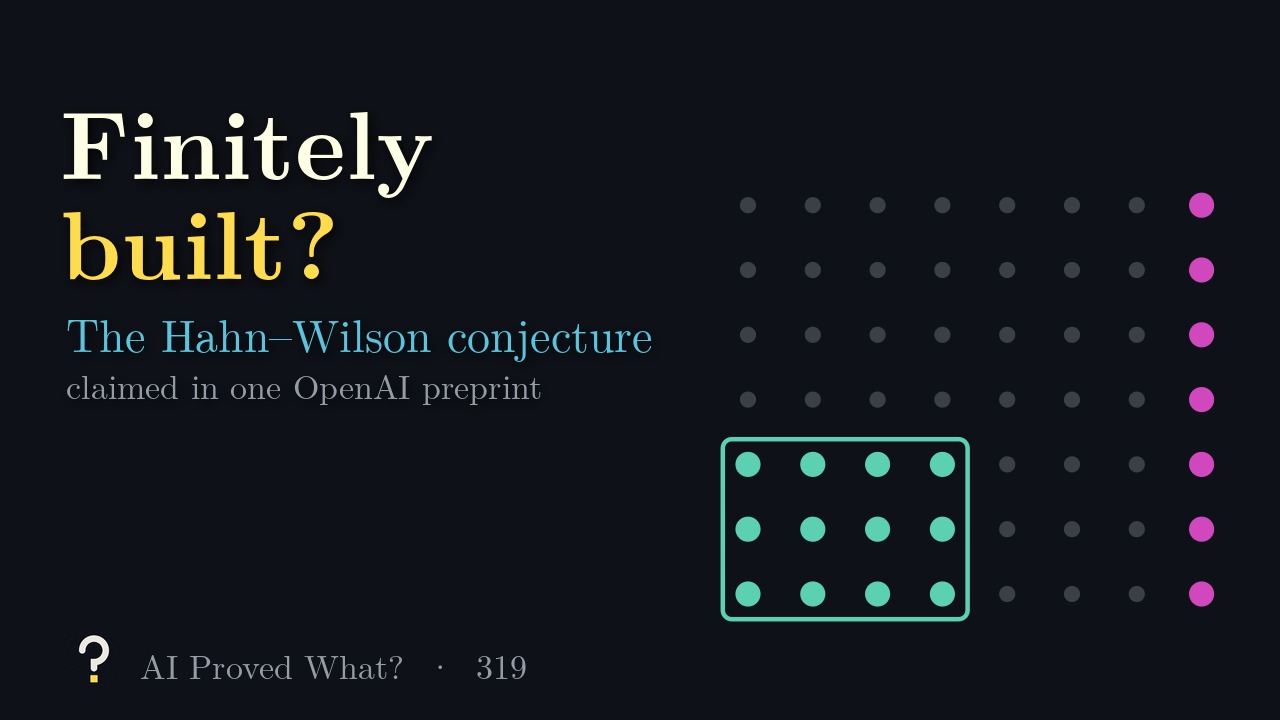
In 1999 Mahowald and Rezk singled out a class of infinite spectra, the fp-spectra, whose homotopy becomes finite after you smash them with a suitable finite probe. The fp-type measures the probe you need: it is one less than the lowest type of probe that works. The model example of fp-type n is the truncated Brown–Peterson spectrum, BP⟨n⟩. Our computer shows the test at height 2 and the prime 3: smash BP⟨2⟩ with a suitable probe of type 3, and its homotopy shrinks to a finite box; a probe of type 2 leaves an infinite column.
The conjecture, attributed to Hahn and Wilson, is that this is the whole story: every spectrum of fp-type at most n can be built from BP⟨n⟩ in finitely many steps, by sums, shifts, cones and retracts. It was first written down in 2024, by Lee and Pstrągowski, who learned it from Dylan Wilson in 2021. They proved it at height 1, and proved a K(n)-local version at every height. In a footnote to their first version, Charles Rezk was quoted: “I think that there is no real evidence towards this strong of a statement”.
Note the two senses of finite generation. Episode 313 was about homotopy groups being finitely generated. Here it means being built in finitely many steps.
Result 319 is one OpenAI paper, 79 pages, dated September 26 and made public October 6, 2026. It claims that at height 2, for every sufficiently large prime, there is a connective p-complete spectrum of exact fp-type 2 that cannot be built from BP⟨2⟩ in finitely many steps. It even passes the two telescope-type comparisons, which blocks the route Lee and Pstrągowski had suggested, and after K(2)-localization it is finitely built from the local BP⟨2⟩: the failure is in how the heights are glued.
What it doesn’t claim
Not claimed: anything at smaller primes, or at heights 3 and up, or a refutation of Lee and Pstrągowski’s local version, which the example satisfies. The spectrum is shown to exist, not written down.
Where it stands
- Posted as a preprint
- OpenAI, 79 pages, dated September 26, 2026
- Peer reviewed
- Not yet
- Checked in Lean
- No formalization for this item
Last checked October 19, 2026. The paper is unrefereed and unchanged since release, with no Lean formalization. In the first 12 days we found no specialist comment, no reported error and no competing claim. OSVerify has not reviewed it.
How the proof goes
- From spectra to algebra. At large primes, Pstrągowski’s algebraicity theorem turns the problem into algebra on the stack of formal groups of height at most 2. There the paper glues the cone of one chosen operator to a discrete height-one lattice across the overlap of heights 1 and 2, pairing off its kernel and cokernel directions.
- A growth race. The obstruction is a growth race. The operator has at least a constant times N^β defects, with β > 1/3, while any finite construction can absorb at most about N^(1/3). Our computer reads the paper’s explicit conditions on the prime: they first hold at 17,073,437, and for every prime from about 17.6 million. At that first prime, β beats 1/3 by only about 0.0001, so the defects win only at astronomically large N; the argument is purely asymptotic.
The numbers in the video
- Ours: at the prime 3, BP⟨2⟩ has generators in degrees 4 and 16; a suitable probe of type 3 crops its homotopy to a finite box (illustrative), while a probe of type 2 leaves an infinite column.
- Ours: the paper’s explicit conditions on the prime first hold at 17,073,437, and for every prime from about 17.6 million.
- Ours: at that first prime, the exponent β beats 1/3 by only about 0.000117, so the defects win only at astronomically large N.
Read the source
- Counterexamples to the Hahn–Wilson Conjecture at Height Two (PDF), 79 pages.
- The collection’s catalog, where this is result 319.
The paper
OpenAI groups related papers into one result; this one has a single paper.
Transcript
Read the full script
0:00The question
In 1999 Mahowald and Rezk singled out a class of infinite spectra, the fp-spectra, whose homotopy becomes finite after you smash them with a suitable finite probe. The fp-type measures the probe you need: it is one less than the lowest type of probe that works. The model example of fp-type n is the truncated Brown–Peterson spectrum, BP⟨n⟩. Our computer shows the test at height 2 and the prime 3: smash BP⟨2⟩ with a suitable probe of type 3, and its homotopy shrinks to a finite box; a probe of type 2 leaves an infinite column. The conjecture, attributed to Hahn and Wilson, is that this is the whole story: every spectrum of fp-type at most n can be built from BP⟨n⟩ in finitely many steps, by sums, shifts, cones and retracts. It was first written down in 2024, by Lee and Pstrągowski, who learned it from Dylan Wilson in 2021. They proved it at height 1, and proved a K(n)-local version at every height. In a footnote to their first version, Charles Rezk was quoted: “I think that there is no real evidence towards this strong of a statement”. Note the two senses of finite generation. Episode 313 was about homotopy groups being finitely generated. Here it means being built in finitely many steps.
1:24The claim
Result 319 is one OpenAI paper, 79 pages, dated September 26 and made public October 6, 2026. It claims that at height 2, for every sufficiently large prime, there is a connective p-complete spectrum of exact fp-type 2 that cannot be built from BP⟨2⟩ in finitely many steps. It even passes the two telescope-type comparisons, which blocks the route Lee and Pstrągowski had suggested, and after K(2)-localization it is finitely built from the local BP⟨2⟩: the failure is in how the heights are glued. Not claimed: anything at smaller primes, or at heights 3 and up, or a refutation of Lee and Pstrągowski’s local version, which the example satisfies. The spectrum is shown to exist, not written down.
2:16How the proof goes
At large primes, Pstrągowski’s algebraicity theorem turns the problem into algebra on the stack of formal groups of height at most 2. There the paper glues the cone of one chosen operator to a discrete height-one lattice across the overlap of heights 1 and 2, pairing off its kernel and cokernel directions. The obstruction is a growth race. The operator has at least a constant times N^β defects, with β > 1/3, while any finite construction can absorb at most about N^(1/3). Our computer reads the paper’s explicit conditions on the prime: they first hold at 17,073,437, and for every prime from about 17.6 million. At that first prime, β beats 1/3 by only about 0.0001, so the defects win only at astronomically large N; the argument is purely asymptotic.
3:13Where it stands
The paper is unrefereed and unchanged since release, with no Lean formalization. In the first 12 days we found no specialist comment, no reported error and no competing claim. If it holds, at height 2 and large primes, some spectra of the expected finiteness type cannot be built from BP⟨2⟩ in finitely many steps, and the Hahn–Wilson conjecture fails.
Spot a mistake?
This episode simplifies on purpose, but it shouldn’t be wrong. If something is, open an issue on GitHub or leave a comment on YouTube. Corrections are noted here with a date.