Covering is not self-dual?
An AI preprint claims counterexamples to Pietsch’s duality conjecture for metric entropy
Covers result 329 in OpenAI’s catalog: its one paper. See its connections to other results and the work it cites.
3:45. English captions available. The video loads from YouTube when you press play.
Chapters
The claim, in plain words
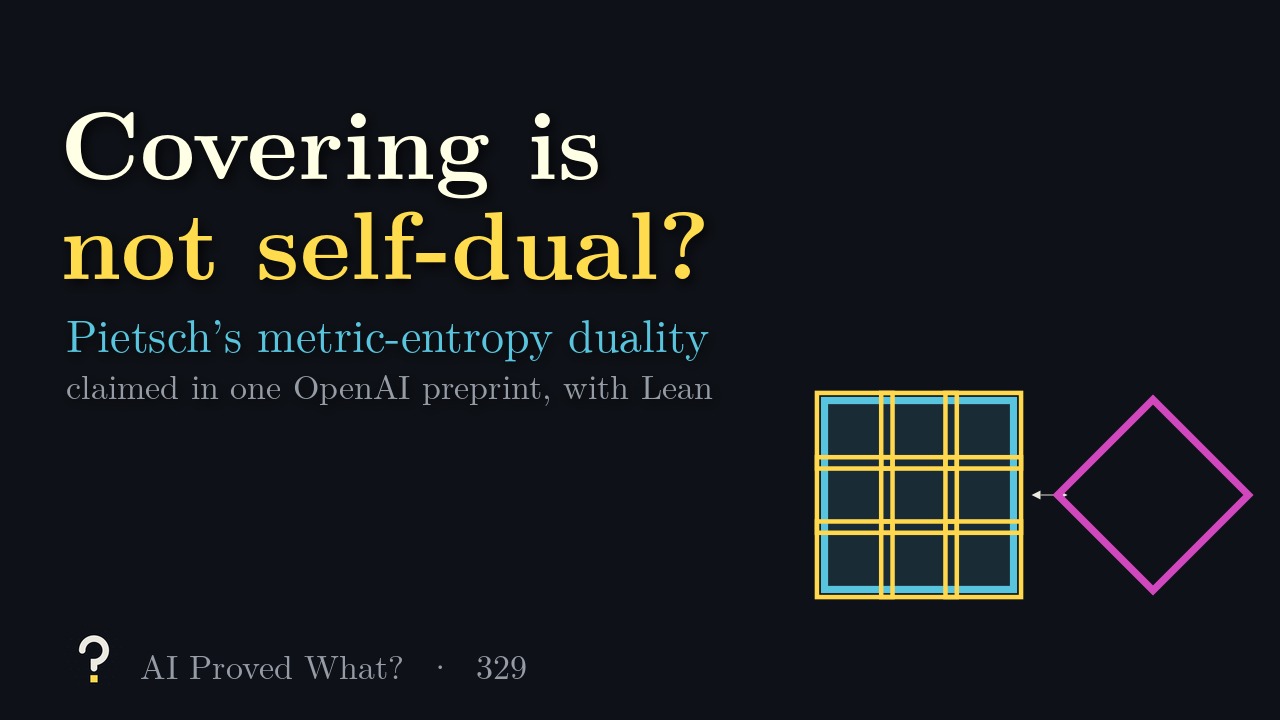
How many translates of a body L does it take to cover a body K? That count, on a logarithmic scale, is the metric entropy of K relative to L. Every symmetric convex body has a polar, its dual shape: the cube’s polar is the diamond, and the round ball is its own. Duality asks whether covering K by L costs about as much as covering the polar of L by the polar of K, with the roles swapped. In the plane, our computer finds that the unit square scaled up 2.5 times needs 9 copies of the unit square, and the dual covering needs 9 too.
Pietsch conjectured in the early 1970s, in the language of operators, that the two entropies agree up to universal constants, in every dimension. Volume arguments show the covering numbers agree to within a factor exponential in the dimension, so the hard case is small entropy in high dimension. A 2004 paper stated the geometric form as a conjecture and proved it when one body is a Euclidean ball; partial results followed, but the general question stayed open, and two experts voiced cautious doubts.
Result 329 is one OpenAI paper, 15 pages, dated September 24 and made public October 6, 2026. It claims the conjecture is false: for any proposed constants a and b, there is a dimension and a symmetric convex body K such that covering K by the unit cube costs more than b times the entropy on the dual side, even when the dual covering body is shrunk by the factor a. The covering body can be the cube itself.
What it doesn’t claim
Not claimed: a counterexample in any fixed dimension, since the dimension must grow with the constants; any explicit body, since one step is random; or anything against weaker versions with logarithmic losses. The ellipsoid case stays proved.
Where it stands
- Posted as a preprint
- OpenAI, 15 pages, dated September 24, 2026
- Peer reviewed
- Not yet
- Formalized in Lean
- The main theorem (docs)
Last checked October 19, 2026. The paper is unrefereed and unchanged since release. Lean formalizes the main theorem, in 52 files and about 6,500 lines, not run by us; the corollary is not formalized. Three outside projects re-ran it and it was accepted, and a reviewer of a separate formal-conjectures entry approved that entry’s statement. We found no public comment from specialists and no reported error. OSVerify has not reviewed it.
How the proof goes
- A matrix: rows apart, columns compressible. The body is built from a matrix. Its rows, pairwise separated, force many cubes on the primal side. Its columns are profiles of graph distance that decay logarithmically, and a compression argument shows every signed combination of columns can be approximated from a list far shorter than the number of rows, which makes the dual side cheap. Our computer checks the logarithmic profile: at cutoff 8 it falls from 1 through 1/2 at distance 2 to 0.
- Rows from finite fields. The rows come from finite fields: symmetric forms over a huge prime field, with random directions defining the partitions. A random choice works: for each pair of rows, deleting a small fraction of directions keeps the two far apart. In a toy over the field of 5 elements, our computer finds 60 of 124 row differences unseparated before deletion and none after, though at this tiny size the deletion is far from small. The sizes are astronomical: with both constants equal to 1, the paper’s parameters need a dimension of about 10^10^10^10^480.
The numbers in the video
- Ours: the unit square scaled up 2.5 times needs 9 copies of the unit square; the dual covering with a = 1 also needs 9.
- Ours: the paper’s logarithmic profile at cutoff 8 is 1, 0.68, 0.5 at distance 2, …, 0.
- Ours, a toy over the field of 5 elements: 60 of 124 row differences are unseparated before deletion and none after (the deletion is not small at this size).
- Ours: with a = b = 1, the paper’s parameters need a dimension of about 10^10^10^10^480.
- Lean: 52 files and 6,520 lines in the import closure (counted by us; not run by us).
Read the source
- Counterexamples to the duality conjecture for metric entropy (PDF), 15 pages.
- The Lean formalization notes.
- The collection’s catalog, where this is result 329.
The paper
OpenAI groups related papers into one result; this one has a single paper.
Transcript
Read the full script
0:00The question
How many translates of a body L does it take to cover a body K? That count, on a logarithmic scale, is the metric entropy of K relative to L. Every symmetric convex body has a polar, its dual shape: the cube’s polar is the diamond, and the round ball is its own. Duality asks whether covering K by L costs about as much as covering the polar of L by the polar of K, with the roles swapped. In the plane, our computer finds that the unit square scaled up 2.5 times needs 9 copies of the unit square, and the dual covering needs 9 too. Pietsch conjectured in the early 1970s, in the language of operators, that the two entropies agree up to universal constants, in every dimension. Volume arguments show the covering numbers agree to within a factor exponential in the dimension, so the hard case is small entropy in high dimension. A 2004 paper stated the geometric form as a conjecture and proved it when one body is a Euclidean ball; partial results followed, but the general question stayed open, and two experts voiced cautious doubts.
1:09The claim
Result 329 is one OpenAI paper, 15 pages, dated September 24 and made public October 6, 2026. It claims the conjecture is false: for any proposed constants a and b, there is a dimension and a symmetric convex body K such that covering K by the unit cube costs more than b times the entropy on the dual side, even when the dual covering body is shrunk by the factor a. The covering body can be the cube itself. Not claimed: a counterexample in any fixed dimension, since the dimension must grow with the constants; any explicit body, since one step is random; or anything against weaker versions with logarithmic losses. The ellipsoid case stays proved.
1:57How the proof goes
The body is built from a matrix. Its rows, pairwise separated, force many cubes on the primal side. Its columns are profiles of graph distance that decay logarithmically, and a compression argument shows every signed combination of columns can be approximated from a list far shorter than the number of rows, which makes the dual side cheap. Our computer checks the logarithmic profile: at cutoff 8 it falls from 1 through 1/2 at distance 2 to 0. The rows come from finite fields: symmetric forms over a huge prime field, with random directions defining the partitions. A random choice works: for each pair of rows, deleting a small fraction of directions keeps the two far apart. In a toy over the field of 5 elements, our computer finds 60 of 124 row differences unseparated before deletion and none after, though at this tiny size the deletion is far from small. The sizes are astronomical: with both constants equal to 1, the paper’s parameters need a dimension of about 10^10^10^10^480.
3:04Where it stands
The paper is unrefereed and unchanged since release. Lean formalizes the main theorem, in 52 files and about 6,500 lines, not run by us; the corollary is not formalized. Three outside projects re-ran it and it was accepted, and a reviewer of a separate formal-conjectures entry approved that entry’s statement. We found no public comment from specialists and no reported error. If it holds, metric entropy is not self-dual up to universal constants: in high enough dimension, covering a body and covering its dual can cost wildly different amounts.
Spot a mistake?
This episode simplifies on purpose, but it shouldn’t be wrong. If something is, open an issue on GitHub or leave a comment on YouTube. Corrections are noted here with a date.