Taxicab maps extend?
An AI preprint claims metric Markov cotype two for ℓ₁, settling Lipschitz extension from Hilbert space into ℓ₁
Covers result 332 in OpenAI’s catalog: its one paper. See its connections to other results and the work it cites.
3:51. English captions available. The video loads from YouTube when you press play.
Chapters
The claim, in plain words
Given a Lipschitz map on part of a space, can you extend it to the whole space without stretching distances much more? Into the real line, always. From Hilbert space into Hilbert space, also, with no loss. But into ℓ₁, distance measured taxicab style, nobody knew whether the loss could always be kept bounded. Extending one coordinate at a time can lose a lot: on a simplex of 64 points our computer finds a loss of 32, growing with the number of points.
In 1992 Ball linked extension to how random walks behave in a space. Later work by Mendel and Naor showed that a metric version of Ball’s property, called metric Markov cotype two, for the target, would give extension from Hilbert space with a universal loss. In 2013 they asked whether ℓ₁ has it, noting that a yes would settle a long-standing question attributed to Ball. As late as 2022, a research paper by Naor and Young called the ℓ₁ case a major open problem.
Result 332 is one OpenAI paper, 9 pages, dated October 5 and made public October 6, 2026. It claims that ℓ₁ has metric Markov cotype two, with constant squared at most 3,024. Combined with Mendel and Naor’s theorem, every Lipschitz map from any subset of a Hilbert space into ℓ₁ extends to the whole space, losing at most a universal factor.
What it doesn’t claim
Not claimed: an explicit extension constant, optimal constants, every subspace of ℓ₁, or Ball’s original linear version of Markov cotype, which ℓ₁ still fails. There is no Lean formalization for this item.
Where it stands
- Posted as a preprint
- OpenAI, 9 pages, dated October 5, 2026
- Peer reviewed
- Not yet
- Formalized in Lean
- No formalization for this item
Last checked October 19, 2026. The paper is unrefereed and unchanged since release, and there is no Lean formalization. The extension result rests on Mendel and Naor’s published theorem. We found no public comment from specialists and no reported error; the only engagement so far is AI-assisted write-ups and checks, which are not independent review. OSVerify has not reviewed it.
How the proof goes
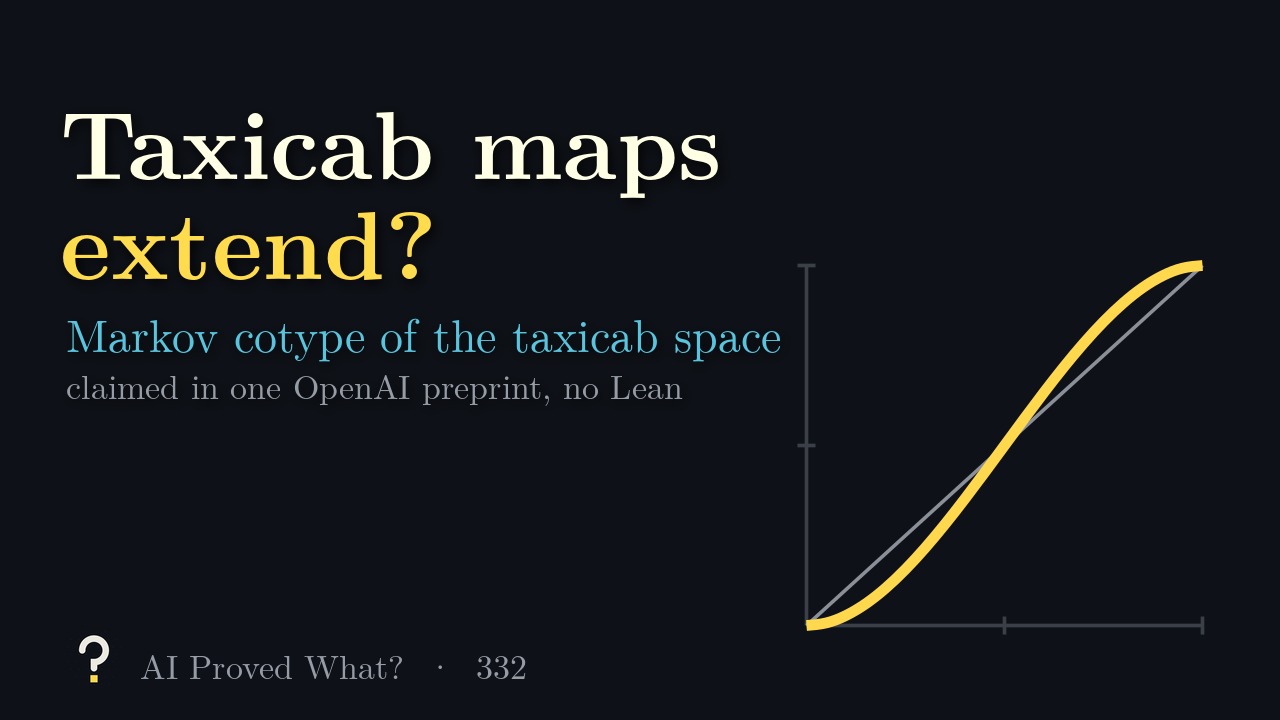
- Smooth the points with an S-curve. Metric Markov cotype lets you move the points: the cost of moving them, plus the time times their leftover one-step jitter, must stay within a fixed multiple of how far the walk spreads the original data. The paper first writes ℓ₁ distances through cuts, so each point becomes a 0-1 vector. It then averages along a walk stopped at a random time, and rounds each coordinate with the S-curve 3r² − 2r³. That curve is the chance that at least two of three coins land heads when each lands heads with chance r, so each new point is the expected median of three independent endpoints of the walk. Our computer confirms this median formula exactly on a test example.
- A martingale pays for both. A martingale and a fourth-power potential then pay for both the move and the remaining jitter at a factor of 108; swapping the random stopping time for a fixed time costs another 28. The S-curve’s flatness at 0 and 1 is essential to this argument: our computer finds the key ratio stays below 18 with it and grows without bound without it. On 239 random examples the whole inequality holds with ratio at most 1.21, while leaving the points unmoved reaches 135. A similar S-curve trick appeared four weeks earlier, for a different question, in a paper by Cheng, Wang and Xiang.
The numbers in the video
- Ours: extending coordinate by coordinate on an m-point simplex loses m/2 (32 at m = 64).
- Ours: the median-of-three formula holds exactly on a test example.
- Ours: on 239 random examples the inequality holds with ratio at most 1.21 (proved bound 3,024); leaving the points unmoved reaches 135.
- Ours: the key lemma’s ratio stays below 18 with the S-curve and grows without bound without it.
Read the source
- Metric Markov Cotype Two of ℓ1 (PDF), 9 pages.
- The collection’s catalog, where this is result 332.
The paper
OpenAI groups related papers into one result; this one has a single paper.
Transcript
Read the full script
0:00The question
Given a Lipschitz map on part of a space, can you extend it to the whole space without stretching distances much more? Into the real line, always. From Hilbert space into Hilbert space, also, with no loss. But into ℓ₁, distance measured taxicab style, nobody knew whether the loss could always be kept bounded. Extending one coordinate at a time can lose a lot: on a simplex of 64 points our computer finds a loss of 32, growing with the number of points. In 1992 Ball linked extension to how random walks behave in a space. Later work by Mendel and Naor showed that a metric version of Ball’s property, called metric Markov cotype two, for the target, would give extension from Hilbert space with a universal loss. In 2013 they asked whether ℓ₁ has it, noting that a yes would settle a long-standing question attributed to Ball. As late as 2022, a research paper by Naor and Young called the ℓ₁ case a major open problem.
1:04The claim
Result 332 is one OpenAI paper, 9 pages, dated October 5 and made public October 6, 2026. It claims that ℓ₁ has metric Markov cotype two, with constant squared at most 3,024. Combined with Mendel and Naor’s theorem, every Lipschitz map from any subset of a Hilbert space into ℓ₁ extends to the whole space, losing at most a universal factor. Not claimed: an explicit extension constant, optimal constants, every subspace of ℓ₁, or Ball’s original linear version of Markov cotype, which ℓ₁ still fails. There is no Lean formalization for this item.
1:47How the proof goes
Metric Markov cotype lets you move the points: the cost of moving them, plus the time times their leftover one-step jitter, must stay within a fixed multiple of how far the walk spreads the original data. The paper first writes ℓ₁ distances through cuts, so each point becomes a 0-1 vector. It then averages along a walk stopped at a random time, and rounds each coordinate with the S-curve 3r² − 2r³. That curve is the chance that at least two of three coins land heads when each lands heads with chance r, so each new point is the expected median of three independent endpoints of the walk. Our computer confirms this median formula exactly on a test example. A martingale and a fourth-power potential then pay for both the move and the remaining jitter at a factor of 108; swapping the random stopping time for a fixed time costs another 28. The S-curve’s flatness at 0 and 1 is essential to this argument: our computer finds the key ratio stays below 18 with it and grows without bound without it. On 239 random examples the whole inequality holds with ratio at most 1.21, while leaving the points unmoved reaches 135. A similar S-curve trick appeared four weeks earlier, for a different question, in a paper by Cheng, Wang and Xiang.
3:12Where it stands
The paper is unrefereed and unchanged since release, and there is no Lean formalization. The extension result rests on Mendel and Naor’s published theorem. We found no public comment from specialists and no reported error; the only engagement so far is AI-assisted write-ups and checks, which are not independent review. If it holds, Lipschitz maps from subsets of Hilbert space into ℓ₁ can always be extended with a universal loss, answering Mendel and Naor’s question and the long-standing extension question attributed to Ball.
Spot a mistake?
This episode simplifies on purpose, but it shouldn’t be wrong. If something is, open an issue on GitHub or leave a comment on YouTube. Corrections are noted here with a date.