Curvature pays for topology?
Two AI preprints claim Gromov's integral scalar-curvature bound and the Gromov–Lawson aspherical conjecture in every dimension
Covers result 335 in OpenAI’s catalog: all 2 papers. See its connections to other results and the work it cites.
4:18. English captions available. The video loads from YouTube when you press play.
Chapters
The claim, in plain words
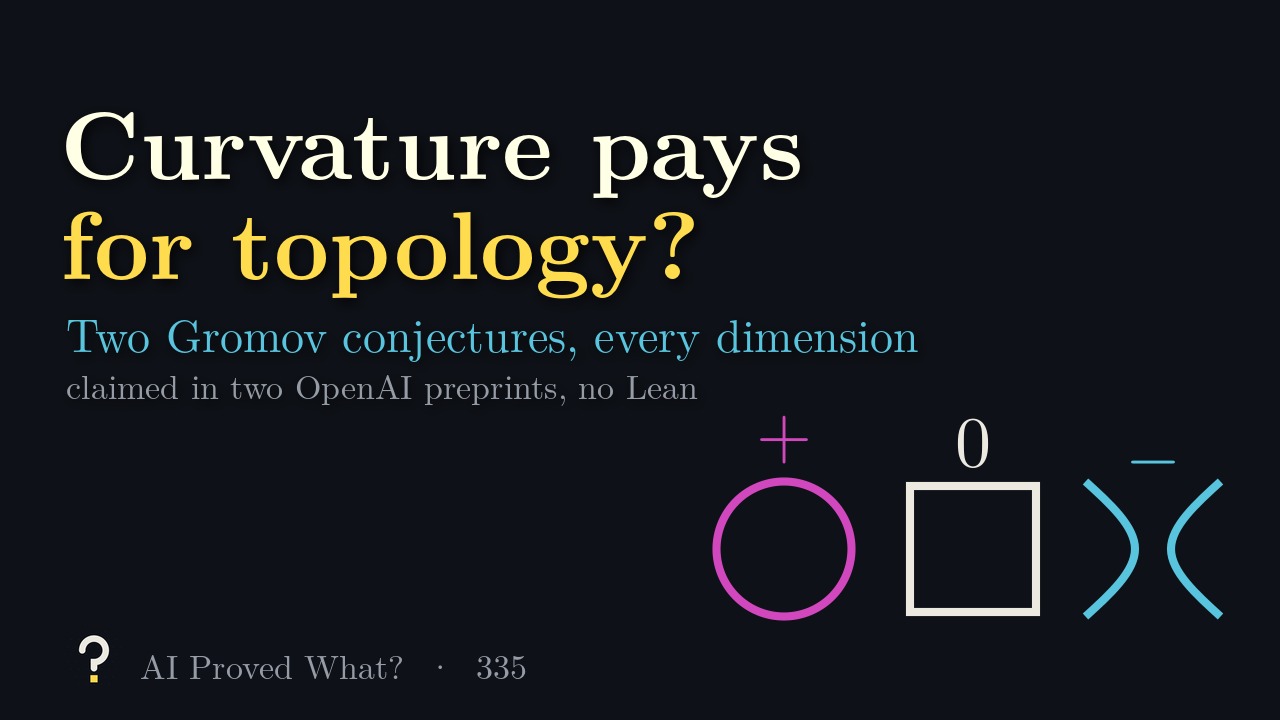
Scalar curvature is one number at each point of a space, measuring how small balls gain or lose volume compared with flat space. Spheres have positive scalar curvature, flat tori zero, hyperbolic spaces negative. Simplicial volume measures topology instead: the cheapest way to build the space from simplices, counted with signed weights. A torus costs nothing, because wrapping it around itself k times divides the cost by k squared, as our computer checks. Closed hyperbolic spaces cost something positive.
Two conjectures link the two. In 1983 Gromov and Lawson wrote that it was a possibility that no closed aspherical manifold, one whose universal cover is contractible like a torus’s, can carry positive scalar curvature; Schoen and Yau raised it too. It was known up to dimension 5. In 1986 Gromov proposed an inequality: the negative part of scalar curvature, raised to the power n over two and integrated, is at least a fixed multiple of the simplicial volume. That power is the only one that ignores rescaling, as our computer confirms. Gromov later wrote that there is little evidence for such conjectures.
Result 335 is two OpenAI papers, made public October 6, 2026. The first, 84 pages and dated October 5, claims Gromov’s inequality in every dimension from 3 up, with a positive constant depending only on the dimension. It relies on the second, 37 pages and dated September 23, which claims that positive scalar curvature makes a closed manifold’s fundamental class vanish rationally in the classifying space of its fundamental group, in every dimension, with no spin assumption. That gives the Gromov–Lawson aspherical conjecture, and a closed aspherical manifold with nonnegative scalar curvature must be flat.
What it doesn’t claim
Not claimed: any value for the constant, which comes out of towers of exponentials; dimension 2, which the first paper’s inequality leaves out; or a machine-checked proof, since neither paper has Lean.
Where it stands
- Posted as preprints
- OpenAI, 2 papers (84 and 37 pages), dated October 5 and September 23, 2026
- Peer reviewed
- Not yet
- Formalized in Lean
- Not yet
Last checked October 19, 2026. Both papers are unrefereed and unchanged since release, and neither has a Lean proof. The curvature obstruction used at the end is applied in dimensions far above 8, even for a 3-dimensional manifold, and there it relies on Schoen and Yau’s 2017 theory of minimal slicings, published but still described by experts as a proposed approach. We found no specialist assessment and no reported error. Jialong Deng noted publicly that this result and the next one generalize two results from their September 2 paper without citing it. OSVerify has not reviewed it.
How the proof goes
- Paper 2: shorten every direction, cheaply. The second paper argues by contradiction. A rationally essential manifold gives, on a large cover, a map of nonzero degree to a high-dimensional box, with gentle slopes. The proof shortens all q coordinates of the box by adding circle factors and bending graphs. Each update costs some scalar curvature, but the costs mostly telescope: their main parts add up to at most the dimension, so a whole pass costs only about the logarithm of q. Our toy shows 1,000 updates in 3 dimensions summing to just under 3. At the end, a theorem of Cecchini and Schick forbids such a short map of nonzero degree under positive scalar curvature.
- Paper 1: from curvature to volume. The first paper uses a conformal change to reduce to scalar curvature exactly minus one, and must show that the simplicial volume is at most a constant times the volume. It detects simplicial volume with a bounded cocycle, builds weighted entropy metrics, estimates a measured degree by slicing with bubble-like hypersurfaces, and finishes by rounding onto cubes. The second paper’s vanishing theorem is the only result from that paper it uses without proof.
The numbers in the video
- Ours: on closed hyperbolic surfaces the integral equals exactly 2π times the simplicial volume, the dimension-two analogue.
- Ours: in dimension 3, making lengths 4 times larger multiplies the integral of the negative part to the power p by 4, 2, 1, 0.25 and 0.016 for p = 1, 1.25, 1.5, 2, 3: only p = 1.5 = n/2 is unchanged.
- Ours: wrapping a torus around itself k times gives a fundamental cycle of cost 2/k² (0.5, 0.22, 0.08, 0.02 for k = 2, 3, 5, 10), so its simplicial volume is zero.
- Ours: in a toy of the second paper’s telescoping, about 1,000 updates in dimension 3 add up to 2.99999, never more than 3.
Read the source
- An integral scalar curvature bound for real simplicial volume (PDF), 84 pages.
- Positive scalar curvature forces rational inessentiality (PDF), 37 pages.
- The collection’s catalog, where this is result 335.
The 2 papers in this result
OpenAI groups related papers, such as alternative proofs, supporting results and consequences, into one result; we label the first paper it lists the main paper and the others companions.
Transcript
Read the full script
0:00The question
Scalar curvature is one number at each point of a space, measuring how small balls gain or lose volume compared with flat space. Spheres have positive scalar curvature, flat tori zero, hyperbolic spaces negative. Simplicial volume measures topology instead: the cheapest way to build the space from simplices, counted with signed weights. A torus costs nothing, because wrapping it around itself k times divides the cost by k squared, as our computer checks. Closed hyperbolic spaces cost something positive. Two conjectures link the two. In 1983 Gromov and Lawson wrote that it was a possibility that no closed aspherical manifold, one whose universal cover is contractible like a torus’s, can carry positive scalar curvature; Schoen and Yau raised it too. It was known up to dimension 5. In 1986 Gromov proposed an inequality: the negative part of scalar curvature, raised to the power n over two and integrated, is at least a fixed multiple of the simplicial volume. That power is the only one that ignores rescaling, as our computer confirms. Gromov later wrote that there is little evidence for such conjectures.
1:16The claim
Result 335 is two OpenAI papers, made public October 6, 2026. The first, 84 pages and dated October 5, claims Gromov’s inequality in every dimension from 3 up, with a positive constant depending only on the dimension. It relies on the second, 37 pages and dated September 23, which claims that positive scalar curvature makes a closed manifold’s fundamental class vanish rationally in the classifying space of its fundamental group, in every dimension, with no spin assumption. That gives the Gromov–Lawson aspherical conjecture, and a closed aspherical manifold with nonnegative scalar curvature must be flat. Not claimed: any value for the constant, which comes out of towers of exponentials; dimension 2, which the first paper’s inequality leaves out; or a machine-checked proof, since neither paper has Lean.
2:15How the proof goes
The second paper argues by contradiction. A rationally essential manifold gives, on a large cover, a map of nonzero degree to a high-dimensional box, with gentle slopes. The proof shortens all q coordinates of the box by adding circle factors and bending graphs. Each update costs some scalar curvature, but the costs mostly telescope: their main parts add up to at most the dimension, so a whole pass costs only about the logarithm of q. Our toy shows 1,000 updates in 3 dimensions summing to just under 3. At the end, a theorem of Cecchini and Schick forbids such a short map of nonzero degree under positive scalar curvature. The first paper uses a conformal change to reduce to scalar curvature exactly minus one, and must show that the simplicial volume is at most a constant times the volume. It detects simplicial volume with a bounded cocycle, builds weighted entropy metrics, estimates a measured degree by slicing with bubble-like hypersurfaces, and finishes by rounding onto cubes. The second paper’s vanishing theorem is the only result from that paper it uses without proof.
3:26Where it stands
Both papers are unrefereed and unchanged since release, and neither has a Lean proof. The curvature obstruction used at the end is applied in dimensions far above 8, even for a 3-dimensional manifold, and there it relies on Schoen and Yau’s 2017 theory of minimal slicings, published but still described by experts as a proposed approach. We found no specialist assessment and no reported error. Jialong Deng noted publicly that this result and the next one generalize two results from their September 2 paper without citing it. If it holds, no closed aspherical manifold in any dimension carries positive scalar curvature, and negative scalar curvature, measured the scale-free way, always pays for simplicial volume.
Spot a mistake?
This episode simplifies on purpose, but it shouldn’t be wrong. If something is, open an issue on GitHub or leave a comment on YouTube. Corrections are noted here with a date.