Yau’s question settled?
An AI preprint claims that positive bisectional curvature forces complex Euclidean space
Covers result 338 in OpenAI’s catalog: its one paper. See its connections to other results and the work it cites.
4:26. English captions available. The video loads from YouTube when you press play.
Chapters
The claim, in plain words
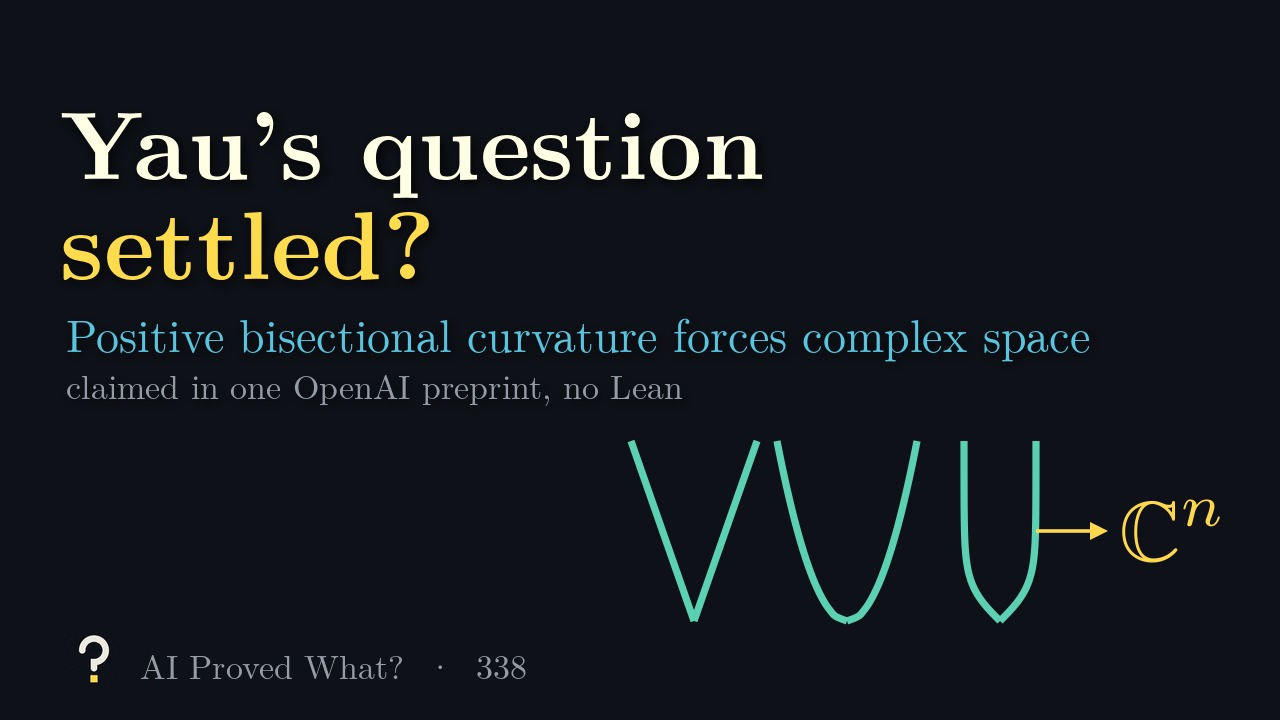
A complete surface with positive curvature that is not compact always has the complex structure of the plane. Our computer checks three such surfaces, a rounded cone, a paraboloid and a cigar: each is conformally the plane, though only the rounded cone grows in area the way the plane does. In higher complex dimensions the natural curvature is holomorphic bisectional curvature; on complex projective space, scaled so its largest value is one, it lies between 1/2 and 1. For compact manifolds, Mori, and Siu and Yau, showed that positive bisectional curvature forces projective space.
In the 1970s, Yau conjectured the noncompact version: a complete, noncompact Kähler manifold with positive bisectional curvature must be complex Euclidean space. In 1984 Mok showed such a manifold is affine algebraic, assuming maximal volume growth and curvature decay. Chau and Tam proved the conjecture with bounded curvature and maximal volume growth in 2006, and Gang Liu, then Lee and Tam, removed the curvature bound in the maximal volume growth case. Without volume assumptions it stayed open, even for complex surfaces; in 2026 Datar, Pingali and Seshadri proved the surface case under the stronger hypothesis of positive sectional curvature.
Result 338 is one OpenAI paper, 77 pages, dated September 23 and made public October 6, 2026. It claims the conjecture in every complex dimension: a connected noncompact complex manifold carrying a complete Kähler metric with strictly positive bisectional curvature is biholomorphic to complex Euclidean space. The positivity is pointwise only, with no uniform lower bound, no upper bound, and no assumption about volume growth.
What it doesn’t claim
Not claimed: that distances match those of flat space, since only the complex structure is identified; anything about curvature that is merely nonnegative; or explicit coordinates, since the map to Euclidean space is built as a limit.
Where it stands
- Posted as a preprint
- OpenAI, 77 pages, dated September 23, 2026
- Peer reviewed
- Not yet
- Formalized in Lean
- Not yet (one uncatalogued file covers only the final growth step)
Last checked October 19, 2026. The paper is unrefereed and unchanged since release. It has no catalogued Lean; one uncatalogued file of about 400 lines formalizes only the final growth step, taking its inputs as assumptions; we did not run it. We found no specialist assessment and no reported error. The day after the release, Datar, Pingali and Seshadri wrote that they can prove the two-dimensional case with substantial AI assistance, and called OpenAI’s a claimed proof in all dimensions with a quite different approach. The paper cites Yau’s 1982 survey for the question; Yau’s own account cites a different text from that year. OSVerify has not reviewed it.
How the proof goes
- Run the Kähler–Ricci flow. The proof runs the Kähler–Ricci flow, built as a limit over growing domains, from a metric whose curvature may be unbounded. To show the flow keeps nonnegative curvature without the usual maximum principle, it minimizes over holomorphic discs in the cotangent bundle. The flow then gives a volume clock, measuring on a log scale how much volume the base point has lost, and charts that shrink as the clock runs. On Hamilton’s cigar, our computer finds that each chart change has determinant exactly e^(−Δclock/2).
- Glue the charts, reach all of complex space. Glued carelessly, such charts could identify the manifold with only part of complex space. So the paper models the chart changes by polynomial automorphisms whose composed degree grows at most linearly in the clock, at least along a sequence of clock times, and builds an injective map into complex space. A growth estimate for polynomials then shows the image is everything. Our toy shows the underlying idea: a polynomial map of two-dimensional complex space that pulls every point to the origin, so its basin of attraction is the whole space.
The numbers in the video
- Ours: a rounded cone, a paraboloid and a cigar are each conformally the complex plane; their areas grow like r², r^(3/2) and r.
- Ours: on complex projective space, bisectional curvature (largest value scaled to 1) lies between 1/2 and 1.
- Ours: under the Kähler–Ricci flow on Hamilton’s cigar, each chart change has determinant exactly e^(−(u−s)/2), e.g. 0.0183 when the clock advances by 8.
- Ours: the polynomial map (z/2, w/3 + z²) pulls every point of two-dimensional complex space to the origin.
Read the source
- Uniformization of complete Kähler manifolds with positive bisectional curvature (PDF), 77 pages.
- The collection’s catalog, where this is result 338.
The paper
OpenAI groups related papers into one result; this one has a single paper.
Transcript
Read the full script
0:00The question
A complete surface with positive curvature that is not compact always has the complex structure of the plane. Our computer checks three such surfaces, a rounded cone, a paraboloid and a cigar: each is conformally the plane, though only the rounded cone grows in area the way the plane does. In higher complex dimensions the natural curvature is holomorphic bisectional curvature; on complex projective space, scaled so its largest value is one, it lies between 1/2 and 1. For compact manifolds, Mori, and Siu and Yau, showed that positive bisectional curvature forces projective space. In the 1970s, Yau conjectured the noncompact version: a complete, noncompact Kähler manifold with positive bisectional curvature must be complex Euclidean space. In 1984 Mok showed such a manifold is affine algebraic, assuming maximal volume growth and curvature decay. Chau and Tam proved the conjecture with bounded curvature and maximal volume growth in 2006, and Gang Liu, then Lee and Tam, removed the curvature bound in the maximal volume growth case. Without volume assumptions it stayed open, even for complex surfaces; in 2026 Datar, Pingali and Seshadri proved the surface case under the stronger hypothesis of positive sectional curvature.
1:26The claim
Result 338 is one OpenAI paper, 77 pages, dated September 23 and made public October 6, 2026. It claims the conjecture in every complex dimension: a connected noncompact complex manifold carrying a complete Kähler metric with strictly positive bisectional curvature is biholomorphic to complex Euclidean space. The positivity is pointwise only, with no uniform lower bound, no upper bound, and no assumption about volume growth. Not claimed: that distances match those of flat space, since only the complex structure is identified; anything about curvature that is merely nonnegative; or explicit coordinates, since the map to Euclidean space is built as a limit.
2:16How the proof goes
The proof runs the Kähler–Ricci flow, built as a limit over growing domains, from a metric whose curvature may be unbounded. To show the flow keeps nonnegative curvature without the usual maximum principle, it minimizes over holomorphic discs in the cotangent bundle. The flow then gives a volume clock, measuring on a log scale how much volume the base point has lost, and charts that shrink as the clock runs. On Hamilton’s cigar, our computer finds that each chart change has determinant exactly e^(−Δclock/2). Glued carelessly, such charts could identify the manifold with only part of complex space. So the paper models the chart changes by polynomial automorphisms whose composed degree grows at most linearly in the clock, at least along a sequence of clock times, and builds an injective map into complex space. A growth estimate for polynomials then shows the image is everything. Our toy shows the underlying idea: a polynomial map of two-dimensional complex space that pulls every point to the origin, so its basin of attraction is the whole space.
3:28Where it stands
The paper is unrefereed and unchanged since release. It has no catalogued Lean; one uncatalogued file of about 400 lines formalizes only the final growth step, taking its inputs as assumptions; we did not run it. We found no specialist assessment and no reported error. The day after the release, Datar, Pingali and Seshadri wrote that they can prove the two-dimensional case with substantial AI assistance, and called OpenAI’s a claimed proof in all dimensions with a quite different approach. The paper cites Yau’s 1982 survey for the question; Yau’s own account cites a different text from that year. If it holds, Yau’s question is settled in every dimension: on a complete, noncompact Kähler manifold, strictly positive bisectional curvature, however irregular, forces complex Euclidean space.
Spot a mistake?
This episode simplifies on purpose, but it shouldn’t be wrong. If something is, open an issue on GitHub or leave a comment on YouTube. Corrections are noted here with a date.