Square-root law?
Three AI preprints claim Yau’s nodal bound on surfaces, and counterexamples in higher dimensions
Covers result 350 in OpenAI’s catalog: all 3 papers. See its connections to other results and the work it cites.
4:09. English captions available. The video loads from YouTube when you press play.
Chapters
The claim, in plain words
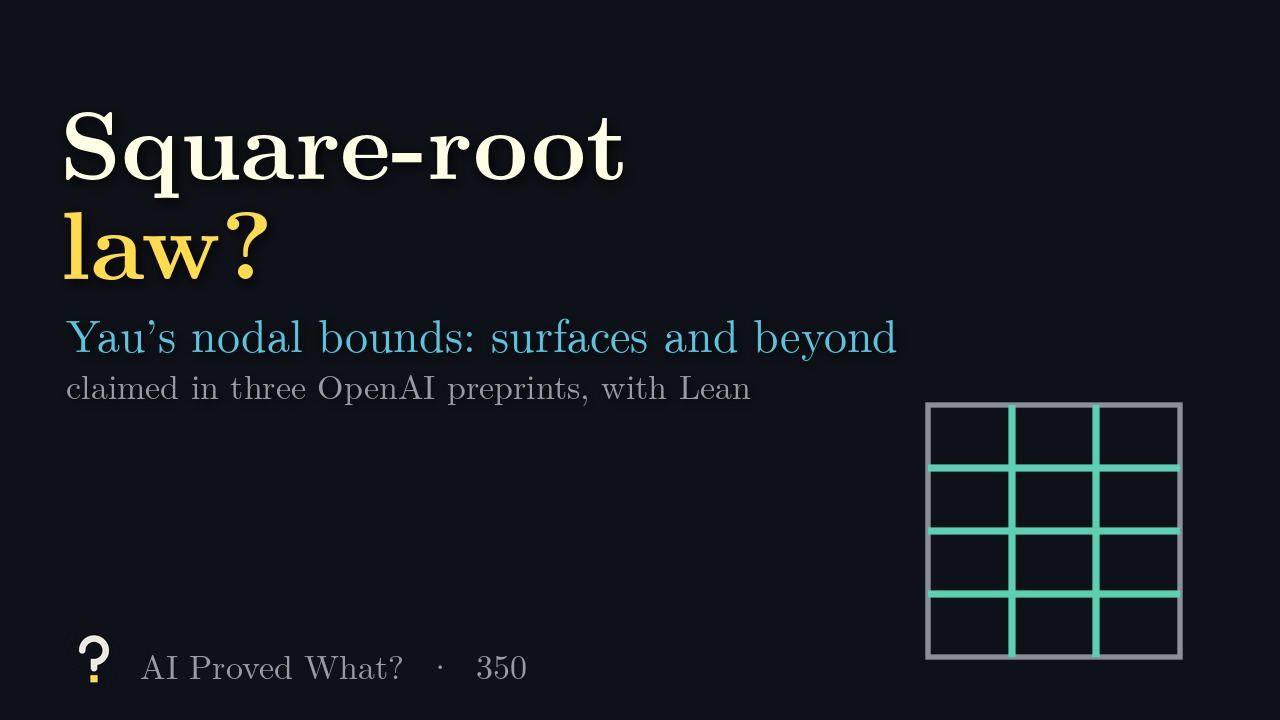
Vibrate a surface at one of its resonant frequencies and some points stay still: the nodal set, where an eigenfunction of the Laplacian vanishes. On a flat torus of side 2π, our computer finds that the nodal length of sine m x times sine n y is exactly 4π(m + n), so its ratio to the square root of the eigenvalue always lies between 4π and 4π√2. On the round sphere, the same ratio for the standard spherical harmonics runs from about four to about 2π. Higher frequencies make longer nodal sets, growing like the square root of the eigenvalue.
Yau conjectured that this is always the rate: on a closed smooth manifold with a fixed metric, the size of the nodal set lies between two constants times the square root of the eigenvalue. Donnelly and Fefferman proved both bounds for real-analytic metrics in 1988. For smooth metrics, Logunov proved the lower bound in every dimension, after Brüning on surfaces, but the upper bound stayed open. On surfaces the best known was a power just below 3/4, by Logunov and Malinnikova, and in higher dimensions only Logunov’s unspecified power above one half.
Result 350 is three OpenAI papers, all dated September 23 and made public October 6, 2026. The first, 26 pages, claims the upper bound on every smooth closed surface, which together with the known lower bound completes Yau’s conjecture there. The second, 60 pages, claims it fails in dimensions three and four: arbitrarily close to the round three-sphere there is a fixed smooth metric with a sequence of eigenfunctions whose nodal areas outgrow any constant times the square root of the eigenvalue, and likewise on a sphere times a torus. The third, 34 pages, claims a fixed metric in dimension five, on a four-sphere times a circle, where nodal measure beats the square root by a fixed positive power.
What it doesn’t claim
Not claimed: failure for round or real-analytic metrics, where the known theorems stand; any rate in dimensions three and four; or a sizable power, since the exponent is never computed, and the one its proof gives is, by our reading of the constants, below 2 in 10 million.
Where it stands
- Posted as preprints
- OpenAI, 3 papers, dated September 23, 2026
- Peer reviewed
- Not yet
- Formalized in Lean
- All three main statements except the dimension-5 power law (docs)
Last checked October 19, 2026. All three papers are unrefereed and unchanged since release. The surface theorem and the dimension three and four counterexamples are formalized in Lean, about 32,000 and 75,000 lines; the dimension-five Lean covers only the square-root statement, not the power law. Two outside projects re-ran all three successfully; we ran none of it. An AI audit found no gap in the surface paper. We found no specialist comment and no reported error. OSVerify has not reviewed it.
How the proof goes
- Surfaces: average the growth. On surfaces, the proof chops the surface into squares the size of a wavelength. A local theorem of Roy-Fortin bounds the nodal length in each square by how fast the eigenfunction grows there, so it is enough to bound the average growth. The paper shows that, where growth is large, subtracting an affine tilt halves the scale-adjusted growth on average at each subdivision, by an argument special to two dimensions.
- Higher dimensions: ripples that add up. For the counterexamples, start from an explicit wave on the round sphere whose nodal set is a fan of half great spheres; our computer checks that its size grows at the square-root rate, with ratio tending to 4π. Then corrugate the wave’s envelope in two directions: a ripple can be tiny in height while its slope stays large, so nodal sheets pile up. Change the metric so the corrugated wave becomes an exact eigenfunction, make the eigenvalue simple so the wave survives small changes, and nest infinitely many such steps into one smooth metric.
The numbers in the video
- Ours: on the flat torus of side 2π, sin(mx) sin(ny) has nodal length exactly 4π(m + n); its ratio to √λ lies between 4π and 4π√2.
- Ours: for the standard spherical harmonics on the round sphere, the ratio runs from about 4 (zonal) to about 2π (sectoral).
- Ours: the round wave Re(x₁ + ix₂)^N on the 3-sphere has nodal area growing at the square-root rate, with ratio tending to 4π.
- Ours: from the dimension-5 paper's stated constants, the exponent its proof gives is below 1.73 × 10⁻⁷.
- Lean: 59 files / 32,394 lines (surfaces), 347 / 75,288 for the two dimension-3/4 theorems, 1,068 / 74,773 (dimension 5, square-root statement); counted by us, not run by us.
Read the source
- Sharp nodal length on smooth surfaces (PDF), 26 pages.
- Smooth counterexamples to Yau's nodal upper bound in dimensions three and four (PDF), 60 pages.
- Power-law violations of Yau's nodal upper bound (PDF), 34 pages.
- The Lean formalization notes.
- The collection’s catalog, where this is result 350.
The 3 papers in this result
OpenAI groups related papers, such as alternative proofs, supporting results and consequences, into one result; we label the first paper it lists the main paper and the others companions.
Transcript
Read the full script
0:00The question
Vibrate a surface at one of its resonant frequencies and some points stay still: the nodal set, where an eigenfunction of the Laplacian vanishes. On a flat torus of side 2π, our computer finds that the nodal length of sine m x times sine n y is exactly 4π(m + n), so its ratio to the square root of the eigenvalue always lies between 4π and 4π√2. On the round sphere, the same ratio for the standard spherical harmonics runs from about four to about 2π. Higher frequencies make longer nodal sets, growing like the square root of the eigenvalue. Yau conjectured that this is always the rate: on a closed smooth manifold with a fixed metric, the size of the nodal set lies between two constants times the square root of the eigenvalue. Donnelly and Fefferman proved both bounds for real-analytic metrics in 1988. For smooth metrics, Logunov proved the lower bound in every dimension, after Brüning on surfaces, but the upper bound stayed open. On surfaces the best known was a power just below 3/4, by Logunov and Malinnikova, and in higher dimensions only Logunov’s unspecified power above one half.
1:17The claim
Result 350 is three OpenAI papers, all dated September 23 and made public October 6, 2026. The first, 26 pages, claims the upper bound on every smooth closed surface, which together with the known lower bound completes Yau’s conjecture there. The second, 60 pages, claims it fails in dimensions three and four: arbitrarily close to the round three-sphere there is a fixed smooth metric with a sequence of eigenfunctions whose nodal areas outgrow any constant times the square root of the eigenvalue, and likewise on a sphere times a torus. The third, 34 pages, claims a fixed metric in dimension five, on a four-sphere times a circle, where nodal measure beats the square root by a fixed positive power. Not claimed: failure for round or real-analytic metrics, where the known theorems stand; any rate in dimensions three and four; or a sizable power, since the exponent is never computed, and the one its proof gives is, by our reading of the constants, below 2 in 10 million.
2:23How the proof goes
On surfaces, the proof chops the surface into squares the size of a wavelength. A local theorem of Roy-Fortin bounds the nodal length in each square by how fast the eigenfunction grows there, so it is enough to bound the average growth. The paper shows that, where growth is large, subtracting an affine tilt halves the scale-adjusted growth on average at each subdivision, by an argument special to two dimensions. For the counterexamples, start from an explicit wave on the round sphere whose nodal set is a fan of half great spheres; our computer checks that its size grows at the square-root rate, with ratio tending to 4π. Then corrugate the wave’s envelope in two directions: a ripple can be tiny in height while its slope stays large, so nodal sheets pile up. Change the metric so the corrugated wave becomes an exact eigenfunction, make the eigenvalue simple so the wave survives small changes, and nest infinitely many such steps into one smooth metric.
3:24Where it stands
All three papers are unrefereed and unchanged since release. The surface theorem and the dimension three and four counterexamples are formalized in Lean, about 32,000 and 75,000 lines; the dimension-five Lean covers only the square-root statement, not the power law. Two outside projects re-ran all three successfully; we ran none of it. An AI audit found no gap in the surface paper. We found no specialist comment and no reported error. If they hold, Yau’s square-root law for nodal sets is true on every smooth closed surface, but fails for some smooth metrics in every dimension from three up.
Spot a mistake?
This episode simplifies on purpose, but it shouldn’t be wrong. If something is, open an issue on GitHub or leave a comment on YouTube. Corrections are noted here with a date.