Smooth any 3-D deformation?
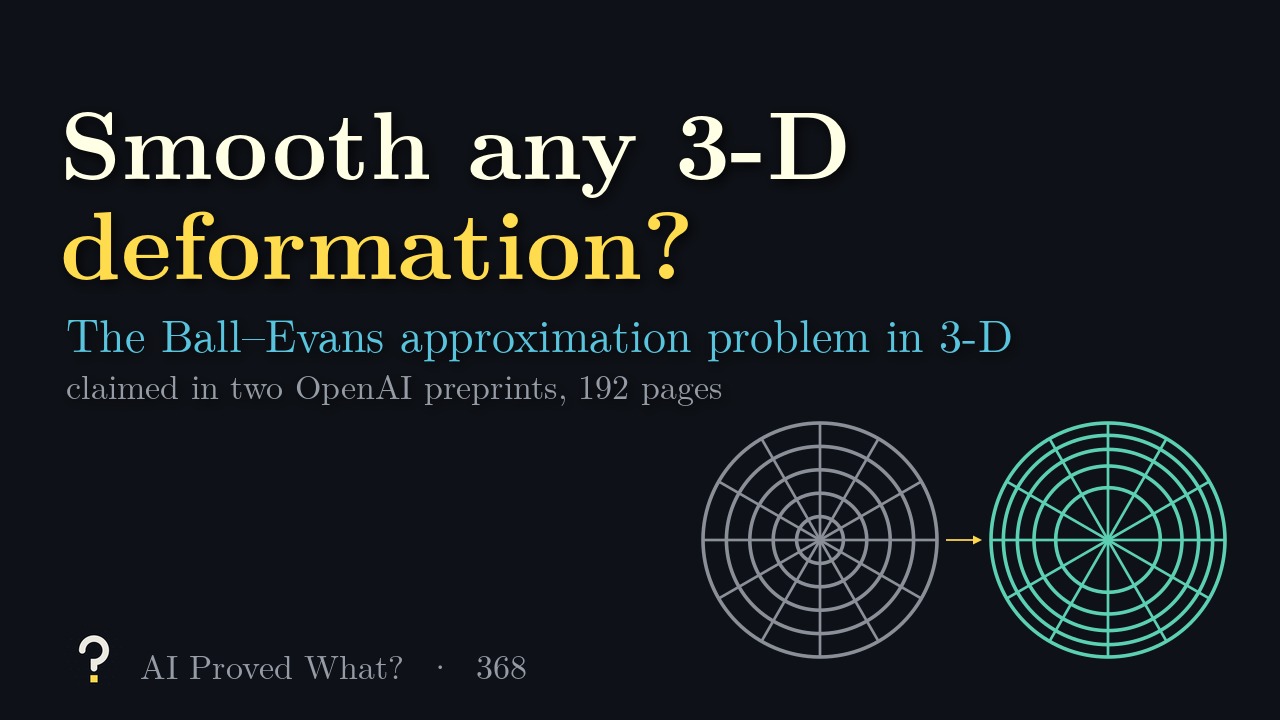
Two AI preprints claim the three-dimensional Ball–Evans approximation problem for Sobolev homeomorphisms
Covers result 368 in OpenAI’s catalog: all 2 papers. See its connections to other results and the work it cites.
4:01. English captions available. The video loads from YouTube when you press play.
Chapters
The claim, in plain words
In the mathematics of elastic solids, a deformation is a one-to-one map, and its energy depends on how much it stretches. Mathematicians measure that with Sobolev classes, W¹ᵖ: the p-th power of the stretching must have a finite total. Such a map can still be wild. Our computer checks a deformation of a ball that stretches infinitely at its centre, yet has finite energy for every p below six.
In 2001, John Ball asked, crediting Lawrence Evans: can every such deformation be approximated, in this energy, by one-to-one maps that are piecewise affine? Later work asked for smooth ones too. The obvious tools fail. Our computer interpolates a twist on a triangle mesh and finds ten triangles flipped inside out at every mesh size, and averaging two one-to-one maps, z and minus z, gives zero. In the plane the answer is yes, from Iwaniec, Kovalev and Onninen, and from Hencl and Pratelli. In four or more dimensions it fails for small p. A 2025 survey by Hencl calls any positive result in higher dimensions, especially three, the main open problem in the area.
Result 368 is two OpenAI papers, both dated September 24 and made public October 6, 2026: 62 pages for p from one to two, and 130 pages for p above two. Together they claim that for any bounded domains in three dimensions and any finite p from one up, every W¹ᵖ homeomorphism from one onto the other is a limit, in W¹ᵖ, of smooth one-to-one maps onto exactly the same target, with no assumptions on the boundary, the inverse or the Jacobian.
What it doesn’t claim
Not claimed: convergence of the inverses or of elastic energies, matching boundary values, or anything in four dimensions and up. Ball’s original question asked for piecewise affine maps, and neither paper states that as a theorem. And smoothing piecewise affine one-to-one maps, in three and four dimensions, had already been done, by Campbell, D’Onofrio and Vítek in 2025.
Where it stands
- Posted as a preprint
- OpenAI, 62 + 130 pages, both dated September 24, 2026
- Peer reviewed
- Not yet; no specialist verdict
- Formalized in Lean
- No Lean proof; the release folders contain no code
Last checked October 19, 2026. Both papers are unrefereed and unchanged since release. Neither has a Lean proof, and the release folders contain no code. Two trackers rate the result as major; a third calls it partial, since Ball asked in every dimension. None has checked it, and we found no competing claim and no specialist verdict. OSVerify has not reviewed it.
How the proof goes
- Two stages, and the case p = 2. Both papers first build a locally bi-Lipschitz one-to-one map onto the target that is close in energy, then smooth it; a degree argument keeps each smooth map one-to-one and onto. For p up to two, the paper charges each crossing of test curves, and at p = 2 test surfaces, with a target mesh to a length or area budget, turns those budgets into an actual map, and rebuilds the derivative piece by piece. At p = 2, filling a face from its edges breaks down: our computer shows the cost growing without bound as the face’s core shrinks, so the paper needs a sharp disk estimate instead.
- Above p = 2: walls, guards and small spheres. For p above two, the paper builds an exact carrier map and a convex quantizer, then places walls pinned by guards. A misplaced wall costs something on many small spheres, and the sphere estimate works only when p is above two, where its factor shrinks with the sphere: at radius 1/1000, our computer finds one tenth at p = 3, while the same formula gives one at p = 2 and ten at p = 3/2. Finally, uniform convexity turns nearly sharp energy bounds into convergence of the derivatives.
The numbers in the video
- Ours: the map x|x|^(−1/2) stretches infinitely at the centre of a ball, yet has finite W¹ᵖ energy for every p below 6.
- Ours: interpolating a twist with Jacobian exactly 1 on a triangle mesh flips 10 triangles at every mesh size.
- Ours: filling a face from its edges at p = 2 costs ln(1/α) — 2.30, 4.61, 9.21 as the core shrinks 10, 100, 10⁴ times.
- Ours: the factor R^(1−2/p) at R = 1/1000 is 10, 1, 0.25 and 0.1 for p = 3/2, 2, 5/2, 3; the papers' sphere estimate is stated for p above 2.
Read the source
- Strong diffeomorphic approximation in three dimensions for 1≤p≤2 (PDF), 62 pages.
- Strong diffeomorphic approximation in three dimensions for p>2 (PDF), 130 pages.
- The collection’s catalog, where this is result 368.
The 2 papers in this result
OpenAI groups related papers, such as alternative proofs, supporting results and consequences, into one result; we label the first paper it lists the main paper and the others companions.
Transcript
Read the full script
0:00The question
In the mathematics of elastic solids, a deformation is a one-to-one map, and its energy depends on how much it stretches. Mathematicians measure that with Sobolev classes, W¹ᵖ: the p-th power of the stretching must have a finite total. Such a map can still be wild. Our computer checks a deformation of a ball that stretches infinitely at its centre, yet has finite energy for every p below six. In 2001, John Ball asked, crediting Lawrence Evans: can every such deformation be approximated, in this energy, by one-to-one maps that are piecewise affine? Later work asked for smooth ones too. The obvious tools fail. Our computer interpolates a twist on a triangle mesh and finds ten triangles flipped inside out at every mesh size, and averaging two one-to-one maps, z and minus z, gives zero. In the plane the answer is yes, from Iwaniec, Kovalev and Onninen, and from Hencl and Pratelli. In four or more dimensions it fails for small p. A 2025 survey by Hencl calls any positive result in higher dimensions, especially three, the main open problem in the area.
1:12The claim
Result 368 is two OpenAI papers, both dated September 24 and made public October 6, 2026: 62 pages for p from one to two, and 130 pages for p above two. Together they claim that for any bounded domains in three dimensions and any finite p from one up, every W¹ᵖ homeomorphism from one onto the other is a limit, in W¹ᵖ, of smooth one-to-one maps onto exactly the same target, with no assumptions on the boundary, the inverse or the Jacobian. Not claimed: convergence of the inverses or of elastic energies, matching boundary values, or anything in four dimensions and up. Ball’s original question asked for piecewise affine maps, and neither paper states that as a theorem. And smoothing piecewise affine one-to-one maps, in three and four dimensions, had already been done, by Campbell, D’Onofrio and Vítek in 2025.
2:13How the proof goes
Both papers first build a locally bi-Lipschitz one-to-one map onto the target that is close in energy, then smooth it; a degree argument keeps each smooth map one-to-one and onto. For p up to two, the paper charges each crossing of test curves, and at p = 2 test surfaces, with a target mesh to a length or area budget, turns those budgets into an actual map, and rebuilds the derivative piece by piece. At p = 2, filling a face from its edges breaks down: our computer shows the cost growing without bound as the face’s core shrinks, so the paper needs a sharp disk estimate instead. For p above two, the paper builds an exact carrier map and a convex quantizer, then places walls pinned by guards. A misplaced wall costs something on many small spheres, and the sphere estimate works only when p is above two, where its factor shrinks with the sphere: at radius 1/1000, our computer finds one tenth at p = 3, while the same formula gives one at p = 2 and ten at p = 3/2. Finally, uniform convexity turns nearly sharp energy bounds into convergence of the derivatives.
3:24Where it stands
Both papers are unrefereed and unchanged since release. Neither has a Lean proof, and the release folders contain no code. Two trackers rate the result as major; a third calls it partial, since Ball asked in every dimension. None has checked it, and we found no competing claim and no specialist verdict. If they hold, every finite-energy deformation between bounded three-dimensional shapes can be approximated by smooth one-to-one deformations onto the same shape: the three-dimensional Ball-Evans problem, settled.
Spot a mistake?
This episode simplifies on purpose, but it shouldn’t be wrong. If something is, open an issue on GitHub or leave a comment on YouTube. Corrections are noted here with a date.