Quantum gravity from the null cone?
A physicist’s 83-page arXiv paper proposes a background independent quantum theory of four-dimensional vacuum gravity, built from light cones, with finite amplitudes and black hole entropy counted by states. One human author; the acknowledgements credit GPT-6 Astra with help on “several of the calculations and proofs”. Not peer reviewed; no independent check yet.
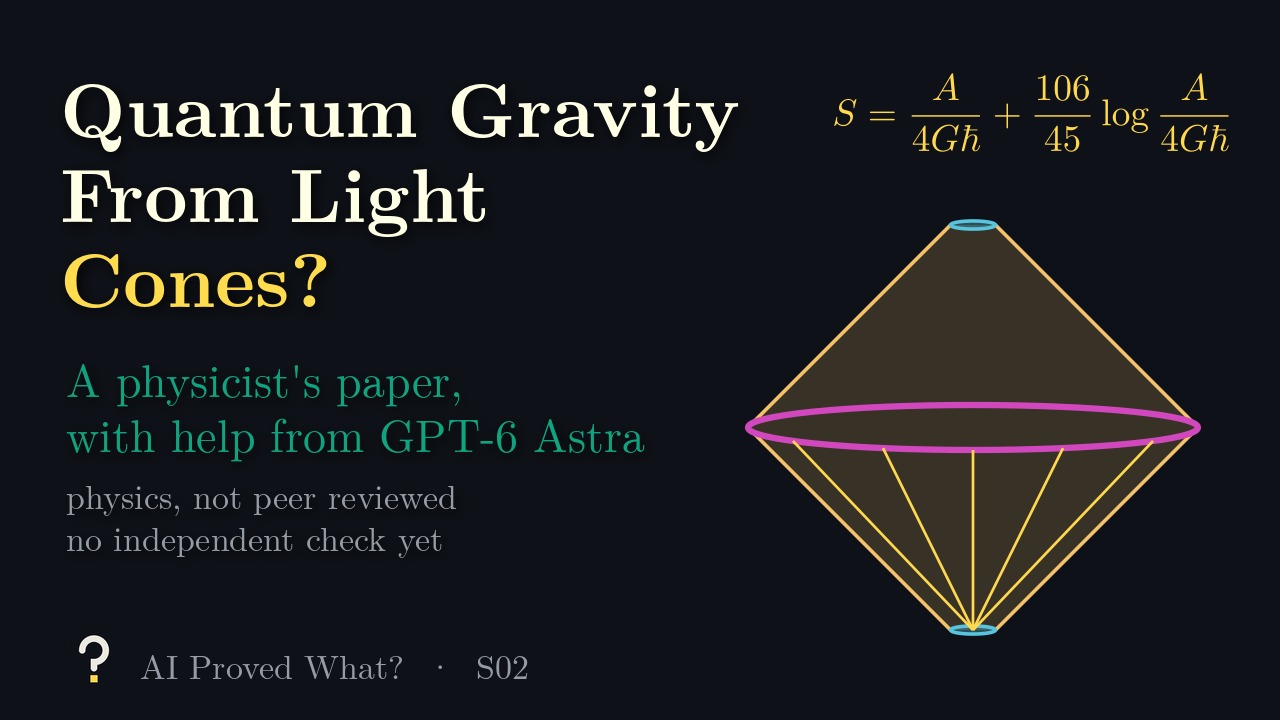
11:09. English captions available. The video loads from YouTube when you press play.
AI Proved What? is independent and not affiliated with OpenAI or Stanford.
Chapters
The question
This is Special S02, outside OpenAI’s math catalogue, and a different kind of Special. On November 25, 2026, the physicist Venkatesa Chandrasekaran posted a paper to arXiv: An algebraic quantization of gravity from the null cone. He is its only author, and the paper lists the Leinweber Institute for Theoretical Physics at Stanford. So a person wrote it. In the acknowledgements, he thanks his OpenAI colleagues, and writes that several of the calculations and proofs were developed through detailed, back and forth collaboration with GPT-6 Astra, over many months, amounting to about 400 million tokens. How large a share of the work that was, the paper does not say. And this is physics: a proposed theory, argued the way physicists argue, with no Lean proof to check. AI Proved What? is independent, and not affiliated with OpenAI or Stanford.
The problem is old. Einstein’s general relativity says gravity is the shape of spacetime. Quantum theory says everything fluctuates. The paper’s introduction recalls why combining them is hard. The usual way fixes a background spacetime and quantizes small ripples on it, gravitons. But in pure gravity, loop corrections to graviton scattering give infinities that Einstein’s theory cannot absorb: at two loops, Goroff and Sagnotti found one in 1986 that needs a new term in the action, so the theory is not renormalizable in perturbation theory. And a full theory should not fix the background at all, since spacetime itself must fluctuate. That is background independence. The paper recalls three approaches. String theory, whose expansion does not fix amplitudes beyond perturbation theory. Loop quantum gravity, built on Ashtekar’s variables, where, in the paper’s words, it remains an open problem how to solve the Hamiltonian constraint in a way that recovers Einstein’s equations. And the anti-de Sitter correspondence of Maldacena, which defines gravity through a quantum field theory on the boundary. There are many proposals for quantum gravity, and none is settled.
This paper starts from light. From any event, light spreads out along a cone in spacetime, a null cone. Take two events, one in the future of the other. The future cone of the first and the past cone of the second meet in a two-dimensional surface, the corner, and together they enclose a causal diamond. On a null cone, the gravitational data can be chosen freely: two functions along the light rays, plus data where the cone is cut. So, the paper argues, that data can be quantized directly, without first choosing a background. Cut off the bottom tip with a small cap, and follow a light ray up to the corner. How far it travels, measured by its affine parameter, is the reading of a gravitational clock. Gravitational waves shear the bundle of rays and focus it, through the Raychaudhuri equation, so the rays must travel further to reach the same area. A limit on the clock therefore limits the radiation on the cone.
The claim, in plain words
The claim. The paper has 54 pages of text, appendices to page 79, 34 figures, and 84 references, dated November 23. The abstract begins: we propose a background independent quantization of vacuum general relativity on four dimensional Lorentzian spacetimes. Here is the chain. Start from first order gravity, where a frame and a connection replace the metric. Solve the gravitational constraints on intersecting null cones, and obtain the reduced phase space at finite Newton’s constant, not order by order. Promote its Poisson brackets to commutators, and use deformations of the action to define an algebra of observables. Build a Hilbert space from Gaussian wavefunctions, in which that algebra generates what mathematicians call a type I factor. Then glue causal diamonds together, summing over the states on each shared slice, to get a Lorentzian path integral in which every such sum converges absolutely.
Then the paper computes what the framework gives. First, the abstract’s check: a pair of gravitons, created and then annihilated on a null cone. Summed exactly, at finite Newton’s constant, the amplitude has a finite closed form. Expanded in Newton’s constant first, it has a logarithmic divergence. Second, a causal diamond, large but of bounded size, has a finite-dimensional Hilbert space, so its area takes discrete values. Third, black holes. For a marginally trapped surface, where outgoing light just stops spreading, the paper obtains the Bekenstein–Hawking entropy: the area divided by four, in Planck units. Our worked example: a black hole of one solar mass has a horizon about 3 kilometers in radius, and that entropy is about 1.5 × 10^77 bits. The paper then computes the first correction, a logarithm of the area, with coefficient 106/45 at fixed mass, with angular momenta summed, and says this agrees with what Ashoke Sen found in 2012 by a different, Euclidean method. For our black hole, in pure gravity, that term is about 600 bits, a few parts in 10^75: tiny, but a definite number to match. Fourth, at one loop, it derives the semiclassical Einstein equations, where the average geometry responds to graviton fluctuations.
In the paper’s words (abstract): “We propose a background independent quantization of vacuum general relativity on four dimensional Lorentzian spacetimes.” It solves “the gravitational constraints on intersecting null cones”, obtains “the reduced phase space at finite GN”, builds a Hilbert space “for which this algebra generates a type I factor”, and a Lorentzian path integral “in which each sum over intermediate states converges absolutely”. As a check, the graviton pair amplitude is “a finite closed form expression, even though expanding first in GN yields a logarithmic divergence”.
What is not claimed, or not shown
What is not claimed, or not shown. In four dimensions the theory is vacuum gravity, with a possible cosmological constant; matter appears only in a two-dimensional warm-up. The black hole results use marginally trapped surfaces, and the logarithm is computed for large Schwarzschild black holes, at one loop. The paper leaves to future work whether different choices of its starting quantum state give equivalent theories. It proposes no laboratory test. The paper states no theorems: it argues as physicists do, and some steps it calls proofs; none has been checked by others yet. And several of the results reproduce answers already known by other methods: the area law, Sen’s coefficient, and Einstein’s equations at low energy. Getting known answers right is a consistency check the paper makes on itself. It is not an independent check by anyone else.
How it goes
How it goes, following the paper. It opens with a prologue in a two-dimensional model, Jackiw–Teitelboim gravity. There, a causal diamond of bounded size still holds infinitely many orthogonal states. In four dimensions, shear changes that: a bound on the clock also restricts gravitational radiation. Next, the null data. In first order gravity, it imposes the simplicity constraint of Plebański’s formulation, solves the constraints on two light cones that meet at the corner, and keeps the corner’s position and local frame as edge modes, after Donnelly and Freidel. The brackets of free null data build on Reisenberger, and on the author’s own work with Flanagan. Two neighbouring regions are glued by matching their fields at a shared corner. The paper calls work by Ciambelli, Freidel and Lee closely related: it also used null constraints to build a gravitational clock and to quantize along light rays.
Now the sums. Glue two pieces of spacetime along a slice, and you must add the amplitudes over every state on it, including gravitons of arbitrarily short wavelength. Time evolution preserves lengths in Hilbert space, so the Cauchy–Schwarz inequality bounds that sum, and it converges absolutely. The graviton pair shows how this fits with the old infinities. Each radial mode k carries a weight of 1/k², and a phase that turns by 2k/s, where s is a quarter of the corner area, in Planck units. Here is our toy version, with s = 1,000. Expand the phase first, as perturbation theory does, and the sum becomes the harmonic series, 1 + 1/2 + 1/3, which grows without end. Sum first, and the phases begin to cancel once k nears s: the total levels off, near 1 + log(s/2). The log of the cutoff has become a log of the area. For entropy, the paper glues the future half of a diamond to its mirror image and turns the boost at the corner into a full rotation, so each state weighs e^(−s), a quarter of its area in Planck units: that gives the area term. The logarithm comes from a curvature integral at the corner and the Gauss–Bonnet theorem: 53/45, times four, times one half, is 106/45; after the measure and the change to fixed mass, the same number comes back. We checked that arithmetic, not the steps behind it.
Prior work as the paper cites it: null initial data (Choquet-Bruhat, Chruściel and Martín-García 2011; Chruściel 2012); Poisson brackets of free null data (Reisenberger 2008, 2013; Chandrasekaran and Flanagan 2023); edge modes (Donnelly and Freidel 2016; Speranza 2018); perturbative algebras with an observer Hamiltonian (Chandrasekaran, Longo, Penington and Witten 2022; Chandrasekaran, Penington and Witten 2022); subregion algebras (Chandrasekaran and Flanagan, January 2026); a gravitational clock and quantization along null generators (Ciambelli, Freidel and Leigh 2023, 2024, “closely related”); quantization of gravity on null hypersurfaces (Ciambelli and Klinger, July 2026); the log coefficient (Sen 2012). By our check, Wolfgang Wieland’s papers on quantizing gravity on null surfaces (2017–2026) are not cited.
Where it stands
- Public
- arXiv:2611.34924v1 (hep-th; cross-listed gr-qc, math-ph), submitted November 25, 2026, 18:58 UTC; the paper is dated November 23. Comments: “54 pages + appendices, 34 figures”. One version so far. The author gave a talk on the work to a Berkeley group (video, uploaded November 18).
- Under expert review
- Not yet
- Peer reviewed
- No (no journal reference).
- AI role
- Only what the acknowledgements say (p. 54): “Several of the calculations and proofs in this paper were developed through detailed, back and forth collaboration with GPT-6 Astra over the course of many months, amounting to ∼ 400M total tokens spent; I thank OpenAI for providing this compute.” Which calculations, and how large a share, is not stated. The paper is by one human author; this is not an AI-authored paper.
- Lean or formal check
- None. It is a physics paper: much of it is physicists’ argument, not theorem and proof.
- Independent check
- None named. Its black hole entropy, Sen’s logarithmic coefficient and the semiclassical Einstein equations are the paper’s own derivations of known results: a consistency check it makes on itself.
- OpenAI announcement
- None found on openai.com (news feed checked November 26, 08:35 UTC). The acknowledgements thank “Sam Altman, Sebastien Bubeck, and my OpenAI colleagues”. Greg Brockman reportedly shared the paper on X; we could not read or confirm that post. OpenAI employee roon wrote that “results in theoretical physics aren’t like results in math” and that it “has to be picked apart by other experts”.
- Expert reaction
- No named physicist found as of November 26, 2026, 08:41 UTC: nothing on Not Even Wrong, Shtetl-Optimized, Backreaction, Preposterous Universe, John Baez’s pages or Physics Forums; two Hacker News threads (1, 2) with a few comments, none from a physicist (“big if true”). News write-ups quote no expert. X, Reddit and Bluesky could not be read in full.
Last checked November 26, 2026, 08:41 UTC (00:41 PT); expert reactions re-checked about 08:56 UTC. We did not check the physics; nothing was built or run by us.
Online claims, checked against the paper. An anonymous post said he “built much of it with help from an AI”; the paper says “several of the calculations and proofs” were developed with GPT-6 Astra. The same post said he “has found a working theory of quantum gravity”; the paper says “We propose”. The black hole entropy and Einstein’s equations are the paper’s own derivations of known results, not outside checks. (We found no source using the phrases “built in large part with GPT-6 Astra” or “passes the first checks”; roon wrote that these results are “the minimum tests such a theory would have to pass”.) Is he “OpenAI’s” researcher? The paper lists the Leinweber Institute for Theoretical Physics, Stanford (with a stanford.edu address); an OpenAI Forum event page (October 2026) calls him “Researcher @ OpenAI”; the acknowledgements thank “my OpenAI colleagues”. So both.
This is a Specials episode. Special S01 covered OpenAI’s claimed Navier–Stokes blowup, the other Special. Episode 260 covered a claimed proof of the spacetime Penrose inequality, which bounds the area of trapped surfaces by the mass, in classical gravity. If this paper holds, pure gravity in four dimensions would have a quantum theory built from light cones, with finite amplitudes, and black hole entropy counted by states. Whether it holds is now for other physicists to test. See S01 and 260.
The numbers in the video
- Ours: a black hole of one solar mass (IAU nominal GM☉, CODATA G, ħ, c) has horizon radius 2.95 km and area 109.6 km². Its Bekenstein–Hawking entropy A/(4 ℓ_P²) is 1.049e+77 (in units of Boltzmann’s constant), or 1.513e+77 bits.
- Ours: the paper’s logarithmic term (106/45) ln s at that size, for pure gravity (other massless fields change the coefficient, per Sen), (s = A/(4Għ) = 1.049e+77, ln s = 177.3) is 418, or 603 bits: 4.0e-75 of the leading term.
- Checked by us (exact fractions): (5.67c) 53/(45 (4π)²) × 8π × 8π × 1/2 = 106/45; the measure adds 1/2, giving 257/90 = q/(2(1 − q)) with q = 257/302 (5.68); at fixed mass q/(2(1 − q)) − 1/2 = 106/45 (5.69). In Sen’s paper (arXiv:1205.0971), pure four-dimensional gravity gives 212/45 ln a, that is (106/45) ln A, in the ensemble with the mass fixed and angular momentum summed, which is the ensemble the paper names; Sen’s other ensembles give 167/90 (J₃ fixed) and 77/90 (J = 0) times ln A.
- Ours (toy): with θ = 2/s, the paper’s mode sum Σ e^(−ikθ)/k² equals Li₂(e^(−iθ)); its imaginary part is −Cl₂(θ). Expanding the phase first gives −θ (1 + 1/2 + … + 1/N), which grows like ln N (H at N = 10⁶ is 14.39); summed first, (s/2) Cl₂(2/s) = 7.2146 for s = 1000, close to 1 + ln(s/2) = 7.2146. This matches, up to a constant, the paper’s remark that summing first turns the log N divergence into a finite −i log s/s³ term.
- Not checked: the paper’s derivations (the reduced phase space, the representation, the finiteness and entropy arguments, the one-loop calculations). Nothing was built or run by us.
Read the source
- V. Chandrasekaran, An algebraic quantization of gravity from the null cone, arXiv:2611.34924v1 (November 2026; PDF), 54 pages plus appendices, 84 references.
- A. Sen, Logarithmic Corrections to Schwarzschild and Other Non-extremal Black Hole Entropy in Different Dimensions, JHEP 04 (2013) 156, arXiv:1205.0971.
- Background the paper cites: M. Goroff and A. Sagnotti, The ultraviolet behavior of Einstein gravity (1986); A. Ashtekar, New variables for classical and quantum gravity (1986); J. Maldacena, The large N limit of superconformal field theories and supergravity (1998); J. Bekenstein, Black holes and entropy (1973); S. Hawking, Particle creation by black holes (1975).
AI Proved What? is independent and not affiliated with OpenAI or Stanford.
Transcript
Read the full script
0:00The question
This is Special S02, outside OpenAI’s math catalogue, and a different kind of Special. On November 25, 2026, the physicist Venkatesa Chandrasekaran posted a paper to arXiv: An algebraic quantization of gravity from the null cone. He is its only author, and the paper lists the Leinweber Institute for Theoretical Physics at Stanford. So a person wrote it. In the acknowledgements, he thanks his OpenAI colleagues, and writes that several of the calculations and proofs were developed through detailed, back and forth collaboration with GPT-6 Astra, over many months, amounting to about 400 million tokens. How large a share of the work that was, the paper does not say. And this is physics: a proposed theory, argued the way physicists argue, with no Lean proof to check. AI Proved What? is independent, and not affiliated with OpenAI or Stanford. The problem is old. Einstein’s general relativity says gravity is the shape of spacetime. Quantum theory says everything fluctuates. The paper’s introduction recalls why combining them is hard. The usual way fixes a background spacetime and quantizes small ripples on it, gravitons. But in pure gravity, loop corrections to graviton scattering give infinities that Einstein’s theory cannot absorb: at two loops, Goroff and Sagnotti found one in 1986 that needs a new term in the action, so the theory is not renormalizable in perturbation theory. And a full theory should not fix the background at all, since spacetime itself must fluctuate. That is background independence. The paper recalls three approaches. String theory, whose expansion does not fix amplitudes beyond perturbation theory. Loop quantum gravity, built on Ashtekar’s variables, where, in the paper’s words, it remains an open problem how to solve the Hamiltonian constraint in a way that recovers Einstein’s equations. And the anti-de Sitter correspondence of Maldacena, which defines gravity through a quantum field theory on the boundary. There are many proposals for quantum gravity, and none is settled. This paper starts from light. From any event, light spreads out along a cone in spacetime, a null cone. Take two events, one in the future of the other. The future cone of the first and the past cone of the second meet in a two-dimensional surface, the corner, and together they enclose a causal diamond. On a null cone, the gravitational data can be chosen freely: two functions along the light rays, plus data where the cone is cut. So, the paper argues, that data can be quantized directly, without first choosing a background. Cut off the bottom tip with a small cap, and follow a light ray up to the corner. How far it travels, measured by its affine parameter, is the reading of a gravitational clock. Gravitational waves shear the bundle of rays and focus it, through the Raychaudhuri equation, so the rays must travel further to reach the same area. A limit on the clock therefore limits the radiation on the cone.
3:14The claim
The claim. The paper has 54 pages of text, appendices to page 79, 34 figures, and 84 references, dated November 23. The abstract begins: we propose a background independent quantization of vacuum general relativity on four dimensional Lorentzian spacetimes. Here is the chain. Start from first order gravity, where a frame and a connection replace the metric. Solve the gravitational constraints on intersecting null cones, and obtain the reduced phase space at finite Newton’s constant, not order by order. Promote its Poisson brackets to commutators, and use deformations of the action to define an algebra of observables. Build a Hilbert space from Gaussian wavefunctions, in which that algebra generates what mathematicians call a type I factor. Then glue causal diamonds together, summing over the states on each shared slice, to get a Lorentzian path integral in which every such sum converges absolutely. Then the paper computes what the framework gives. First, the abstract’s check: a pair of gravitons, created and then annihilated on a null cone. Summed exactly, at finite Newton’s constant, the amplitude has a finite closed form. Expanded in Newton’s constant first, it has a logarithmic divergence. Second, a causal diamond, large but of bounded size, has a finite-dimensional Hilbert space, so its area takes discrete values. Third, black holes. For a marginally trapped surface, where outgoing light just stops spreading, the paper obtains the Bekenstein–Hawking entropy: the area divided by four, in Planck units. Our worked example: a black hole of one solar mass has a horizon about 3 kilometers in radius, and that entropy is about 1.5 × 10^77 bits. The paper then computes the first correction, a logarithm of the area, with coefficient 106/45 at fixed mass, with angular momenta summed, and says this agrees with what Ashoke Sen found in 2012 by a different, Euclidean method. For our black hole, in pure gravity, that term is about 600 bits, a few parts in 10^75: tiny, but a definite number to match. Fourth, at one loop, it derives the semiclassical Einstein equations, where the average geometry responds to graviton fluctuations. What is not claimed, or not shown. In four dimensions the theory is vacuum gravity, with a possible cosmological constant; matter appears only in a two-dimensional warm-up. The black hole results use marginally trapped surfaces, and the logarithm is computed for large Schwarzschild black holes, at one loop. The paper leaves to future work whether different choices of its starting quantum state give equivalent theories. It proposes no laboratory test. The paper states no theorems: it argues as physicists do, and some steps it calls proofs; none has been checked by others yet. And several of the results reproduce answers already known by other methods: the area law, Sen’s coefficient, and Einstein’s equations at low energy. Getting known answers right is a consistency check the paper makes on itself. It is not an independent check by anyone else.
6:34How it goes
How it goes, following the paper. It opens with a prologue in a two-dimensional model, Jackiw–Teitelboim gravity. There, a causal diamond of bounded size still holds infinitely many orthogonal states. In four dimensions, shear changes that: a bound on the clock also restricts gravitational radiation. Next, the null data. In first order gravity, it imposes the simplicity constraint of Plebański’s formulation, solves the constraints on two light cones that meet at the corner, and keeps the corner’s position and local frame as edge modes, after Donnelly and Freidel. The brackets of free null data build on Reisenberger, and on the author’s own work with Flanagan. Two neighbouring regions are glued by matching their fields at a shared corner. The paper calls work by Ciambelli, Freidel and Lee closely related: it also used null constraints to build a gravitational clock and to quantize along light rays. Now the sums. Glue two pieces of spacetime along a slice, and you must add the amplitudes over every state on it, including gravitons of arbitrarily short wavelength. Time evolution preserves lengths in Hilbert space, so the Cauchy–Schwarz inequality bounds that sum, and it converges absolutely. The graviton pair shows how this fits with the old infinities. Each radial mode k carries a weight of 1/k², and a phase that turns by 2k/s, where s is a quarter of the corner area, in Planck units. Here is our toy version, with s = 1,000. Expand the phase first, as perturbation theory does, and the sum becomes the harmonic series, 1 + 1/2 + 1/3, which grows without end. Sum first, and the phases begin to cancel once k nears s: the total levels off, near 1 + log(s/2). The log of the cutoff has become a log of the area. For entropy, the paper glues the future half of a diamond to its mirror image and turns the boost at the corner into a full rotation, so each state weighs e^(−s), a quarter of its area in Planck units: that gives the area term. The logarithm comes from a curvature integral at the corner and the Gauss–Bonnet theorem: 53/45, times four, times one half, is 106/45; after the measure and the change to fixed mass, the same number comes back. We checked that arithmetic, not the steps behind it.
9:05Where it stands
Where it stands, on the morning of November 26, Pacific time. The paper is on arXiv, posted November 25, and it is not peer reviewed. The AI’s role is what the acknowledgement says: several of the calculations and proofs were developed with GPT-6 Astra, an OpenAI model; its share is not specified. There is no Lean or other formal check, and no independent check is named. We found no announcement on OpenAI’s website, and no reaction yet from a named physicist: the blogs we checked were silent, and two Hacker News threads had only a few comments. One post went further than the paper. An anonymous account said he built much of it with help from an AI; the paper says several of the calculations and proofs. The same post said he has found a working theory of quantum gravity; the paper says, we propose. And the entropy and Einstein’s equations are the paper’s own derivations, not checks by others. And is he OpenAI’s researcher? The paper lists Stanford, with a Stanford email address, but an OpenAI forum page from October calls him a researcher at OpenAI, and the acknowledgement thanks his OpenAI colleagues. So, both. An OpenAI employee who shared the paper added that results in theoretical physics aren’t like results in math, and must be picked apart by other experts. We did not check the physics. This is a Specials episode. Special S01 covered OpenAI’s claimed Navier–Stokes blowup, the other Special. Episode 260 covered a claimed proof of the spacetime Penrose inequality, which bounds the area of trapped surfaces by the mass, in classical gravity. If this paper holds, pure gravity in four dimensions would have a quantum theory built from light cones, with finite amplitudes, and black hole entropy counted by states. Whether it holds is now for other physicists to test.
Spot a mistake?
This episode simplifies on purpose, but it shouldn’t be wrong. If something is, open an issue on GitHub or leave a comment on YouTube. Corrections are noted here with a date.